

On October 31, 2026, the share of ChatGPT answers with zero cited sources jumped from 1.5% to 12.2% in our tracking. It happened in a single day and has held for ten. Citations per answer fell 17%.
Our read: ChatGPT is searching the web less often, most likely as a side effect of an OpenAI update that shipped two days earlier. OpenAI hasn’t confirmed that. Ten days after the drop, it launched Business Hub, its first analytics product for brands, which changes what a citation is worth.
For marketers, the practical change is simple: about one in eight ChatGPT answers we track now has no citation to win, and those answers come from what the model already believes about your brand.
One Day, an Eightfold Jump
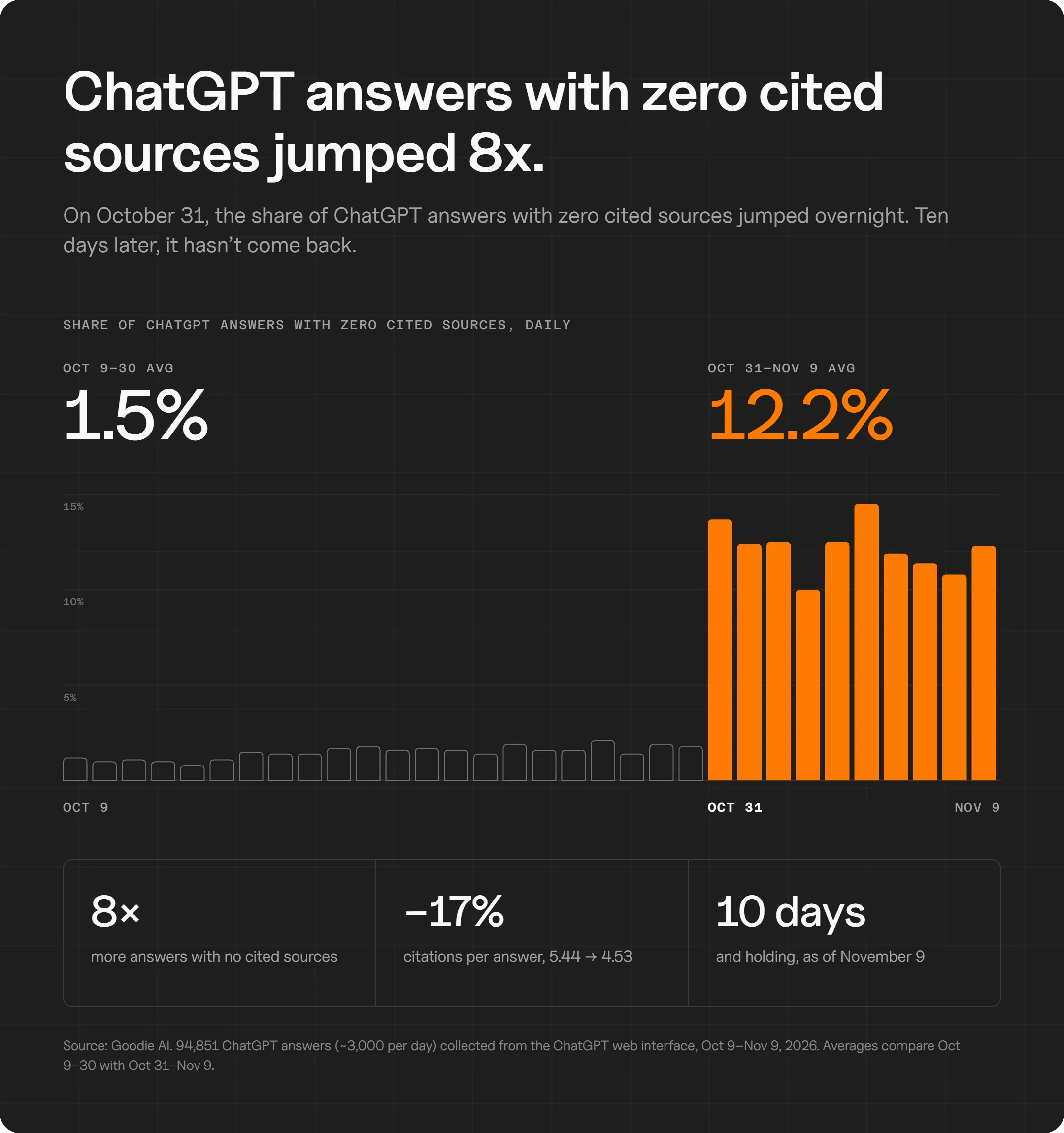
Goodie production tracking · 94,851 ChatGPT answers · ChatGPT web interface · October 9 to November 9, 2026
Between October 9 and 30, the daily share stayed inside a narrow band and never passed 2.1%. From October 31, it never dropped below 10%. The two ranges don’t overlap on a single day.
A change that arrives in one day and stays usually means something shipped.
How We Checked It Wasn’t Us
The first suspect in any tracking anomaly is the tracker. An observability bug can look exactly like a model change. So before asking what OpenAI did, we asked what we did.
The flag came from a monitoring layer our machine learning team had shipped the day before. It watches how each model behaves day over day, and the zero-source spike was one of its first alerts. We then ran four checks.
- By hand. We ran prompts directly in the ChatGPT interface to confirm the answers came back with no sources, and that our data wasn’t dropping them.
- Across collection methods. The same direction showed up in both our web-interface collection data and our API data. An interface-only glitch wouldn’t appear in both.
- Volume. Daily answer counts stayed between about 2,800 and 3,100 through the break, so a change in what we collect doesn’t explain it.
- Time. We waited. A blip fades in a day or two. This held for ten days, across two weekends.
Most of the Lost Citations Come From Answers That Never Searched
Total daily citations fell about 18%, from roughly 16,200 to 13,300. Citations per answer went from 5.44 to 4.53. Two things drove it, and they aren’t equal.
About 63% of the loss comes from answers that cited nothing at all. The other 37% comes from answers that still searched but cited a little less: 5.52 sources each before, 5.16 after.
The source mix barely moved. Reddit appeared in about 2% of answers before and after. Wikipedia was already close to zero on the ChatGPT website. So ChatGPT didn’t change which sources it trusts. It changed how often it looks.
What OpenAI Shipped Around the Drop
OpenAI changed a lot about ChatGPT in five weeks: the default model, how answers look, how links are tagged, and who gets to measure any of it. Only the changes dated October 29 sit close enough to the drop to explain it.
| Date (2026) | What changed | Source |
|---|---|---|
| Nov 10 | OpenAI launches Businesses in ChatGPT in beta. Business Hub shows verified businesses their mentions, profile views, website clicks and discovery topics. Prompts stay hidden. | OpenAI, PPC Land |
| Oct 31 | Zero-source answers jump from 1.5% to 12.2% of ChatGPT answers. | Goodie data |
| Oct 29 | GPT-6 in ChatGPT is updated to give more concise, less flattering answers for Free, Go and logged-out users. Plus and Pro get it only on the fallback model. The same day, OpenAI publishes a rewritten Model Spec that adjusts some behavioral defaults. | OpenAI model release notes |
| Oct 8 to 15 | ChatGPT links lose their tracking tag and referrer, so visits show up as Direct in analytics. OpenAI confirms a bug and the tags return. | Search Engine Journal |
| Oct 7 to 8 | GPT-6 becomes the ChatGPT default, with interactive, widget-style answers. OpenAI says the model makes better decisions about when to look something up. | OpenAI, Search Engine Journal |
Neither October 29 note mentions search or citations. The link to our data is timing, plus the logic that a shorter answer needs fewer sources.
Three Explanations, and Where We Land
1. ChatGPT Is Searching Less (Most Likely)
The simplest reading is the one our machine learning team reached first: the model is answering from what it learned in training more often and grounding fewer answers in a live search.
The evidence fits. Most of the loss is answers with no sources at all, which is what a skipped search looks like. The change showed up through the API too, where there is no interface to hide anything. And there’s a precedent. In March, OpenAI said a new default model was less likely to overindex on web results, and seoClarity measured zero-citation answers in the US rising from 28% to 48% that month. Trackers start from very different baselines (seoClarity’s US panel sat at 28% before March, ours at 1.5% before October 31), so the direction is the comparable part.
What we can’t say yet is which layer changed. ChatGPT has two. The search tool decides which sources to pull. The layer above it decides whether to search at all, and how to show the result. October 31 looks like the second layer. The October 29 update is the best candidate, but it applied to the consumer app and our API data moved as well. Either the update reached further than the note says, or something else shipped with it. One candidate did ship that day: the rewritten Model Spec, which covers how OpenAI wants its models to behave in general, not one ChatGPT plan. We have no evidence it touched search. It is the only other change dated to that window.
2. ChatGPT Is Exposing Less (Possible, and the One to Watch)
This is the harder question. Is ChatGPT still retrieving sources and showing fewer of them? And is that deliberate, with Business Hub arriving ten days later?
The case for it is real. In October, the way ChatGPT displays sources changed more than once. A growing share of answers moved into interactive widgets, links lost their tracking tags for a week, and more links began appearing inside the answer text. Any of those can make a cited answer look uncited to a parser.
Then comes the business model. Business Hub counts mentions and clicks on OpenAI’s terms, and brands can sponsor a Business Agent as the destination for ChatGPT ads. Ads run only on the Free and Go plans, the same tiers that got more concise answers on October 29. Every commercial answer that needs no web source is one OpenAI can fill from a product feed, a business profile or an agent it controls.
The case against is in the data. A display change would trim sources across most answers. We see the opposite: about one in nine answers lost every source, and the rest lost very little. The API moved, and the API has no display. At least one of Business Hub’s numbers depends on citations: OpenAI’s announcement defines discovery topics as themes from conversations where a business’s website is cited (its sign-up page words it more loosely). Cutting citations ten days before launching a citation dashboard would shrink its own counts.
Our judgment: we see no evidence that OpenAI hid citations on October 31. We do see where the incentives point. OpenAI now has its own supply of business facts through profiles and feeds, a paid route through sponsored agents, and its own scoreboard. It doesn’t need to plan a citation cut for open-web citations to matter less inside its product. That’s the trend to watch, whatever caused this one step.
3. Our Measurement Changed (Unlikely, Not Ruled Out)
A parser that misses sources inside the new widget answers would draw this exact chart. Our manual checks and the API data argue against it. The remaining check is an audit of zero-source answers for links a parser can miss, including links inside widgets and product cards.
This Has Happened Before, and It Doesn’t Always Last
ChatGPT’s citation behavior has moved sharply at least twice this year, and a switch in our own collection showed how much the measurement surface matters.
March: the model searched less, then recovered. The jump seoClarity measured in March had mostly returned toward earlier levels by May. A shift like October 31 can be a new normal or a two-month detour. Ten days of data can’t tell us which.
August: the search tool changed its sources. In our data (collected through the API at the time), the share of answers citing Reddit fell from roughly one in four to about 1% in mid-August. Promptwatch reported a collapse of similar size and tied it to a jump in the site-restricted searches ChatGPT runs in the background, though the timing doesn’t fully line up. That was the first layer at work: same search rate, different sources.
Late August: the API and the product turned out to be different things. We switched our own collection from OpenAI’s API to the ChatGPT website. Citations per answer dropped from 8.0 to 5.5. Wikipedia went from appearing in 16% of answers to under 1%. The API ran an older model, so the comparison has limits. The gap is still too large to ignore. Tracking built only on the API measures a product your customers don’t use.
What This Means If You Run Marketing
When ChatGPT doesn’t search, there’s no citation to win. The answer comes from what the model already believes about your category and your brand. Last week’s article and yesterday’s press hit aren’t in the room.
That gives AI search visibility three jobs. Most teams staff one.
Be retrieved. The content, structure and third-party sources a model pulls when it searches. Most AEO work, including getting cited in ChatGPT, goes here today, and it still decides close to nine in ten of the answers we track.
Be remembered. The consistent, widely repeated facts about your brand that a model absorbed from the training data it draws on long before anyone asked. It’s slow work: years of clear positioning, earned coverage, and people describing you the same way. It decides the answers that never search.
Be registered. Since November 10, you can hand OpenAI your business details and product feed directly. Claim the profile. Business Hub shows no prompts, no competitors and no other engines, but the counts are OpenAI’s own and worth having next to independent tracking.
Measurement has to change too. Citations per answer can fall 17% overnight because OpenAI shipped something. Track search rate, how often the model searches, separately from citation share, who gets cited when it does. Mark platform changes on your charts. Otherwise you’ll spend a quarter fixing a problem you didn’t cause.
What We Don’t Know Yet
Four questions are still open. Each has a test.
- Did paid accounts change? The October 29 update targeted Free, Go and logged-out users. Comparing answers across plan types is the test: if Plus answers didn’t move, the October 29 explanation gets much stronger.
- Is ChatGPT searching less, or showing less? Server logs can settle it. If ChatGPT’s fetches of brand sites fell on October 31, it’s searching less. If they held steady while citations fell, it’s showing less. That’s how the March change showed up: Oncrawl’s server logs recorded fewer ChatGPT fetches over the same weeks Resoneo measured fewer cited domains. Goodie’s AI Agent Analytics shows how AI crawlers and agents hit your site, so you can run this check on your own domain.
- Which prompts flipped? We haven’t yet split the change by prompt type. If shopping and local prompts lost sources fastest, that points to feeds and profiles replacing web results.
- Will it last? March reversed in about two months. If October 31 follows that path, it shows up in the data by early January.
One more signal is too early to call. Around November 5, our team saw Google’s AI Mode cite fewer sources and ask users more clarifying questions. Search Engine Roundtable noted a new “continue with this search?” interstitial in AI Mode on November 6, which Barry Schwartz reads as a check against bots and scrapers. If he’s right, that’s a collection problem for anyone tracking AI Mode, the same kind of problem we ruled out on ChatGPT before publishing this. We need more days of data before saying anything firmer.
We’ll publish an update when these tests are in, whichever way they point.
Build for the Answers That Never Search
The larger point doesn’t depend on those tests. For two years, the working assumption in AI search has been that an answer comes with sources, and that winning means being one of them. On October 31, for 12% of the answers we track, the sources weren’t there. Brands that had only built for retrieval had nothing to show up with.
Start with your own charts. Mark October 31, split search rate from citation share, and check your server logs for ChatGPT’s fetches. Seeing the same break, or a different one? Send it to the Goodie research team. We’re comparing notes with teams who track this, and the update will be better for it.
Methodology
- Data sample. 94,851 ChatGPT answers from Goodie’s production tracking, about 3,000 a day, collected from the ChatGPT web interface between October 9 and November 9, 2026.
- Definition. A zero-source answer is an answer returned with no citations.
- Periods. Baseline: October 9 to 30 (65,431 answers, 984 with no sources). Comparison: October 31 to November 9 (29,420 answers, 3,601 with no sources).
- Earlier data. July 1 to October 8 was collected differently: through OpenAI’s API until August 28, then through an earlier web collector. We use it only for the August comparisons.
- Disclosure. Goodie builds AI search analytics, so we have a stake in how this gets measured. That’s also why the caveats are in the piece.
See How Often ChatGPT Still Cites Your Brand
When AI answers stop citing sources, you need to know which answers still include you. Goodie tracks your brand’s visibility and citations across ChatGPT and other AI models.