

Key Takeaways
- Instinct AI has no results page. Users text or call it with a goal, and it completes the task. Your brand gets used or it doesn’t show up at all.
- Instinct AI picks brands in two steps. First, it looks for evidence that you’re the right choice on your website, in reviews, and in the press. Then it tries to finish the order or booking.
- Site friction is a visibility problem. Login walls, CAPTCHAs, broken forms, and messy checkouts can make Instinct give up and book a competitor.
- Your phone line and inbox count too. Instinct calls businesses, emails them, and plans inside group chats, so those channels now affect whether you get chosen.
- Track Instinct separately. A brand that’s visible in ChatGPT can still lose in Instinct, so measure how often it picks you on task prompts like “book,” “order,” and “compare.”
- Start before Black Friday. Holiday travel, gifting, and Thanksgiving planning are already running through Instinct threads.
Instinct AI doesn’t hand anyone a list of ten options. Someone texts it “find a hotel near my sister’s place for Thanksgiving weekend,” and a few minutes later the room is booked. The user never sees which brands it considered or why one of them won.
That changes what visibility means. Holiday planning is moving into text threads: TechCrunch lists trip planning and coordinating Thanksgiving dishes among Instinct’s group chat uses, and founder Noah Shinn says more than half of transactions on the platform are travel-related. Brands that want to get recommended by Instinct need three things. It has to find you, trust you, and be able to finish the job with you. Most brands are losing on the third.
Here’s how Instinct AI works, how it decides, and what to fix this quarter.
What Is Instinct AI and How Does It Work?
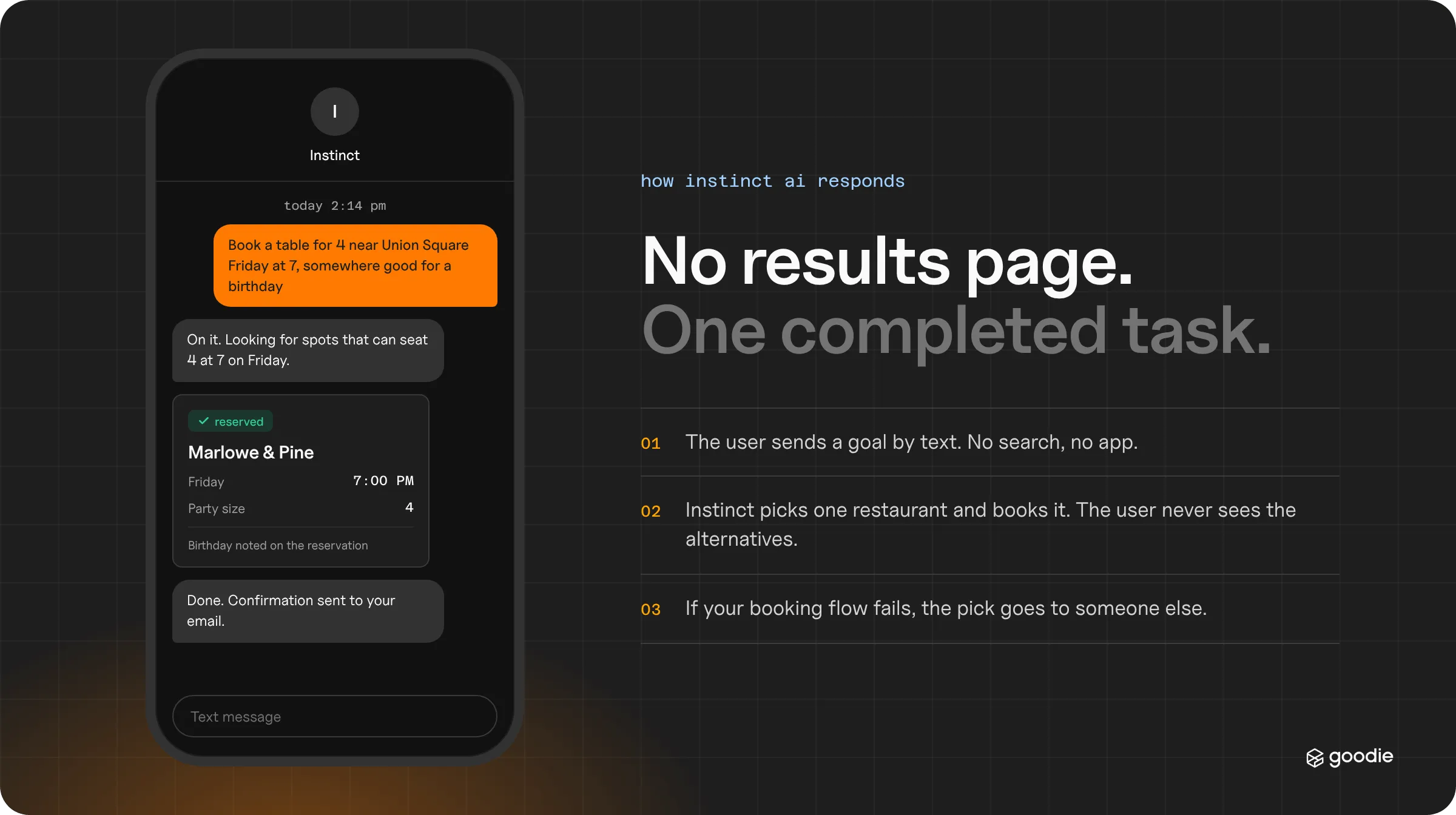
Instinct AI is a personal assistant that people text or call with a goal. It completes the task by using a phone and computer the way a person would, across the apps and accounts it’s been connected to.
A few behaviors matter most for brands:
- There’s no interface. Instinct has no app, desktop program, or website in the traditional sense (as with other AI platforms like ChatGPT). Users reach it by text, voice call, or WhatsApp.
- It runs in the cloud. It works in its own virtual computer and browser, and connects to the user’s mail, messaging, and calendar apps.
- It has its own email address. Instinct can create accounts, contact businesses, and follow up without using the user’s inbox.
- It makes phone calls. Instinct Concierge, announced in September, calls restaurants that don’t take online reservations, adds users to dentist cancellation lists, and disputes bills.
- It joins group chats. Since October, users can add Instinct to a group chat, and friends don’t need their own accounts.
As of November 2026, access is still invite-only, with a waitlist at instinct.com. Usage is growing anyway. Shinn says the platform is approaching $1 billion in annual agent-handled transactions, though he didn’t explain how that figure was calculated.
Goodie tracks Instinct AI as a custom model, separate from chat assistants, because its visibility patterns differ from theirs.
How Is Instinct AI Different From Muse and ChatGPT?
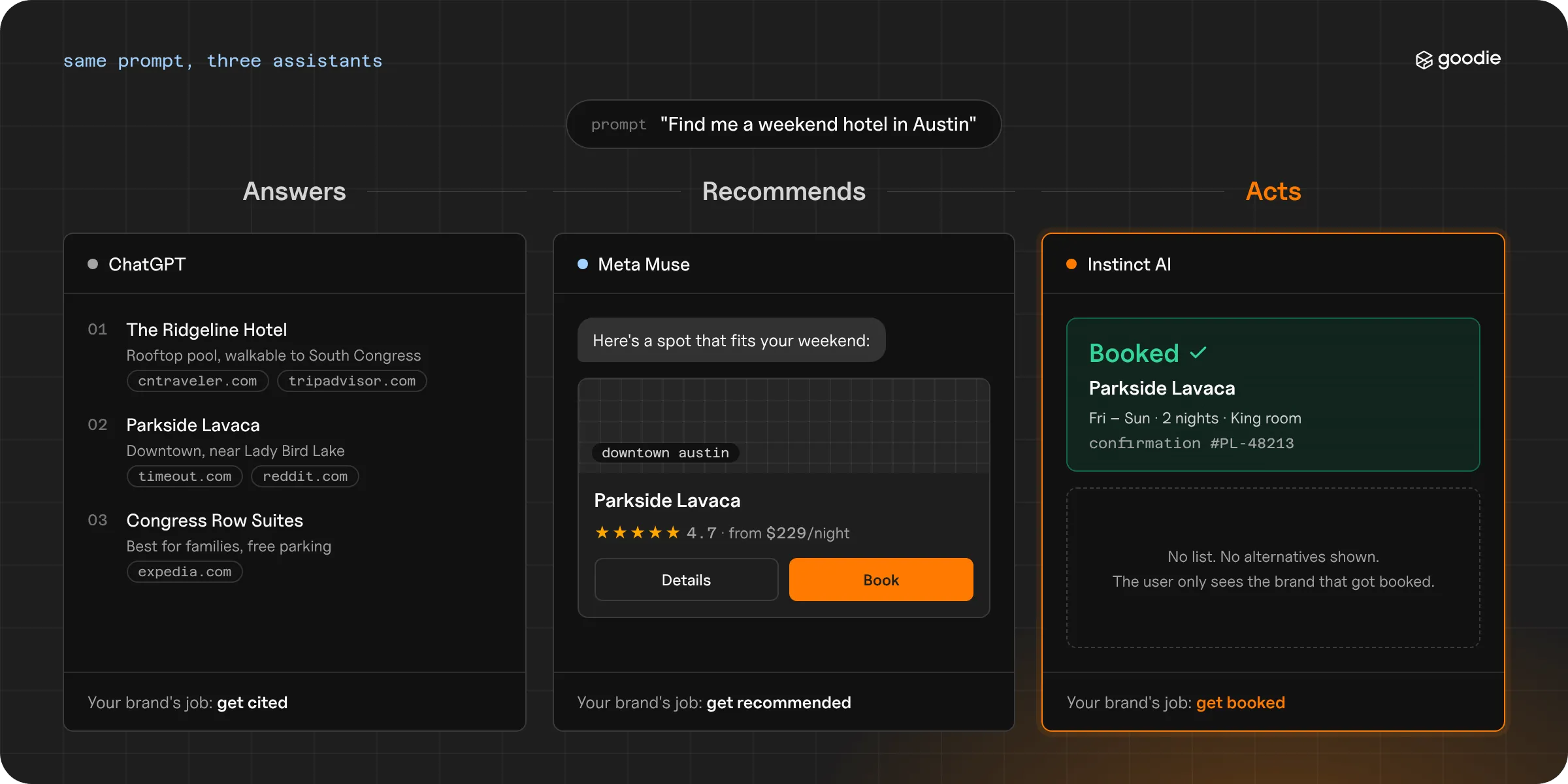
ChatGPT mostly answers and recommends. Instinct AI mostly acts. Meta’s Muse sits between the two, as an agent that lives inside Meta’s ecosystem. A brand can be well cited in ChatGPT and still never get chosen by Instinct.
| Instinct AI | Meta Muse | ChatGPT (including dots) | |
| Main job | Completes tasks end to end | Agent across Meta’s apps | Answers, plus agentic shopping and background agents. |
| How users reach it | Text, phone call, WhatsApp | Meta apps | ChatGPT; dots via Slack, Teams, and other work platforms |
| Places phone calls | Yes (Instinct Concierge) | In limited testing | Not announced |
| Joins group chats | Yes | Not yet | Not announced |
| Suggests products unprompted | Yes (Instinct Selections) | No | No |
| Availability | Invite-only | U.S. and Canada | Dots: Pro and Business Premium |
The practical difference is where your brand can lose. In ChatGPT, it loses when it isn’t cited. In Instinct, it can be cited, picked, and still lose at checkout. If you’re also planning for Meta’s agent, our guide to optimizing for Meta Muse covers how its signals differ.
How Does Instinct AI Decide Which Brands to Use?
Instinct AI looks for evidence that a brand fits the task, then tries to complete the task with that brand. A strong reputation gets you shortlisted. A working checkout gets you the booking.
The Evidence Instinct AI Checks
Instinct looks for proof in three places: your website, your reviews, and your press coverage. It weighs those against what it knows about the user. It infers needs from email, upcoming trips, and digital activity, which is how one user’s coffee subscription turned into a travel flask recommendation.
So the comparison runs on your product facts and also on how well you fit this particular user. Brands with clear specs, current pricing, and consistent facts across sources are easier to match, which is the same dynamic behind AI comparison shopping visibility.
Instinct Selections Put Expert Taste Into the Pick
In late September, Instinct launched Instinct Selections, curated lists for dining, travel, and shopping. Shinn says they’re built with local chefs, designers, architects, and travel guides to bring “human taste” to the product. Instinct hasn’t specifically named those partners yet.
That makes expert curation a deliberate input, which raises the value of earned media, chef and editor lists, and local guides. Goodie’s research on expert vs. customer reviews in AI search shows how differently AI weighs those two kinds of signal.
How Instinct AI Completes Purchases and Bookings (and Where It Breaks)
Instinct AI uses your site the way a person would, so anything that would annoy a human can stop it outright. A person sighs and pushes through a clunky checkout. An agent with a deadline books the competitor whose flow works.
Here’s what Instinct does at the transaction step:
- Selects and buys. It selects items on websites, uses the user’s stored payment credentials, and asks permission before buying.
- Uses payment and login partners. A Stripe partnership supports bookings and purchases, and a 1Password partnership handles logins to users’ existing accounts.
- Signs up on its own. It uses its own email address to create accounts it needs to finish a task.
- Watches availability. Shinn says an agent can check restaurant sites every five seconds and report open slots.
Our model page puts it plainly: a clunky, gated, or unclear flow can make Instinct fail, and a competitor whose flow works may win the pick.
The Friction Points That Cost You the Pick
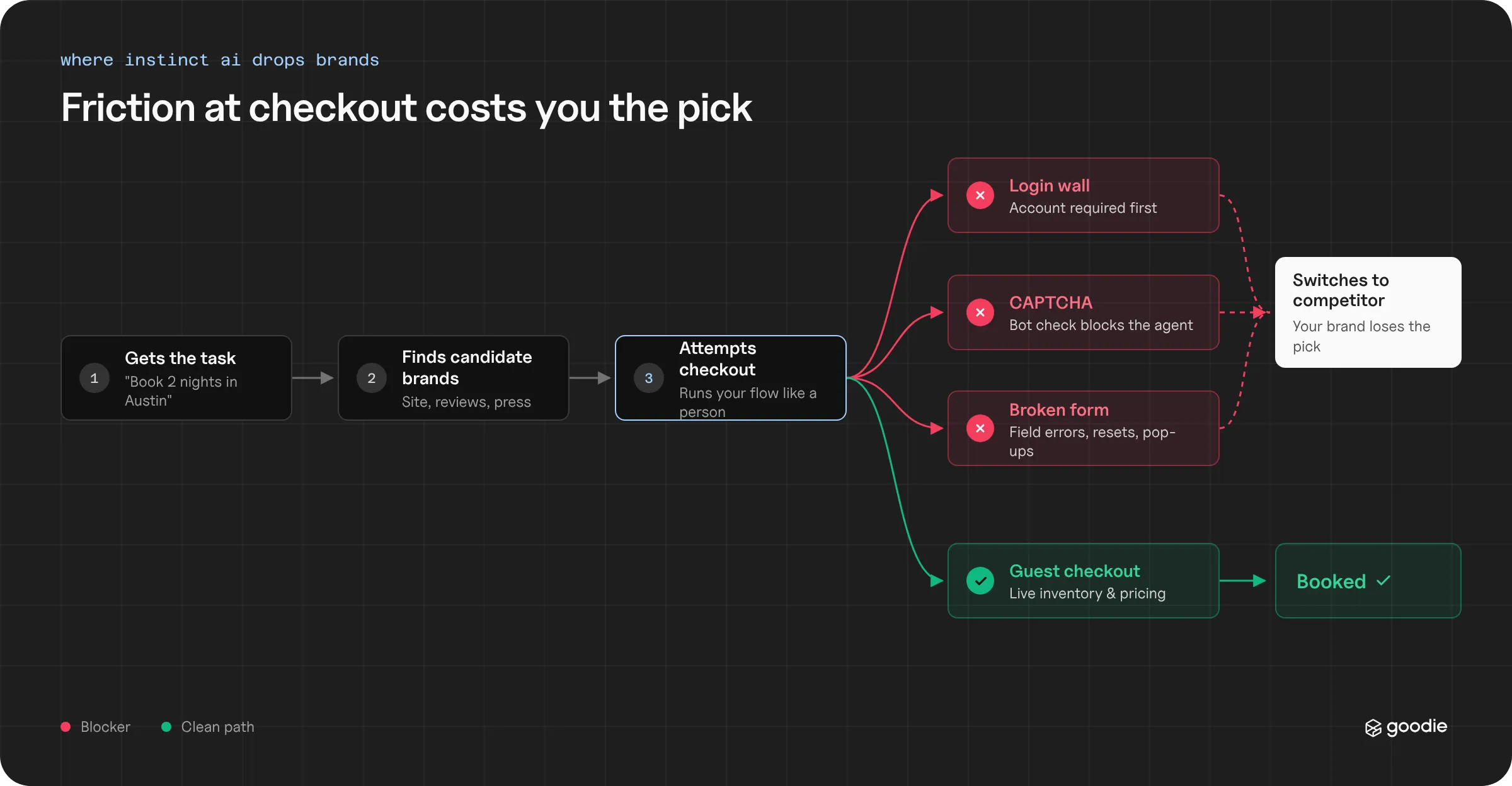
- Forced account creation. Every extra signup step is another point where the task can fail.
- CAPTCHAs and aggressive bot blocking. Rules built to stop scrapers can also block a real customer’s agent placing a real order.
- Fragile forms. Unlabeled required fields, mid-flow pop-ups, and multi-page forms that reset on error.
- Hidden or stale availability. Pricing and inventory that only appear after login, or that don’t match what’s actually bookable.
- Phone-only booking with no one answering. Instinct will call, but only if someone picks up.
For product brands, the Agentic Commerce Suite shows how assistants find, compare, and choose products, and helps get your catalog ready for agent checkout.
How to Optimize Your Brand for Instinct AI
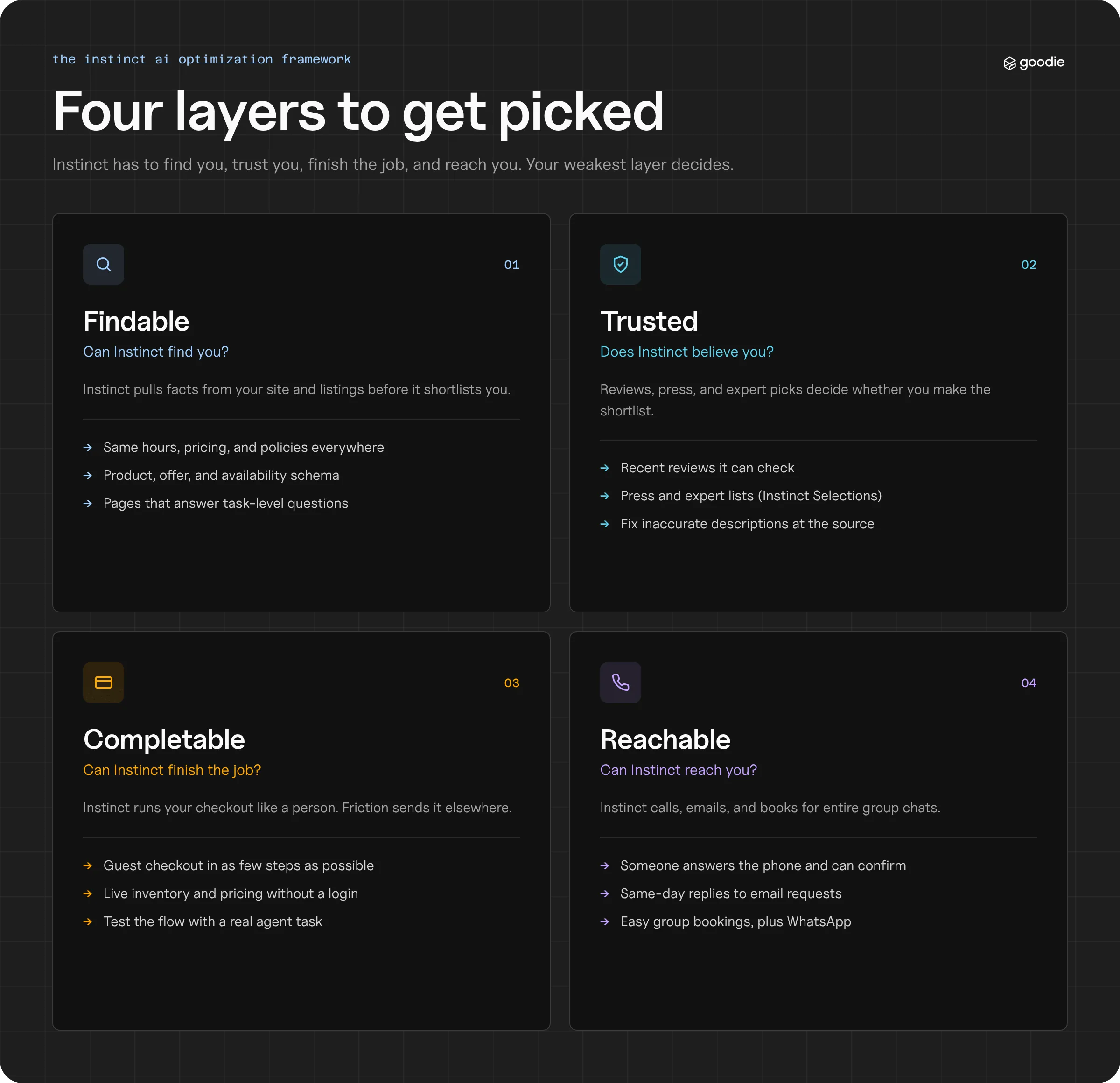
Instinct AI optimization comes down to four layers: findable, trusted, completable, and reachable. Each one maps to a behavior covered above, and the weakest layer usually decides the outcome.
Make Your Brand Findable
- Keep core facts consistent everywhere. Hours, locations, pricing, return policies, and booking rules should match across your site, Google Business Profile, and listings.
- Mark up what an agent needs to act. Product, offer, availability, and location schema give Instinct structured facts it doesn’t have to infer.
- Write pages that answer task-level questions. “Can I book a group of 8?” and “Do you ship by Dec. 20?” matter more to an agent than brand storytelling.
The AEO Periodic Table of AI search visibility factors breaks down which of these signals carry the most weight.
Build the Trust Signals Instinct AI Reads
- Keep reviews recent. Instinct checks reviews directly, and stale ones are weak proof.
- Earn coverage in the press and expert lists. Instinct Selections pull from chefs, designers, and travel guides, so local guides and editor roundups are worth pitching.
- Fix how you’re described. If Instinct describes your brand inaccurately, trace the description back to its sources and correct them there.
Many of these signals overlap with what moves AI personal shoppers, so work you’ve already done there carries over.
Remove Friction From Checkout and Booking
- Offer guest checkout and keep it to as few steps as possible.
- Show live inventory and pricing without requiring a login.
- Test the flow with an agent. Give an AI agent a real task on your site, such as “book a table for 4 on Friday,” and watch where it stalls.
Treat Your Phone Line and Inbox as AEO Channels
- Answer the phone. Concierge calls businesses directly, and Instinct warns that agreements made on a user’s behalf can be binding. Staff and phone systems need to confirm a booking on a call.
- Respond quickly to email. Instinct emails businesses about special requests and availability. A reply that arrives the next day is too late.
- Make group orders easy. In a group chat, one Instinct works for the whole group, so a single booking can cover eight people. Group reservations, split payments, and bulk orders need to work without a phone call to a manager.
- Cover WhatsApp if your customers already order or book there, since it’s one of Instinct’s core channels.
How to Track Your Brand’s Visibility in Instinct AI
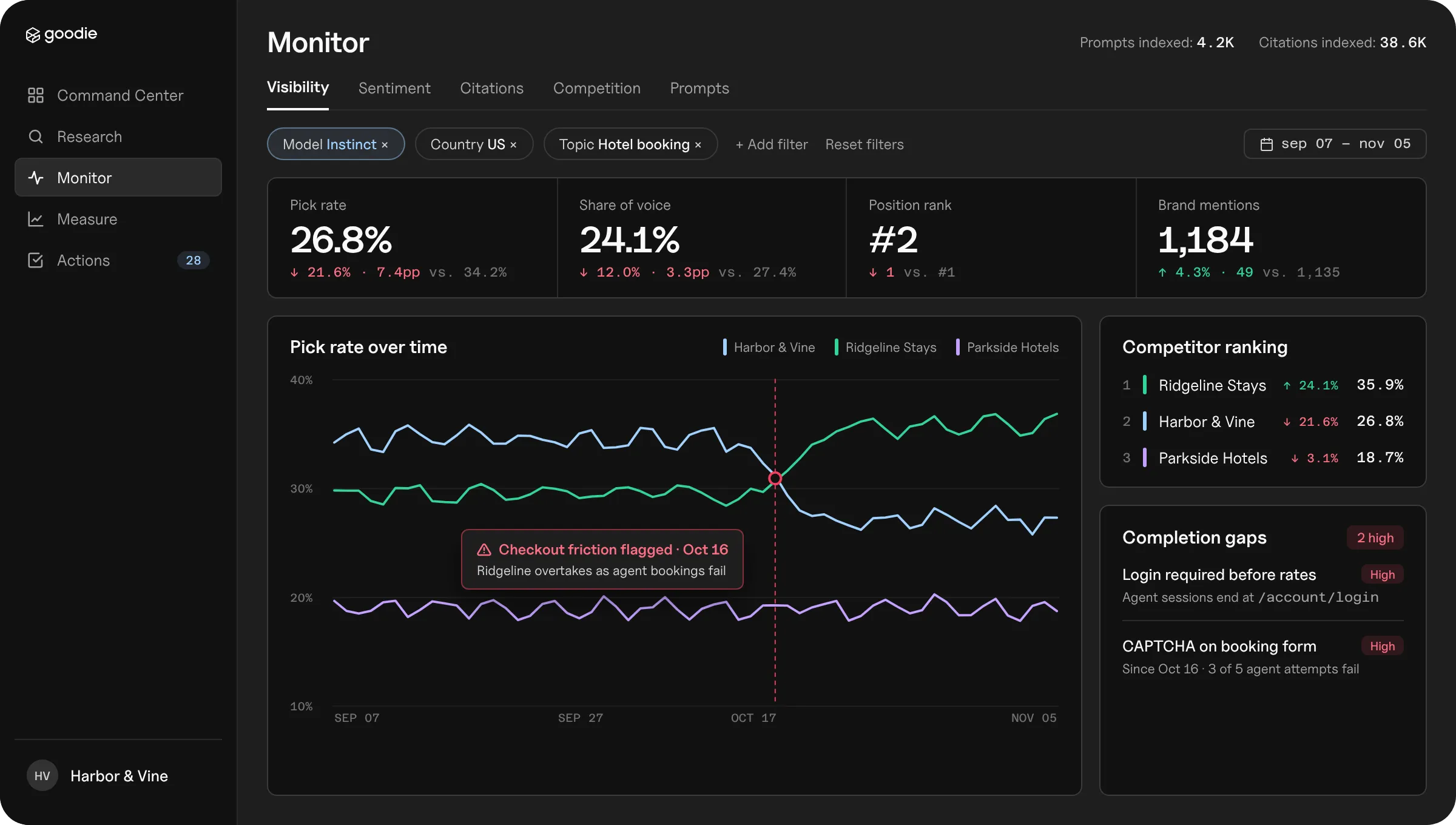
Track Instinct AI separately from chat assistants, using prompts that mirror real tasks (“book,” “order,” “compare”) rather than questions. Goodie’s Instinct tracking uses task-style prompts across industries, use cases, and buyer personas, collected daily.
The metrics that matter:
- Pick rate: How often Instinct chooses your brand for a given task
- Competitor share: Who wins when you don’t
- Description and sentiment: How Instinct talks about you
- Sources: Which sites shape the decision
- Completion gaps: Where agents reach your site and fail
Goodie’s Visibility Monitoring covers the first three: how often Instinct picks your brand, how it describes you, and which competitors it chooses instead. Analytics & Attribution covers the last one. It shows how AI agents reach your site and flags the technical gaps that block orders or bookings, using AI Agent Analytics to see agent traffic directly.
Get Your Brand Instinct-Ready Before Black Friday
Before holiday traffic peaks, run through one check per layer:
- Findable: Holiday hours, shipping cutoffs, and pricing match everywhere.
- Trusted: Recent reviews, plus at least one gift guide or local list you’re on.
- Completable: An agent can check out as a guest without hitting a CAPTCHA.
- Reachable: Someone answers the phone and the inbox during peak weeks.
See What an Agent Sees on Your Site
Goodie’s free Agent Readiness Audit runs 36 checks across 8 categories, including whether agents can transact on your site.
Instinct AI Optimization: FAQs
Instinct AI has been free for early users. Shinn has said he wants to keep it free after public release, but pricing hasn’t been confirmed.
Access is invite-only. New users need a private invitation from an existing user, or they can join the waitlist at instinct.com with a mobile number.
Yes. Instinct Concierge lets the assistant place calls on a user’s behalf, for example, to book restaurants that don’t take online reservations or to sort out billing issues. Instinct warns that agreements made on a user’s behalf can be binding.
Instinct hasn’t announced ads. Its Instinct Selections feature curates recommendations with human experts, and the company hasn’t said whether it earns money from them.
Instinct asks permission before making purchases. Early users have reported the agent taking actions without permission and falling for a phishing attempt, and the product is still in early testing.