Key Takeaways
- Expert review outlets outweigh user-review platforms by roughly 15 to 1 in consumer AI citations, winning 17 of 21 consumer industries outright.
- B2B software runs the opposite direction. User-review platforms lead three of five software categories, with the platform that wins (Gartner Peer Insights, G2, or tech press) depending on the buying motion.
- Citation share concentrates hard: three domains capture 85% or more of review citations in 16 of 31 industries studied, so spreading review effort across a dozen platforms mostly lands on sources AI models never touch.
- App stores and marketplaces barely register in AI citations (Amazon around 0.1%, Apple’s App Store and Google Play under 0.5%), even though they’re where many brands concentrate review effort.
Download the Full Study.
AI search doesn’t treat all reviews the same way, and the gap is bigger than most brands assume. We pulled 902,609 citations from 114,526 AI responses across 31 industries to see which review sources ChatGPT, Perplexity, Google AI Mode, and Copilot actually reach for when someone asks what to buy, who to bank with, or which vendor to shortlist. In consumer categories, expert outlets outweigh user-review platforms by roughly 15 to 1. In B2B software, that ratio flips.
The full breakdown, methodology, and every industry number are in the complete study; this piece covers the findings that should change how you spend your review budget.
The Verdict: AI Search Picks Sides on Reviews
15 to 1. That’s the citation gap between expert review outlets and user-review platforms across 21 consumer industries.
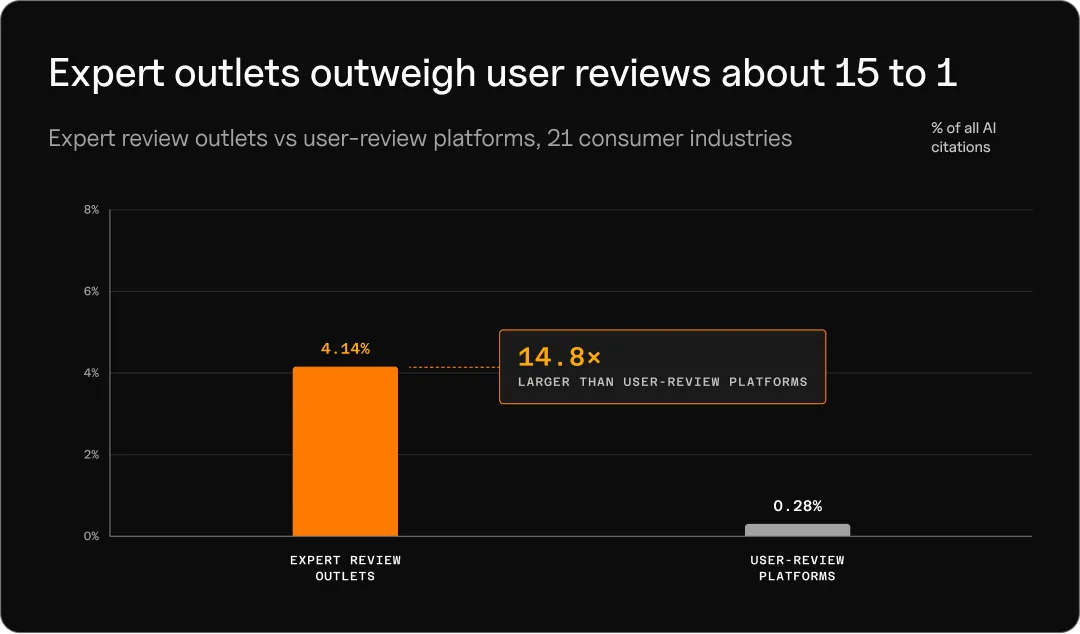
Expert outlets took 4.14% of all AI citations in consumer categories. User-review platforms took 0.28%. That holds up across the study’s entire sample, broken out across 21 consumer industries:
- 17 industries: expert outlets won by a statistically meaningful margin
- 3 industries: ties, no clear winner
- 1 industry: healthcare, the only consumer category where customer reviews led outright
The Gap Flips in B2B Software
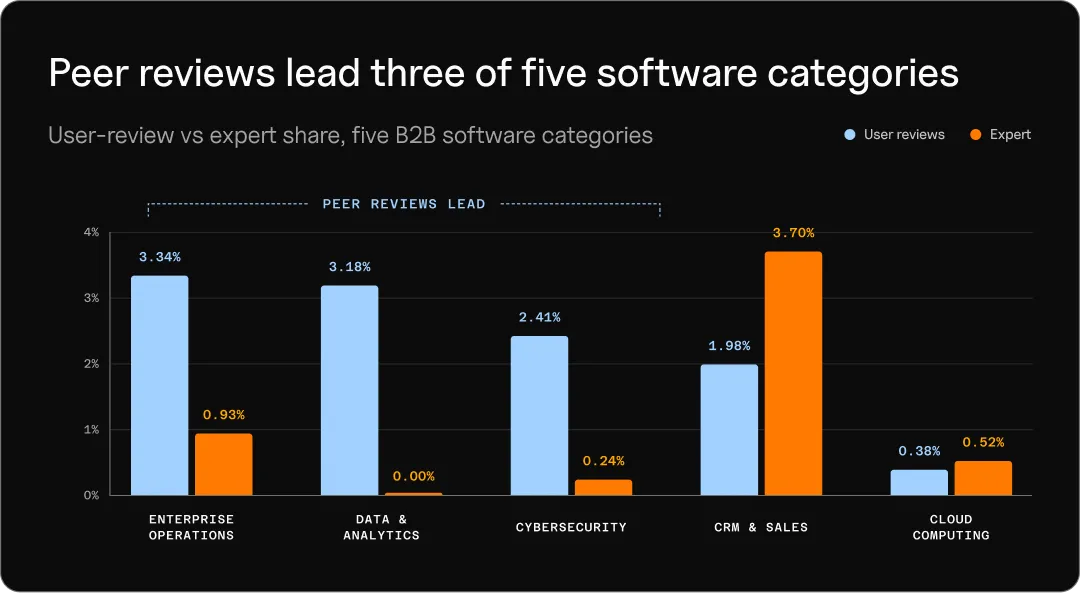
The gap doesn’t hold everywhere, and that’s a critical useful finding. B2B software runs in the opposite direction of consumer industry citation trends. With B2B software, user-review platforms took 2.25% of software citations against expert outlets’ 1.07%, leading three of five categories. Same underlying behavior, different data environment, exactly opposite result.
The upshot: AI search isn’t rewarding “reviews” as a category. It’s rewarding whichever kind of review carries the most trust signal for a given purchase decision, and that changes by what’s being bought. Purchasing a running shoe? AI looks to the experts. Looking for your company’s new cybersecurity solution? AI looks to the masses.
Why Expert Outlets Win the Consumer Fight
The Widest Gap: Gaming Equipment
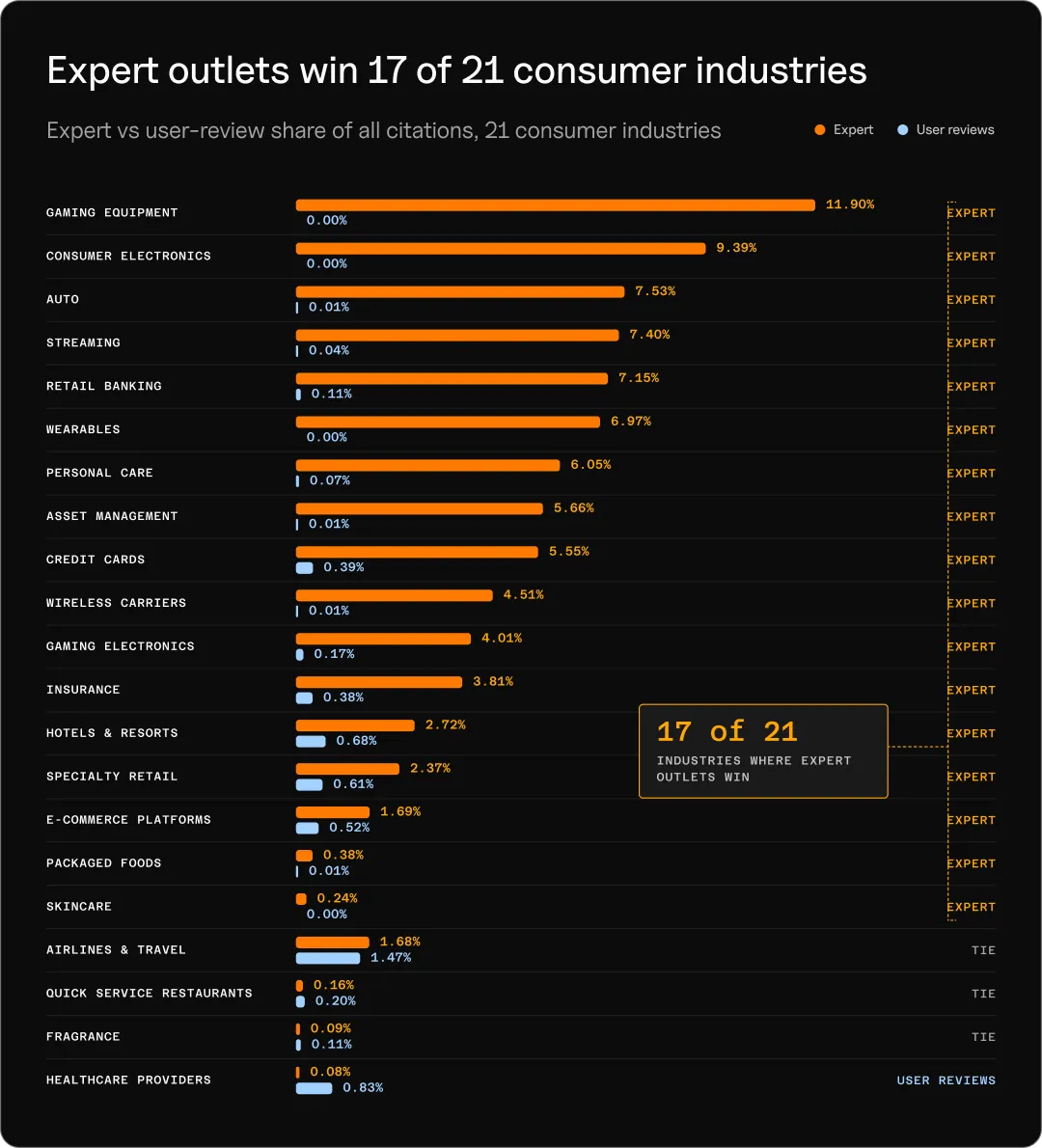
The widest gap in the study came from gaming equipment, and the single biggest source might surprise you.
- RTINGS: 7.49% of citations
- PCMag: 2.06%
- Amazon: 0.09%
- Every user-review platform combined: 0.00%
RTINGS alone carries more than triple PCMag’s share and more than 80 times Amazon’s. Auto tells the same story: Consumer Reports and Kelley Blue Book hold 6.6% of every citation in the category between them, well ahead of the car marketplaces that trail behind.
It’s About Format, Not Expertise
The mechanism is worth understanding, because it’s not about “expert” versus “amateur.” It’s about format. Expert outlets publish standardized, comparison-ready content: consistent testing methodology, structured spec tables, direct verdicts, and authors with bios to back their claims. That’s exactly the shape of content a retrieval system can parse and cite cleanly. A five-star rating with a two-sentence comment doesn’t give a model much to work with. A 2,000-word teardown with a scoring rubric does.
Editorial independence plays into it too. When Consumer Reports says a product underperforms, that carries more weight than a retailer-hosted review precisely because it doesn’t come from anywhere near the shopping cart. Models appear to treat that separation as a trust signal, not just a content-quality one.
Why B2B Software Flips the Dynamic
Software buyers are optimizing for something professional testing labs can’t measure: fit. Does this integrate with what we already run? Does support actually respond? Does it break at our scale? That’s an experience question, and peer reviews answer it in a way lab testing structurally can’t.
No Single Platform Owns B2B
Gartner Peer Insights leads cybersecurity (1.18%) and data & analytics (1.17%). G2 leads enterprise operations (1.44%), running about two to one over Peer Insights there. Which platform wins depends on the buying motion, not the fact that it’s software.
| Category | Leading Platform | Share |
| Enterprise Operations | G2 | 1.44% |
| Data & Analytics | Gartner Peer Insights | 1.17% |
| Cybersecurity | Gartner Peer Insights | 1.18% |
| Cloud Computing | PCMag | 0.41% |
The CRM Exception
CRM is the outlier in the B2B Software category. TechRadar carries 3.09% of CRM citations, ahead of G2 and Capterra combined, and every one of those citations comes from ChatGPT or Copilot. AI Mode and Perplexity cite TechRadar zero times in that category. A CRM brand with no tech press presence is invisible to two of the four surfaces buyers are actually using.
Where to Spend Your Review Budget
Here’s the part that should change what Monday morning looks like for a review-generation program: review citation concentrates dramatically.
- 16 of 31 industries: top three domains capture 85% or more of citations
- Auto: top three domains capture 99%
Being the fourth-best review site’s top selection buys almost nothing in the way of AI search visibility.
Spreading review effort across a dozen platforms per category means mostly landing on sources AI models never touch. The better move for AEO is picking the two or three domains that carry real weight in your category and going deep there with review-unit programs, press outreach, structured data and schema that make your presence on those sites easy to parse.
The full study breaks out leading and second sources for all 21 consumer and 5 software categories — worth before you decide where the next quarter of review effort goes.
The Platforms Getting All the Effort and Almost No Citations
This is where the disconnect between where brands invest and where AI search actually looks gets stark.
- Apple’s App Store: peaks at 0.42%
- Google Play: peaks at 0.37%
- Amazon: about 0.1% in consumer electronics, wearables, gaming equipment, and personal care
Those are the categories where brands often treat Amazon reviews as their primary review asset.
None of that means marketplace ratings are worthless. They still do real work at the point of purchase, once a shopper has already landed on a product page. What this data shows is that they’re contributing almost nothing to what an AI assistant repeats back before that shopper ever gets there.
Build Your Review Strategy Around What AI Cites
The takeaway isn’t “get more reviews.” It’s “get the right reviews, in the right place, for what you’re actually selling.” Consumer brands win by getting products into the hands of testers at the handful of outlets that dominate their category. Software brands win by matching the platform to the buying motion: Gartner Peer Insights for security and analytics, G2 for operations, tech press for CRM.
The harder part is that this data changes by category, by platform, and by which AI surface a customer happens to be using, which is exactly the kind of shift you can’t catch by checking rankings once a quarter. Goodie’s Visibility Monitoring tracks citation share across ChatGPT, Perplexity, Gemini, and more, so you know which sources are actually shaping how AI describes your brand instead of guessing from a review dashboard built for the old search era.
See Where Your Category’s Citations Are Actually Going
Review data shifts by category, by platform, and by AI surface — Goodie’s Visibility Monitoring tracks it continuously instead of leaving you to guess from a dashboard built for the old search era.
Expert Reviews vs. Customer Reviews in AI Search: FAQs
The Goodie platform monitored 902,609 citations across 114,526 AI responses, spanning 31 industries and four AI surfaces (ChatGPT, Perplexity, Google AI Mode, and Copilot) from January through August 2026. Full methodology is in the complete study.
In consumer categories, expert outlets outweigh user-review platforms by roughly 15 to 1 (4.14% of citations versus 0.28%). In B2B software, that flips: user-review platforms take 2.25% against expert outlets’ 1.07%.
Barely, based on this data. Amazon holds about 0.1% of citations in the consumer categories it appears in most, and Apple’s App Store and Google Play peak under 0.5%. They still matter at the point of purchase, just not for what AI assistants cite beforehand.
It depends on the category. Gartner Peer Insights leads cybersecurity and data & analytics citations; G2 leads enterprise operations. CRM is the exception, where tech press outranks both.