

Summary
- What these tools do: ChatGPT optimization tools track whether ChatGPT mentions, cites, and recommends your brand, then show you what to change to get mentioned more often. They’re a different category from prompt-enhancer browser extensions, which help users write better prompts.
- What to track: Mentions, citations, share of voice, sentiment, and the prompts where competitors show up and you don’t. AI referral traffic and conversions close the loop.
- How to choose: Treat monitoring as the baseline. Separate tools on engine coverage, optimization actions, and attribution.
- Who’s on the list: Goodie, Profound, Peec AI, AthenaHQ, Scrunch, OtterlyAI, Semrush AI Visibility Toolkit, Ahrefs Brand Radar, SE Ranking (SE Visible), HubSpot AEO, AirOps, Rankability, and BrightEdge.
- What it costs: Free one-time checkers exist. Paid trackers start around $29 to $99/month, full platforms run roughly $250 to $1,000/month, and enterprise plans are custom.
ChatGPT reaches more than 1 billion weekly users, and when it answers “what’s the best X for Y,” it names a handful of brands and cites a handful of sources. ChatGPT optimization tools tell you whether your brand’s one of them, why or why not, and what you need to fix to get in there.
So let’s walk through the evaluation criteria first, then compare 13 tools against them, with pricing verified on each vendor’s site as of October 2026.
Best ChatGPT Optimization Tools: Quick Overview
| Tool | Best For | Engine Coverage | Optimization Actions | Attribution | Starting Price |
| Goodie | Brands that want monitoring, optimization, and revenue attribution in one platform | 5 (Core), 8 (Pro), 12 (Enterprise) | Yes, prioritized and executable in-platform | Yes, AI traffic to revenue | $295/mo; 7-day free trial |
| Peec AI | Marketing teams and agencies that want lean analytics | 3 of your choice; up to 13 (Enterprise) | Recommendations | Crawl insights; Looker Studio export | $95/mo |
| OtterlyAI | Small teams and budget-conscious marketers | 4 included; Gemini, AI Mode, Claude as add-ons | GEO audits, recommendations | AI referral traffic (Standard+) | $29/mo; free trial |
| Semrush AI Visibility Toolkit | Existing Semrush users | ChatGPT, Google AI, Gemini, Perplexity | AI-readiness audit, recommendations | Enterprise only | $99/mo per domain |
| Ahrefs Brand Radar | Existing Ahrefs users who want large-scale prompt data | 6 core; Claude for custom prompts | Gap discovery, no recommendation engine | Via Ahrefs Web Analytics | From $199/mo add-on to a paid Ahrefs plan |
| SE Ranking (SE Visible) | SMBs and agencies on a budget | 5 | Source and outreach analysis | Not stated | $99/mo standalone; $89/mo add-on |
| HubSpot AEO | SMB and mid-market HubSpot customers | 3 (ChatGPT, Gemini, Perplexity) | Prioritized recommendations | Not stated | $50/mo; free AI Search Grader |
| AthenaHQ | Teams that want agents and a free starting tier | 5 (free), 11 (Starter) | Yes, agent-driven | GA4, GSC, Shopify integrations | Free tier; Starter $295/mo |
| Scrunch | Enterprise and multi-brand teams | 7+ on all plans | Page audits; AI-readable site version | AI referral traffic | 300/mo(250/mo annual); 7-day free trial |
| AirOps | Content teams that publish at volume | ChatGPT only (Solo); 7+ (Pro) | Content scoring, agents, campaigns | Media mix modeling | Free to start; paid plans not listed publicly |
| Rankability | SEO agencies managing many clients | 11 on all plans | Content optimizer and audits | Not stated | $97/mo |
| BrightEdge | Large enterprises already on BrightEdge | ChatGPT, Perplexity, AI Overviews, AI Mode, Gemini, others | Citation gap briefs, CDN-level agent optimization | AI referral traffic, leads, revenue | Custom |
| Profound | Enterprise marketing teams | Up to 9 (Enterprise) | Yes, agent-driven | AI bot and visitor analytics | Free trial; Enterprise custom |
What Are ChatGPT Optimization Tools?
ChatGPT optimization tools are brand visibility platforms that run prompts through ChatGPT (and typically other AI engines) at scale, record how your brand appears in the answers, and recommend changes that improve your odds of being mentioned or cited.
They exist because you can’t see ChatGPT’s answers the way you see a Google results page. Each response is generated on the fly, varies by user and session, and pulls from a mix of training data and live web results. ChatGPT search responses can include citations to the sources it used, but OpenAI states plainly that “placement is not guaranteed.” The only way to know where you stand is to sample answers systematically, which is what these tools do.
If you’re looking for the step-by-step process instead of the software, our guide to tracking and optimizing brand visibility on ChatGPT walks through it.
Quick note on search intent: Search “ChatGPT optimization tools” and you’ll also find Chrome extensions that rewrite your prompts. Those help individuals get better answers from ChatGPT. This list covers tools that help brands show up in ChatGPT’s answers.
What Should a ChatGPT Optimization Tool Track?
At minimum, a tool should report the core metrics behind AI search brand monitoring:
- Brand mentions: How often ChatGPT names your brand across a set of relevant prompts. This is the headline visibility metric.
- Citations: Which URLs ChatGPT links as sources, including your own pages and the third-party sites (review sites, publications, forums) that shape answers about you.
- Share of voice: Your mention rate relative to competitors on the same prompts.
- Sentiment and accuracy: Whether ChatGPT describes you positively, neutrally, or negatively, and whether the facts (pricing, features, positioning) are right.
- Prompt-level gaps: The specific prompts where competitors appear, and you don’t. This is where most optimization work starts.
- Shopping visibility (for ecommerce): ChatGPT shows product results with images and prices, and merchants can submit product feeds. If you sell products, SKU-level tracking matters as much as brand-level tracking. Our breakdown of how chatbot commerce is changing ecommerce funnels covers why.
- Crawler access and AI referral traffic: Whether OpenAI’s crawlers can reach your site, and how many visits ChatGPT sends you. Sites that block OAI-SearchBot won’t be shown in ChatGPT search answers, and ChatGPT automatically tags referral links with utm_source=chatgpt.com, so this traffic is measurable in Google Analytics.
One metric to treat with caution is average rank position. A SparkToro and Gumshoe study of 2,961 AI responses found less than a 1 in 100 chance of getting the same brand list twice, and roughly 1 in 1,000 of getting it in the same order. Mention rate across many runs held up as a usable metric. Single-run rank did not.
How Do You Choose a ChatGPT Optimization Tool?
Nearly every tool on this list handles basic monitoring. The differences show up in four places.
1. Monitoring Quality (the Baseline)
Check how the tool collects data and how much of it you get. Look for daily runs, enough prompts per plan to cover your category (25 prompts is a spot check, 100+ is a program), and segmentation by topic, persona, and region. Because answers vary between runs, a tool that samples more often gives you a more reliable read.
2. Engine Coverage
ChatGPT is the largest AI assistant, but your buyers also use Google AI Overviews, AI Mode, Gemini, Perplexity, Claude, and Copilot, and shoppers increasingly ask retail assistants. Coverage ranges from 3 engines on entry plans to 11 to 14 on enterprise plans across this list, and several vendors charge extra for engines like Claude or Gemini. Confirm which engines your specific plan includes. For reference, Goodie tracks 14 models, including retail assistants Amazon Alexa for Shopping and Walmart’s Sparky.
3. Optimization Actions
Data without direction leaves your team guessing. The stronger platforms translate gaps into prioritized work: which pages to update, which schema is missing, which third-party sites to pursue for citations, and what to fix technically. Some go further and let you execute changes in the platform or hand them to AI agents.
4. Attribution
Visibility only matters if it moves pipeline. Look for tools that connect AI referral traffic to conversions and revenue, ideally through GA4 and your CRM. Our guide to measuring AEO impact on revenue explains the measurement model in more detail. Tools without attribution can tell you that visibility went up. Tools with it can tell you what that was worth.
Top 13 ChatGPT Optimization Tools
1. Goodie
Best for: Brands and agencies that want research, monitoring, optimization, and attribution connected in one workflow, including ecommerce teams that need SKU-level AI shopping data.
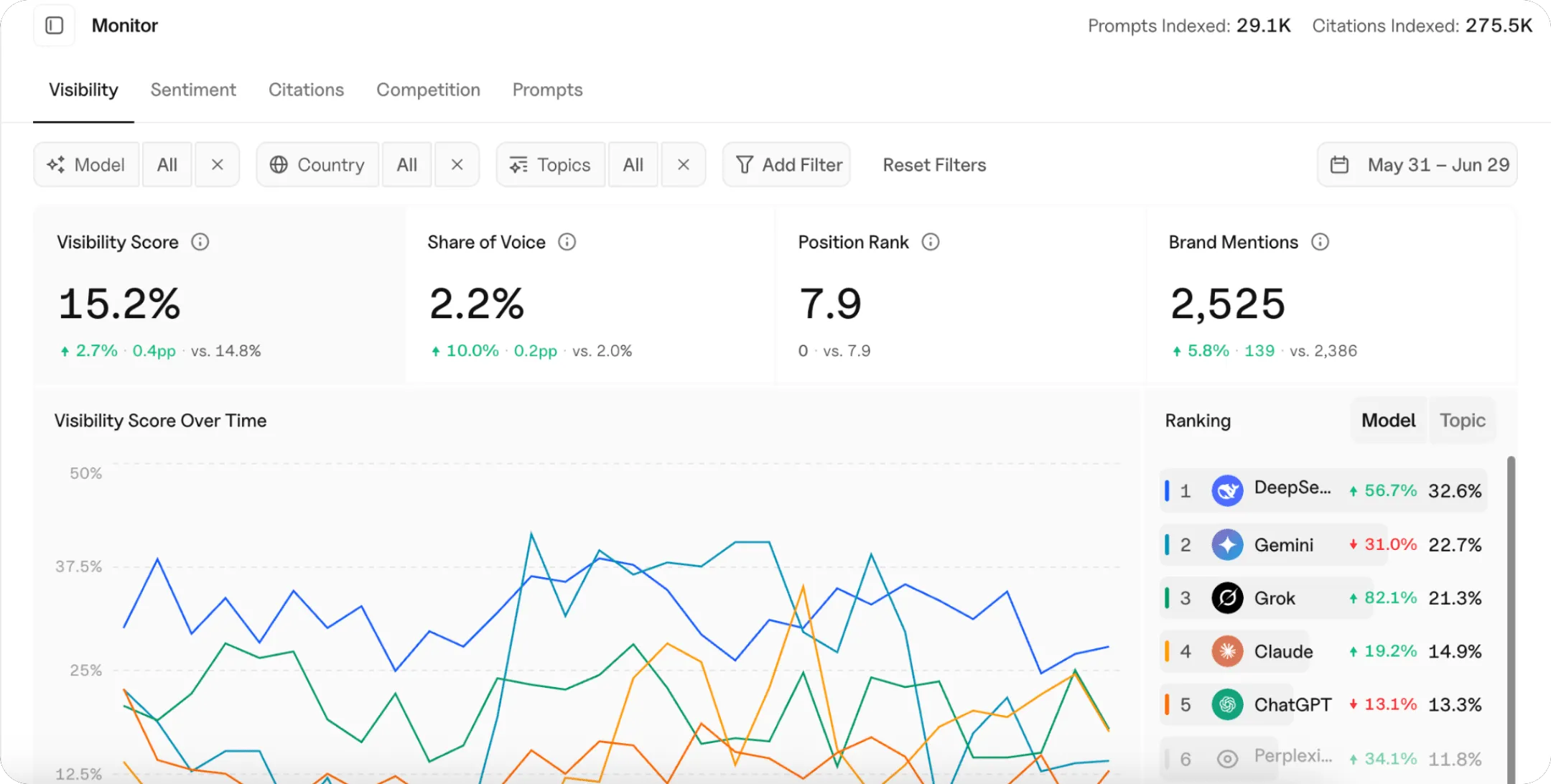
Goodie is an end-to-end AEO platform that runs the full loop in one place: finding the prompts your buyers use, tracking how AI describes you, fixing the gaps, and tying the results to revenue. Visibility Monitoring reports mentions, ranking position, top citing domains, share of voice, sentiment, and the prompts where competitors are cited and you aren’t, with alerts for sudden drops or new competitive threats. Prompt Research shows what customers ask AI, grouped into prompt clusters with volume and intent trends. See how Goodie tracks ChatGPT specifically.
Its scope reaches past brand mentions. Brand Command checks AI answers against your approved brand facts and flags false claims, and the Agentic Commerce Suite tracks SKU-level visibility in ChatGPT Shopping, Amazon Rufus, Perplexity Shopping, and AI Mode Shopping.
On the action side, Optimization Actions ranks fixes by projected impact across owned content, earned media targets, technical fixes, and social profiles, with a difficulty level and timeline for each, and lets you push changes like meta descriptions and structured data from the platform. Content Studio drafts AI-ready content in your brand voice using the citation data already in your account, and Goodie MCP brings the workflow into the AI tools your team already uses.
Analytics & Attribution traces AI referral traffic through leads and CRM revenue, models influenced revenue from zero-click AI answers, and compares performance before and after each fix. AI Agent Analytics shows how AI crawlers interact with your site. Integrations include GA4, Google Search Console, Bing Webmaster Tools, Adobe Analytics, HubSpot, Salesforce, Shopify, WordPress, Cloudflare, Vercel, AWS, Akamai, Google Cloud, Slack, and Microsoft Teams. Enterprise plans add white-glove implementation and a dedicated strategist. The main trade-off: Core covers 5 of the 12 models, and full model coverage, API access, and multi-brand reporting come with Enterprise.
- Engine coverage: 14 models, including ChatGPT, AI Overview, AI Mode, Perplexity, Gemini, Claude, Microsoft Copilot, Meta AI, DeepSeek, Grok, Amazon Alexa for Shopping, Muse, and Sparky.
- Pricing: Core is $295/month with a 7-day free trial. Pro is $999/month. Enterprise is custom. See Goodie pricing for agency plans.
- Data collection: Daily, segmented by geography, persona, model, language, and topic.
- Plan limits: Core includes 110 prompts, 5 models, unlimited seats, and 50 optimizations per month. Pro includes 250 prompts, 8 models, and unlimited seats.
- Security and support: SOC 2 Type I and Type II, SAML SSO, SCIM provisioning, and role-based access (security).
2. Peec AI
Best for: Marketing teams and agencies that want focused analytics with unlimited users on every plan.
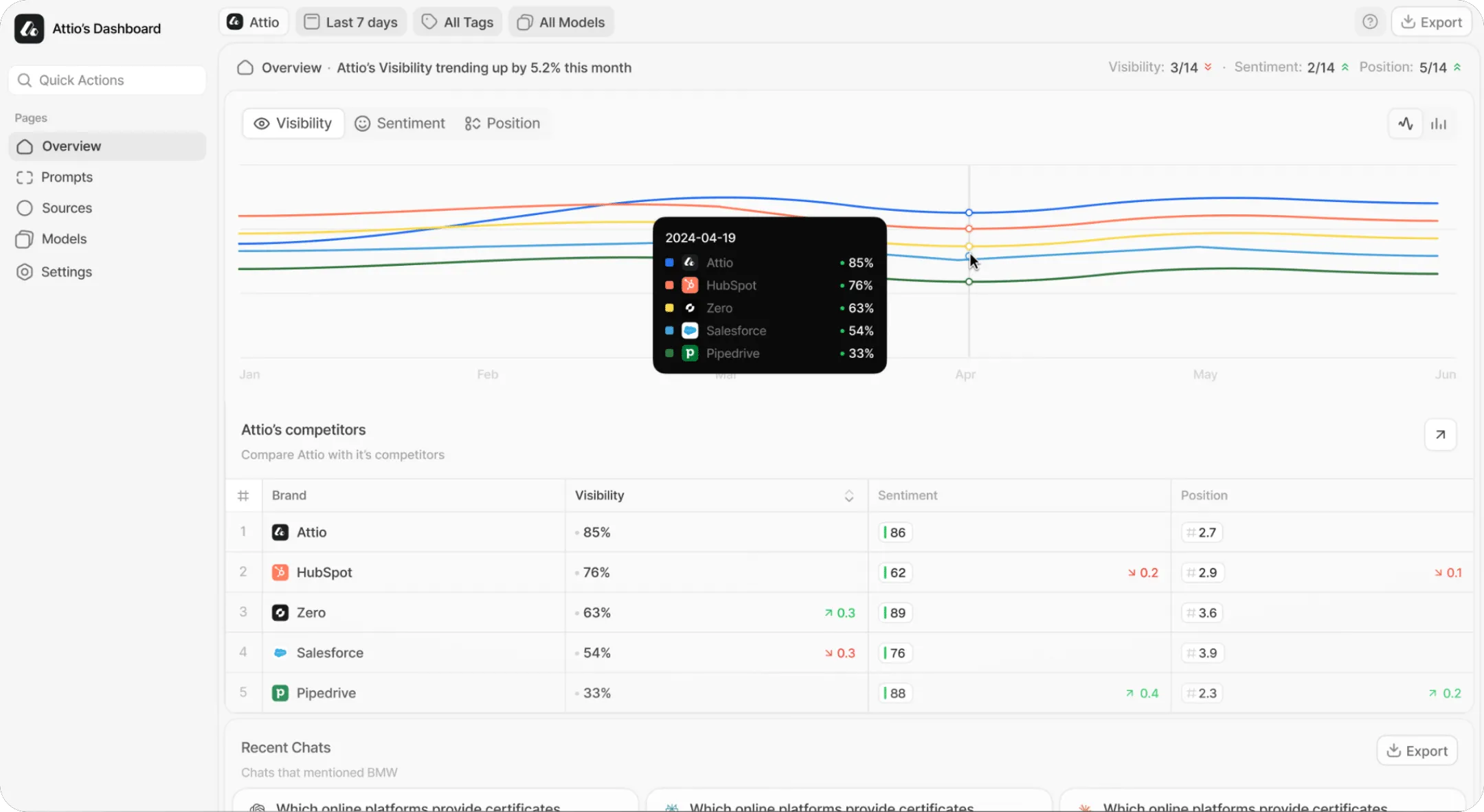
Peec AI positions itself as “AI search analytics for marketing teams,” with a focus on clean visibility, position, and source data and a steady release cadence. It tracks visibility (share of chats that mention you), position, sentiment, and cited sources at the domain or URL level. Recent additions include AI Shopping Analytics for SKU-level ChatGPT shopping visibility, a Query Fanouts page, and Brand Perception.
For action, Peec offers recommendations for closing visibility gaps, prompt suggestions with search volumes, and an MCP server for Claude, Cursor, and other AI tools. Integrations include GA4 for AI referrals, Crawl Insights from server logs (Cloudflare, Vercel, CloudFront, Akamai, and others), a Looker Studio connector, and CSV exports. API access is Enterprise-only.
Support is chat and self-serve on Starter, with dedicated support on Enterprise. Self-serve plans are capped at 3 engines, and teams with SOC 2 procurement requirements should confirm status first. For a head-to-head, see our Goodie vs. Peec AI comparison.
- Engine coverage: Starter through Advanced plans let you choose 3 models from ChatGPT, AI Mode, AI Overviews, Copilot, Gemini, and Naver AI, with additional engines (including Perplexity) as paid add-ons. Enterprise covers up to 13.
- Pricing: Starter is $95/month for 50 prompts, Pro is $245/month for 150 prompts, and Advanced is $495/month for 350 prompts. Each includes 3 models of your choice, unlimited users, and daily tracking. Enterprise is custom. See Peec’s pricing page for annual billing, which carries a 15% discount.
- Data collection: Daily, through browser automation of each platform’s web interface, which Peec says matches what a logged-out user sees.
- Plan limits: Starter includes 50 prompts, 3 models, 1 project, and 1 country and language. Advanced raises that to 350 prompts, 5 projects, 3 countries, and 5 languages.
- Security: SAML SSO on Enterprise and role-based access. Peec states it is pursuing SOC 2 but isn’t certified yet.
3. OtterlyAI
Best for: Small marketing teams, SEO teams, and agencies getting started with AI visibility on a limited budget.
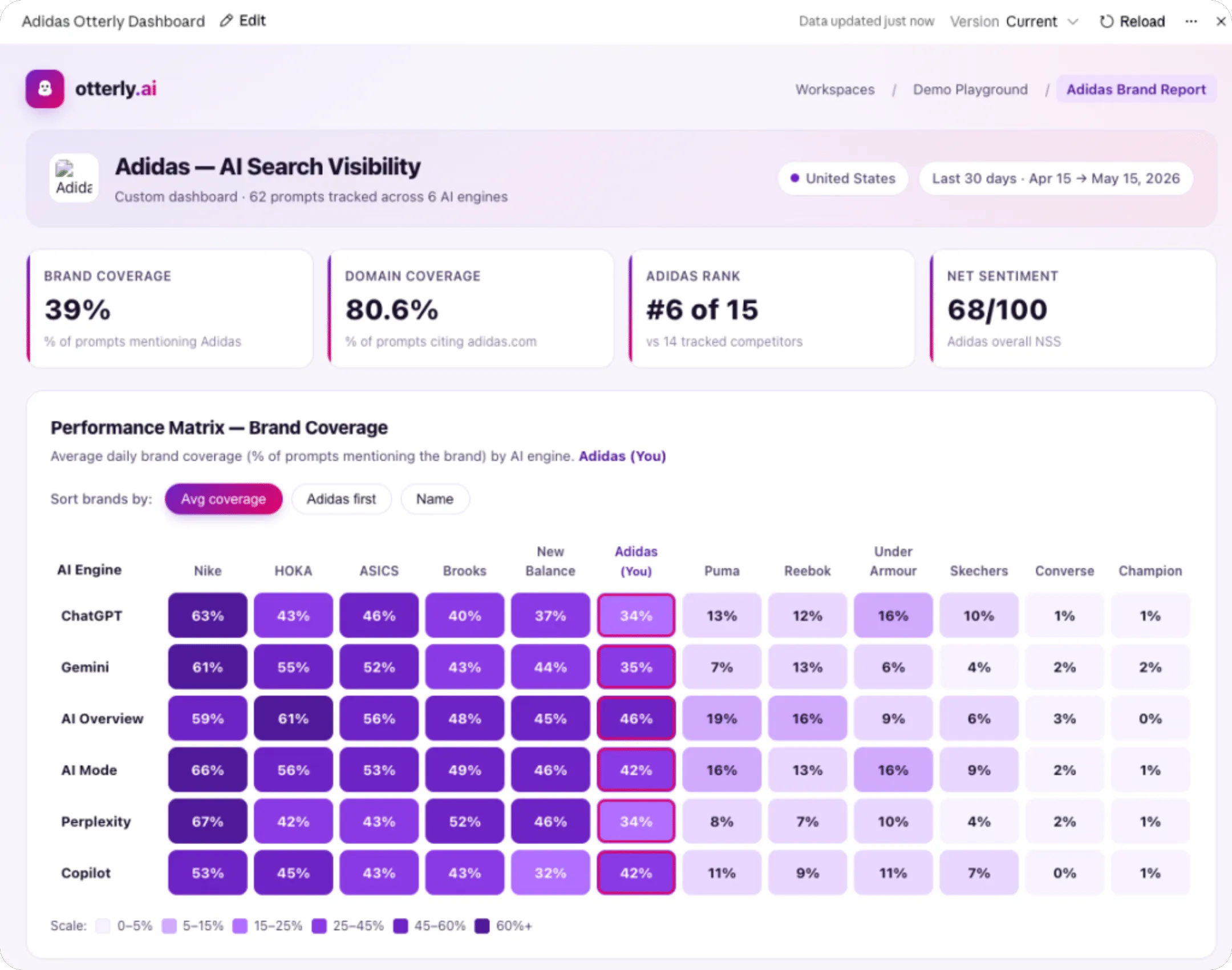
OtterlyAI is a monitoring-first tool with one of the lowest entry prices on this list and a fast-growing feature set, including a public API and MCP server launched in 2026. It tracks brand mentions, website citations, share of AI voice, sentiment, average brand position, and AI referral traffic through Agent Analytics (Standard plan and up).
Optimization features include GEO URL audits, weekly recommendations (3 per week on Lite, unlimited above that), content briefs, and downloadable brand reports. Agent Analytics connects via Cloudflare, Netlify, WordPress, webhook, or file upload, and a Looker Studio connector, API, and MCP are available from Standard up. Onboarding is group-based on Lite and Standard, with a personal session on Premium and a dedicated CSM on Enterprise.
Lite’s 15 prompts work as a spot check more than a program, and it excludes the API, MCP, and Agent Analytics. ChatGPT Ads reporting has been paused since September 2026.
- Engine coverage: ChatGPT, Google AI Overviews, Perplexity, and Microsoft Copilot are included. Google AI Mode with Gemini, and Claude, are paid add-ons.
- Pricing: Lite is $29/month, Standard is $189/month, and Premium is $489/month. A free trial is available.
- Data collection: Daily, through each platform’s public web interface, except Claude, which runs through the API.
- Plan limits: Lite includes 15 prompts and unlimited team members. Standard includes 100 prompts and Premium 400. Coverage spans 50+ countries.
- Security: GDPR compliant, with SAML SSO and viewer roles on Enterprise.
4. Semrush AI Visibility Toolkit
Best for: SEO teams already using Semrush that want AI visibility in the same dashboard as their keyword data.
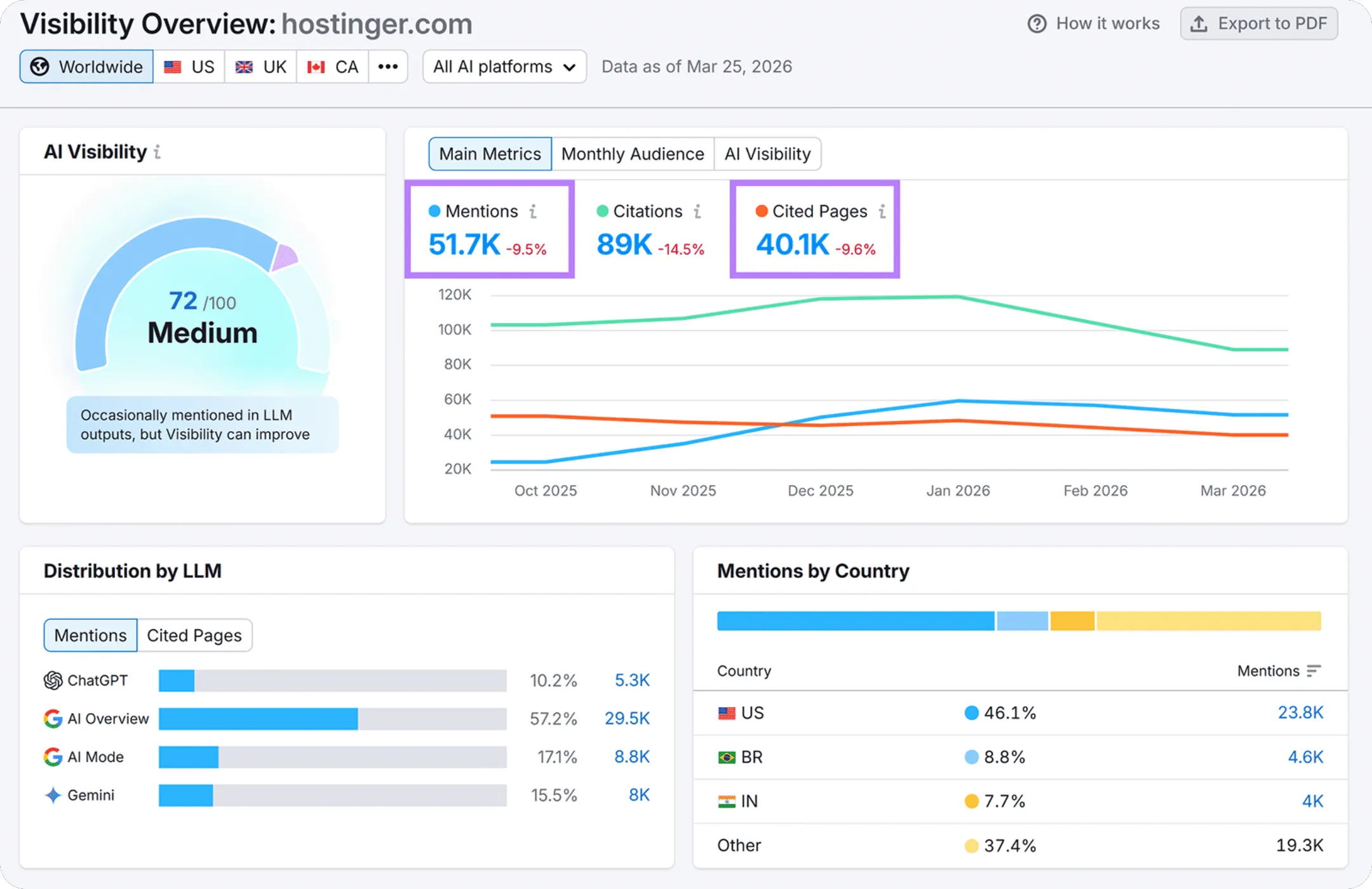
The Semrush AI Visibility Toolkit adds AI mention tracking and prompt research to Semrush’s SEO suite, so AI visibility sits next to your keyword and site audit data. It reports an AI Visibility Score, citations and cited pages, share of voice and sentiment (in the weekly Brand Performance report), prompt tracking, and prompts where competitors are cited and you aren’t.
On the action side, it includes an AI-readiness site audit (including whether AI bots are blocked), AI-generated strategy recommendations ranked by urgency, and prompt research with topic opportunities. Data exports to CSV, Excel, Google Sheets, and PDF, and support runs through the knowledge base, Academy, and webinars. AI traffic attribution is reserved for Semrush Enterprise.
There’s no free trial on the standalone toolkit, and Prompt Tracking doesn’t include share of voice. The best value comes from pairing it with an existing Semrush subscription.
- Engine coverage: ChatGPT, Google AI, Gemini, and Perplexity.
- Pricing: $99/month per domain as a standalone toolkit. Bundled SEO + AI Search plans start at $199/month with a 7-day trial.
- Data collection: Semrush says responses are captured from real requests and not via any APIs of LLMs. Prompt Tracking runs daily on desktop.
- Plan limits: The standalone toolkit includes 1 project, 25 tracked prompts, and 1 Brand Performance domain. Each user needs a separate license.
- Security: SAML SSO is tied to higher Semrush plans.
5. Ahrefs Brand Radar
Best for: SEO and content teams already on Ahrefs that want large-scale competitive share of voice and market research.
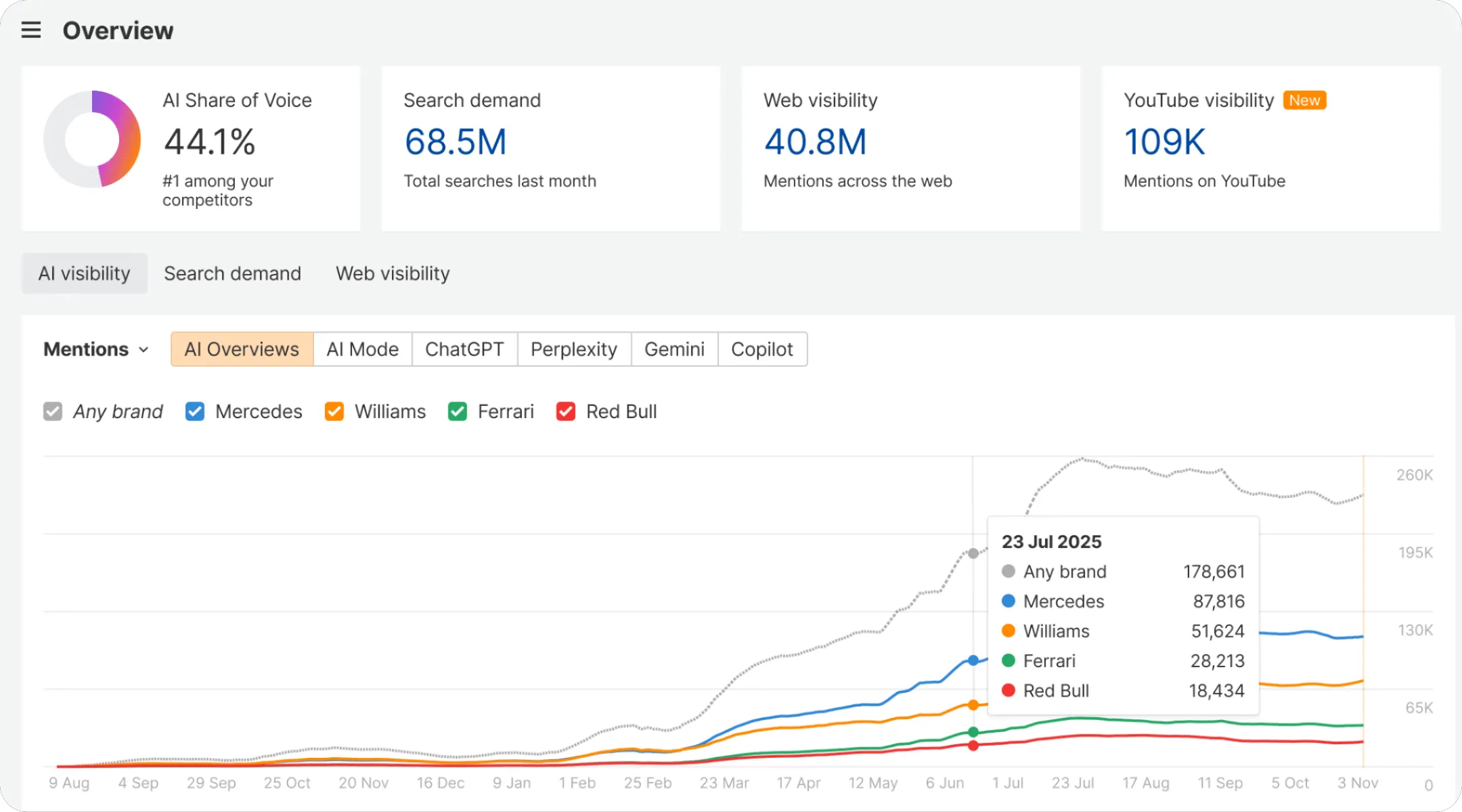
Ahrefs Brand Radar tracks brand, product, and competitor visibility across a prebuilt index of hundreds of millions of AI prompts, so you get category-level data without building a prompt list first. It reports mentions, citations, share of voice, and impressions weighted by search volume, plus custom prompts. Recent additions include “Found but not cited” reporting and entity matching.
Brand Radar has no built-in recommendation engine. It surfaces citation opportunities, content gaps from fan-out queries, and pages already earning AI traffic, and leaves the next step to your team. AI traffic and AI bot visits require Ahrefs Web Analytics and Bot Analytics, and API, MCP, and a Looker Studio connector are available. Support includes 24/7 chat. A free AI Visibility Checker offers a quick preview.
It requires a paid Ahrefs plan. Index data refreshes monthly, and brands with low search volume get thinner index coverage.
- Engine coverage: AI Overviews, AI Mode, ChatGPT, Perplexity, Gemini, and Copilot. Claude is available for custom prompts only.
- Pricing: The AI add-on starts at $199/month on top of a paid Ahrefs plan, with custom prompt bundles from $50/month. Ahrefs’ pricing page and help center show slightly different tiers, so confirm before buying.
- Data collection: All prompts run through each engine’s free public web interface on its default model, with no personalization. The chatbot index is tested monthly. Custom prompts can refresh daily, weekly, or monthly.
- Plan limits: Custom prompt checks scale with your Ahrefs plan (5 per day on Lite). No cap on tracked brands.
- Security: SAML SSO on Enterprise. Ahrefs states SOC 2 is in progress.
6. SE Visible
Best for: SMBs and agencies that want high prompt volume for the price.
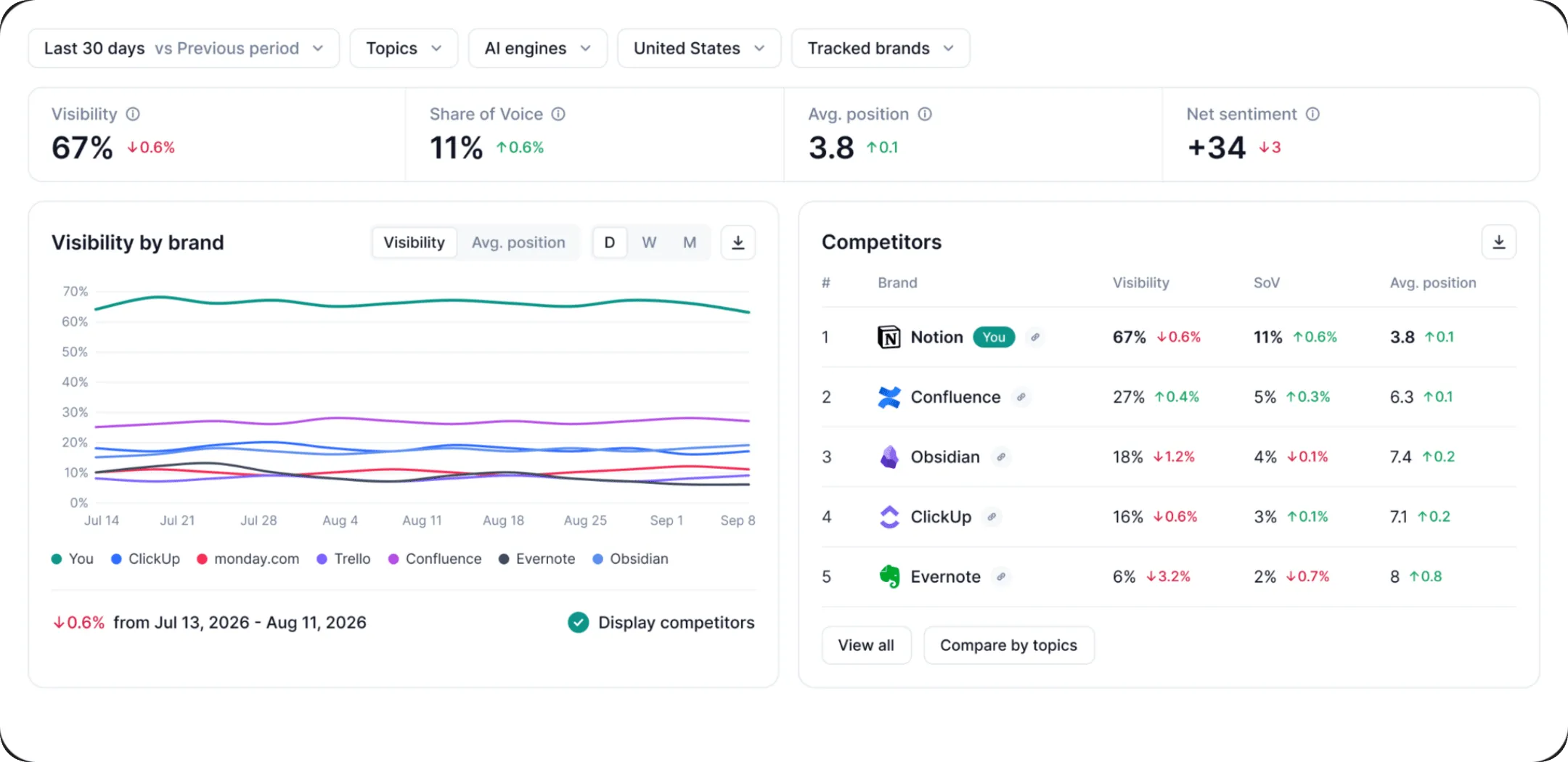
SE Visible is SE Ranking’s standalone AI visibility product. The same data is available as an AI Search add-on inside SE Ranking. It tracks mentions, citations, sentiment, share of voice, competitor benchmarks, and the domains and URLs cited most often, with a sources “gap score.”
Source and competitor analysis helps teams plan outreach, and Agents are in beta. API access is included on all plans, along with CSV exports. No attribution features are stated, and onboarding is self-serve.
The trade-offs: five engines, no white-labeling, and a visibility score that excludes citations.
- Engine coverage: ChatGPT, Gemini, Perplexity, AI Overviews, and AI Mode. Claude and Copilot are on the roadmap.
- Pricing: SE Visible starts at $99/month with a 10-day free trial. The AI Search add-on is $89/month on top of an SE Ranking subscription.
- Data collection: Real browser sessions in each engine’s interface, with responses stored unedited. Daily by default, with a weekly option.
- Plan limits: Basic includes 200 prompts and 3 projects, with prompts pooled across the account. Each project covers one brand and one location.
- Security: Google SSO for all users, with SAML on request.
7. HubSpot AEO
Best for: SMB and mid-market teams, especially existing HubSpot customers who want AEO data next to their CRM.
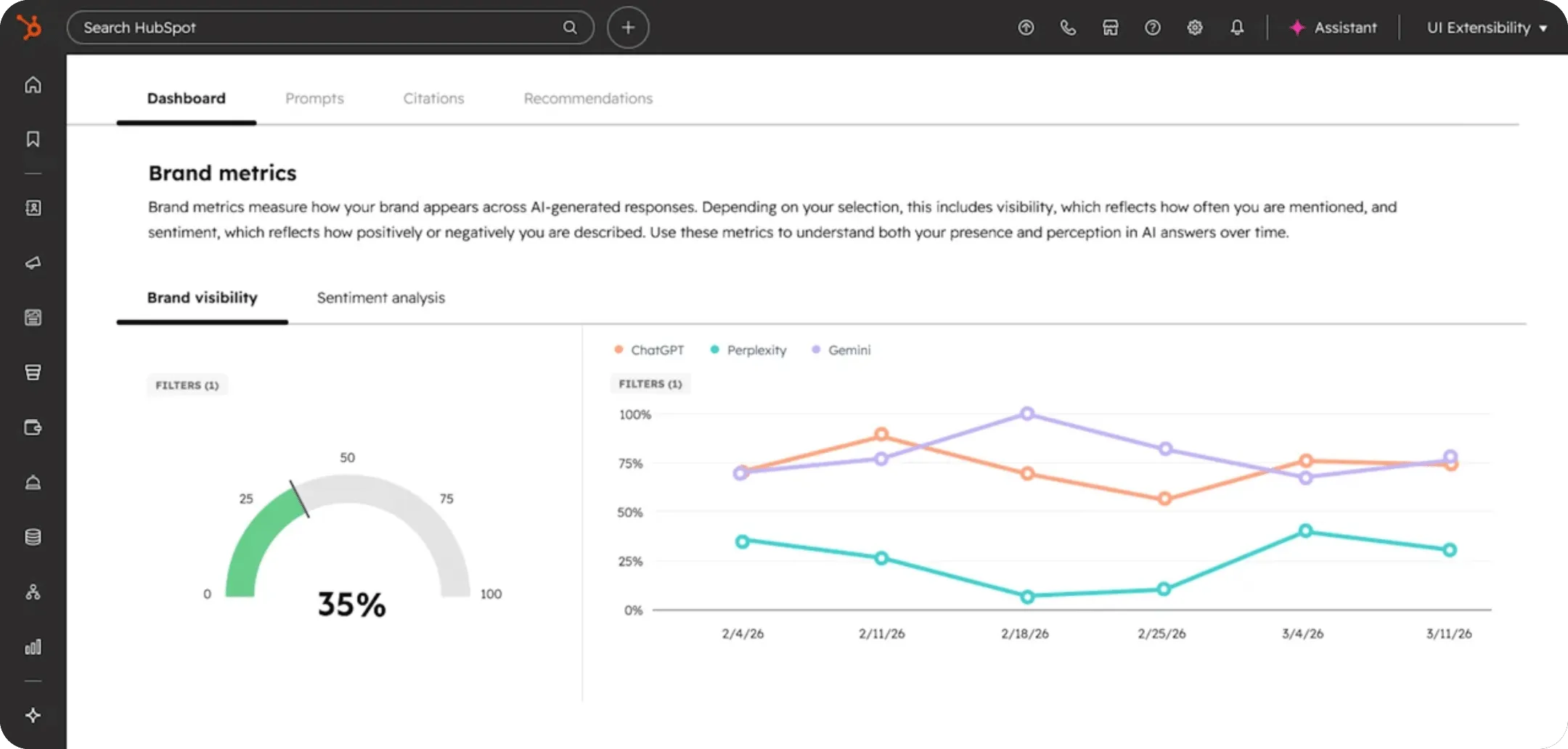
HubSpot AEO tracks visibility across three engines and turns gaps into prioritized recommendations, with no HubSpot subscription required. It reports a visibility score, mentions, competitor mentions, sentiment, share of voice, and citations by domain, page, and content type. HubSpot’s free AI Search Grader runs a one-time snapshot if you want a quick read first.
Recommendations cover new pages, technical fixes, video topics, social posts, and outreach. Marketing Hub customers also get CRM-based prompt suggestions and blog post generation, and a HubSpot connector brings AEO data into Claude and ChatGPT. AI traffic attribution isn’t stated. A 28-day free trial is available.
The product is still labeled beta, with three engines and a 25-prompt base plan.
- Engine coverage: ChatGPT, Gemini, and Perplexity.
- Pricing: $50/month for 25 prompts ($45/month billed annually). Each additional brand is $50/month.
- Data collection: Tracked prompts run daily.
- Plan limits: 25 prompts per day and 2,500 answers per month on the standalone plan, and 50 prompts on Marketing Hub Enterprise. One owned domain per setup.
- Security: HubSpot-wide SOC 2 Type II and SAML SSO.
8. AthenaHQ
Best for: Commercial and enterprise marketing teams, plus ecommerce brands tracking product-level recommendations.
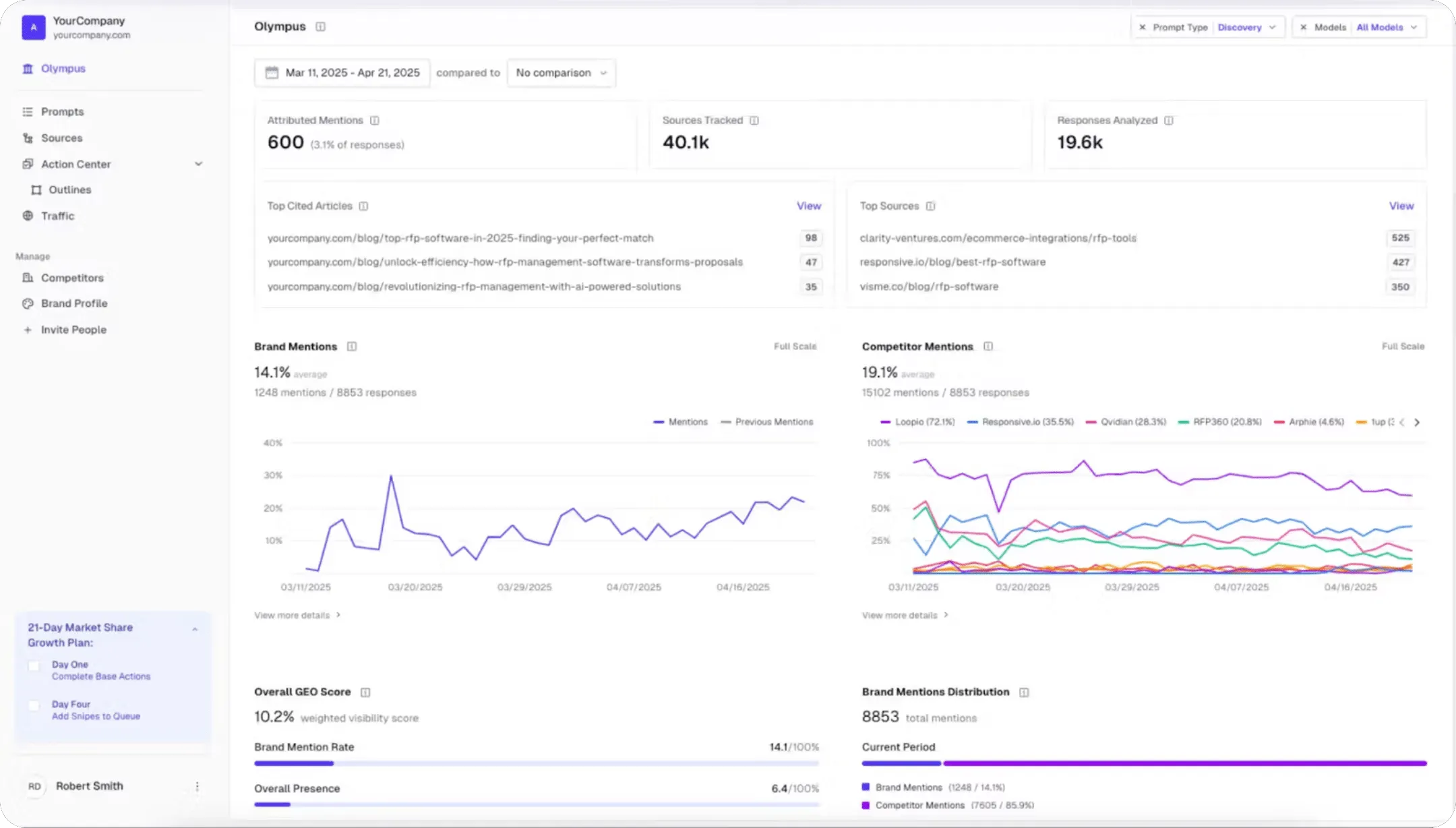
AthenaHQ is an AEO platform built around AI agents that turn visibility data into content and on-page actions, with a free tier to start. It tracks mentions, citations, sentiment, competitor visibility, mention rate, citation rate, and citation gaps. The ecommerce product adds category share of voice and product recommendations.
Workflow features include content recommendations, a content optimization agent, robots.txt and llms.txt management, and an MCP server. The Athena Citation Engine and persona targeting are Enterprise-only. Integrations cover GA4, Google Search Console, Google Ads, Shopify, and major CMS platforms, with API access as a paid add-on on Starter. Enterprise support includes a dedicated Slack channel.
Credit-based usage takes planning (some engines cost more credits per response), and multi-region tracking requires Enterprise.
- Engine coverage: 5 engines on the free tier. Starter covers 11: ChatGPT, Perplexity, AI Overviews, AI Mode, Gemini, Claude, Copilot, Grok, DeepSeek, Meta AI, and Mistral.
- Pricing: Free Essentials tier. Starter is $295/month ($245/month billed yearly). Enterprise is custom. See AthenaHQ plans.
- Data collection: Credit-based, where one credit equals one AI response. You choose which days tracking runs.
- Plan limits: Starter includes 3,600 credits per month, unlimited seats, and 1 language and region.
- Security: SOC 2 Type I and Type II. SSO on Enterprise.
9. Scrunch
Best for: Enterprise and multi-brand, multi-region teams.
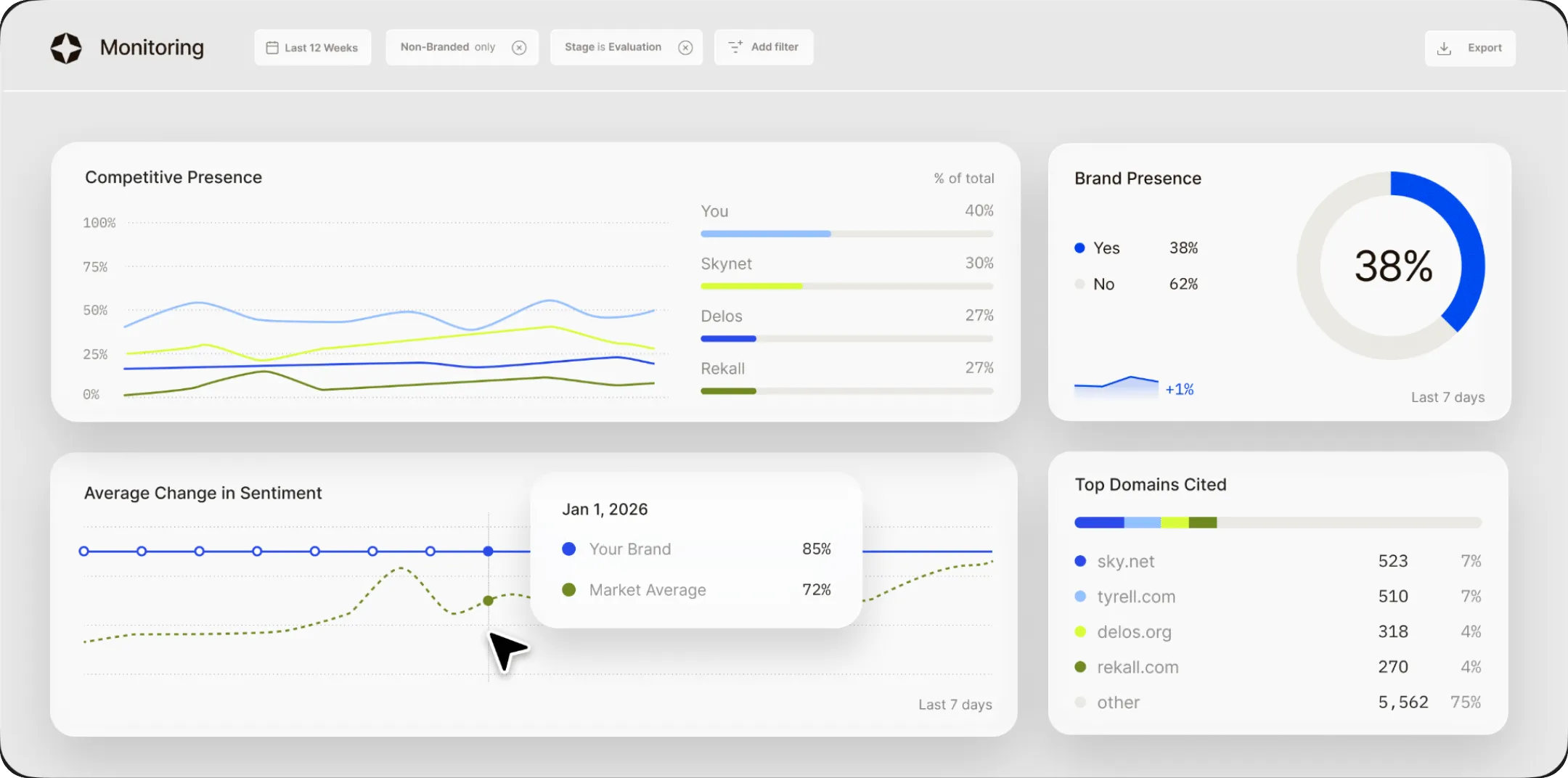
Scrunch monitors AI visibility and builds a machine-readable version of your site for AI agents. It tracks mentions, placement within the answer, share of answer, position, sentiment, citations, and AI agent traffic, filterable by topic, persona, model, and region.
Optimization features include page audits, content diagnostics, and Agent Pages for serving AI agents a dedicated site experience. Integrations include GA4 for AI referrals, CDN log connections, a Looker Studio template, APIs, and MCP. Email support and onboarding come with all plans.
The 72-hour default refresh means fewer data points per prompt than daily-run tools, and Starter caps seats at 3.
- Engine coverage: ChatGPT, Claude, Gemini, Perplexity, Google AI Mode, AI Overviews, and Meta on every plan.
- Pricing: Starter is 300/month(250/month billed annually) with a 7-day free trial. See Scrunch pricing.
- Data collection: A mix of browser automation and official APIs, chosen per platform. New prompts run daily for 14 days, then every 72 hours by default.
- Plan limits: Starter includes 350 custom prompts, 3 seats, and 3 personas.
- Security: SOC 2 Type II and role-based access. SAML SSO on Enterprise.
10. AirOps
Best for: Content teams that need to move from visibility data to published content at volume.
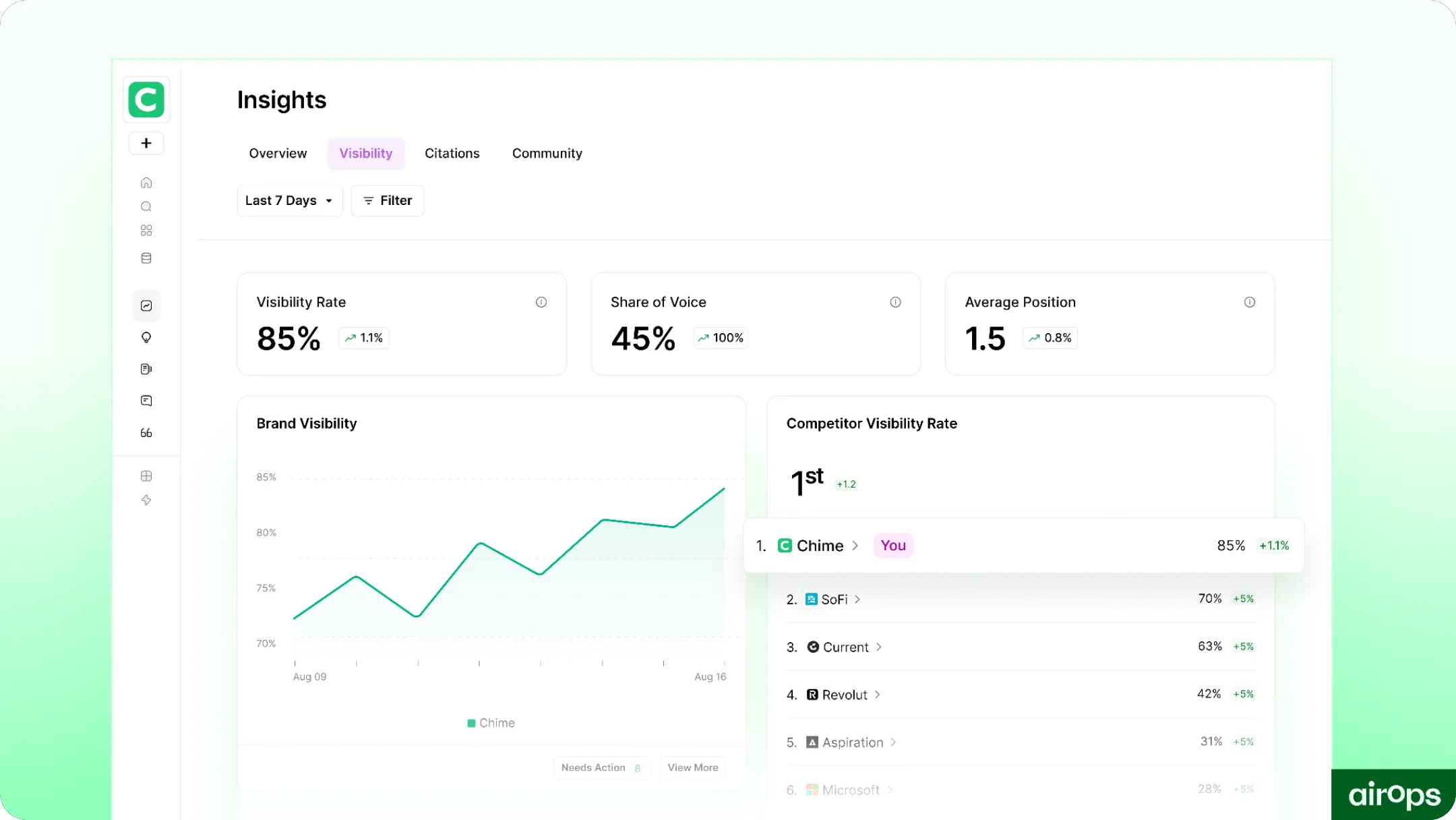
AirOps is a content and workflow platform with built-in AI visibility tracking through its Insights module and an AI agent, Quill, that turns gaps into content campaigns. Insights tracks visibility, citations, sentiment, position, share of voice, crawler activity, and LLM referrals, segmented by model, audience, region, topic, and buying stage.
Its strength is production: Content Scores (readability, claim support, information gain, SEO, and AEO), agents and playbooks, human review steps, and direct CMS publishing to Webflow, WordPress, Contentful, Sanity, and Shopify. It connects to GA4 and Google Search Console, offers an Insights API and MCP on paid plans, and handles revenue attribution through media mix modeling. Support ranges from live chat on Solo to cohort training on Pro and a dedicated account manager on Enterprise.
Because it’s a content production platform first, teams that only need measurement will pay for workflow features they may not use.
- Engine coverage: ChatGPT only on Solo. Pro covers 7+ answer engines.
- Pricing: Free to start. The pricing page doesn’t list paid prices, so contact AirOps for a quote.
- Data collection: One answer per prompt per platform each day by default. Enterprise adds Multi-Answer Collection for several answers per day.
- Plan limits: Solo is a single-user plan with ChatGPT tracking only.
- Security: SOC 2 Type II (security) and Okta SSO.
11. Rankability
Best for: SEO agencies managing many clients (all plans include unlimited client workspaces and seats).
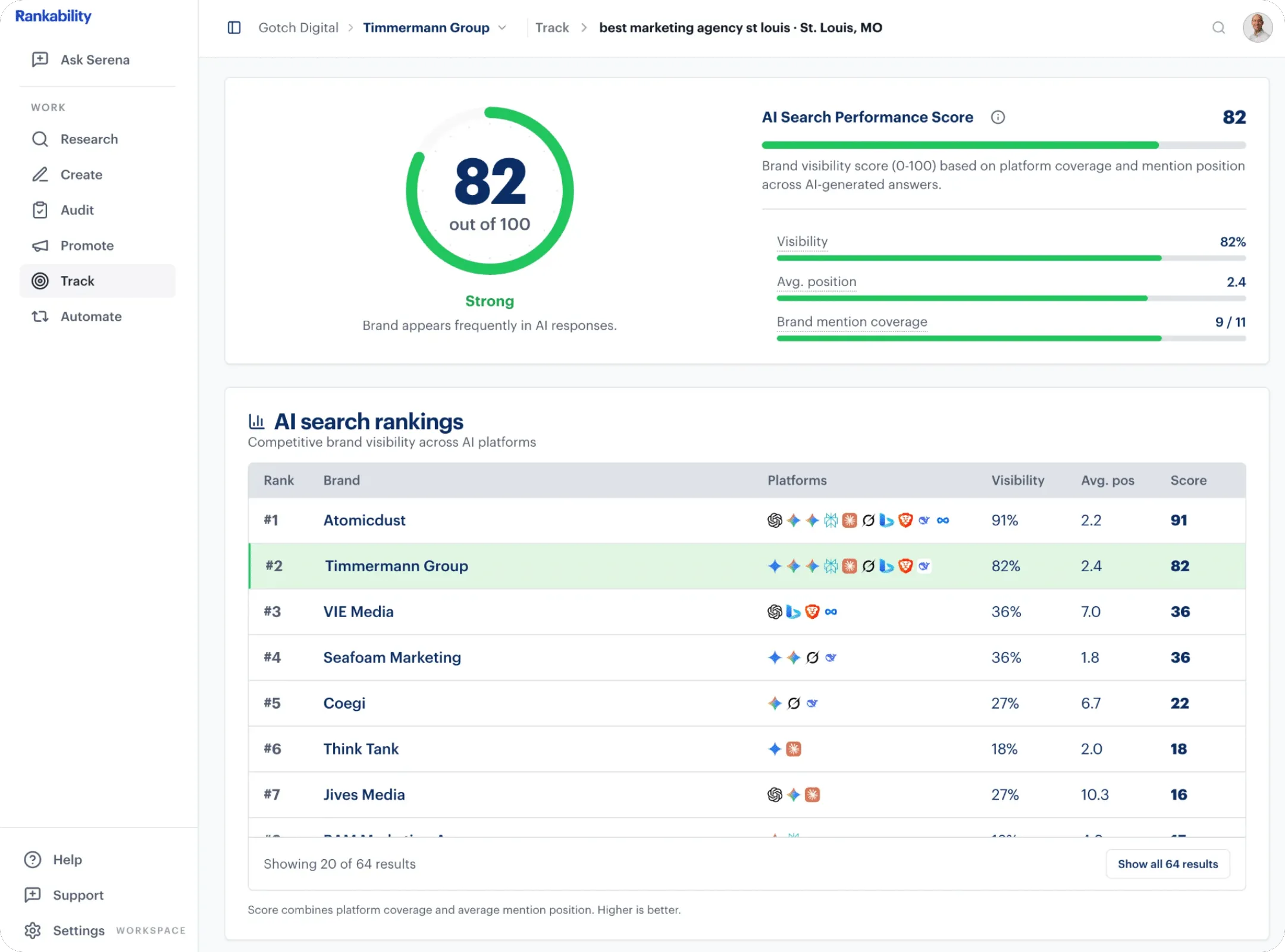
Rankability started as a content optimization tool and now bundles an AI visibility tracker into an agency SEO suite. The Tracker covers mentions, citations, citation sentiment, and competitor comparisons, with AI query fan-out added in 2026.
Around the tracker sit an AI content writer and content optimizer, page and technical audits, and brand voice settings. API and MCP access are included, along with branded reports that pull in Search Console and Analytics data and read-only client portals. Support is standard, with self-serve setup on Starter.
It’s built around agency reporting more than in-house AEO programs, and some platforms depend on plan and add-ons.
- Engine coverage: 11 engines: ChatGPT, Google AI Mode, AI Overviews, Claude, Perplexity, Gemini, Grok, Copilot, Brave AI, DeepSeek, and Meta AI.
- Pricing: Starter is $97/month. See Rankability pricing.
- Data collection: Daily monitoring.
- Plan limits: Starter includes 100 tracked AI queries and 20 content projects per month.
- Security: Rankability states it is not yet SOC 2 Type II certified.
12. BrightEdge
Best for: Large enterprises with existing BrightEdge contracts.
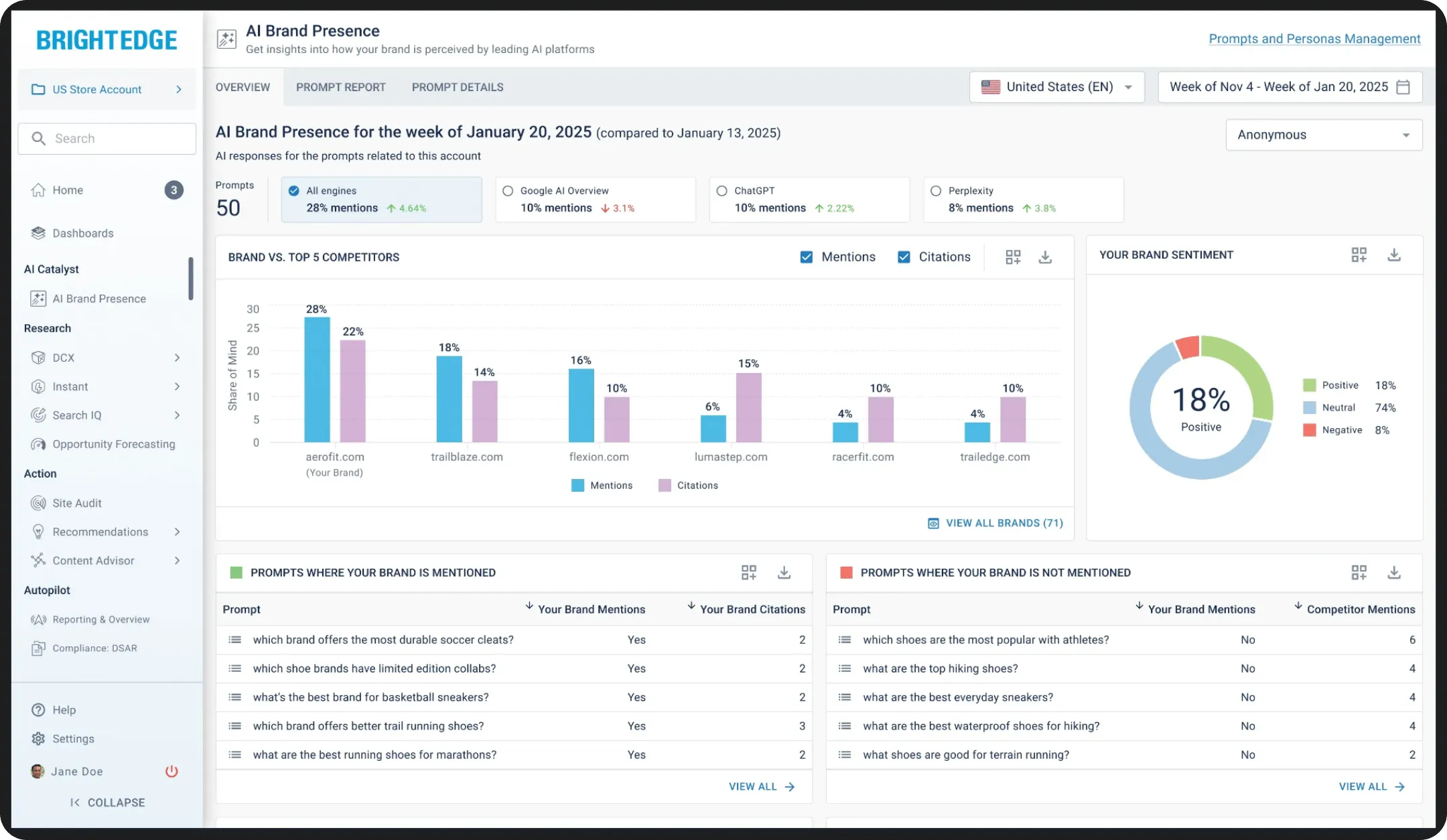
BrightEdge’s AI Catalyst adds AI search intelligence to its enterprise SEO platform. It tracks mention and citation presence by engine, sentiment with reasoning, and prompts mapped to each buying stage, with alerts when a competitor takes over an answer. Agent Edge adds AI agent visits and AI referral traffic.
AI Catalyst compares your pages against the page currently holding a citation and produces a brief your team can act on, while Agent Edge serves AI agents a lighter, machine-readable version of each page at the CDN level. Integrations include GA4, Google Search Console, Adobe Analytics, Looker Studio, and the BrightEdge Connect API (integrations), plus a read-only MCP and Slack app.
BrightEdge doesn’t publish its methodology, limits, or refresh cadence, which makes side-by-side evaluation harder before a sales conversation.
- Engine coverage: ChatGPT, Perplexity, Google AI Overviews, Google AI Mode, Gemini, and other AI platforms.
- Pricing: Not published. Request a demo for custom pricing.
- Data collection: Not published.
- Plan limits: Not published.
- Security: SOC 2, ISO 42001, and SAML SSO per its trust page.
13. Profound
Best for: Enterprise marketing, content, and PR teams with a sales-led buying process.
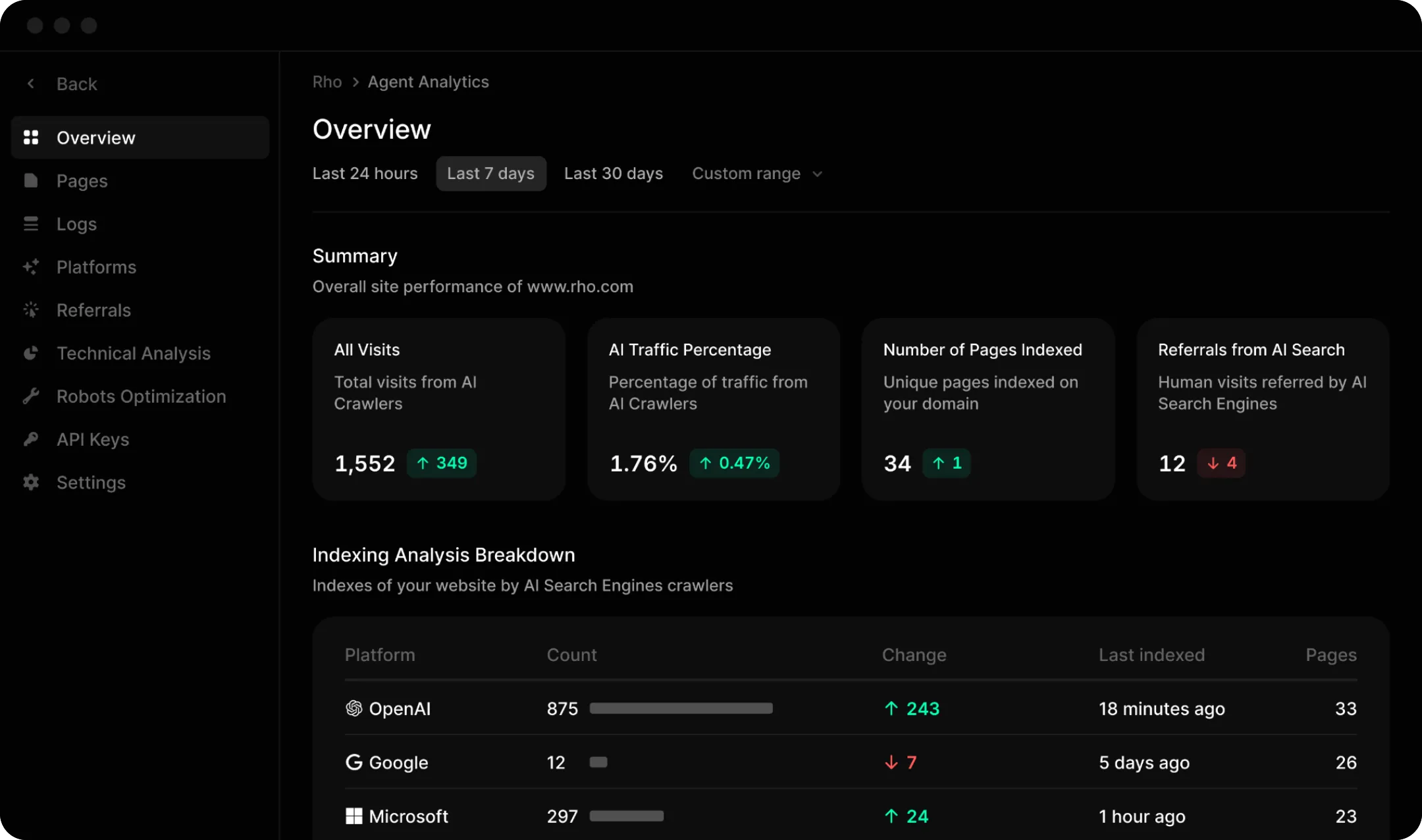
Profound pairs AI search monitoring with an “AI Marketer” and agents that draft content and campaigns for your approval. It tracks visibility score, share of voice, citations, sentiment, competitor rankings, prompt volumes, and AI bot visits, plus ChatGPT Shopping and a fact-check feature on Enterprise.
Workflow features include agents for content and campaigns, an opportunities feed, and a command center. Agent Analytics connects to CDN and hosting sources, while MCP, API, and exports are Enterprise-only.
No self-serve brand plan is listed, and the trial has no exports, API, or history, so most evaluation happens through sales. For a side-by-side breakdown, see our Goodie vs. Profound comparison.
- Engine coverage: Up to 9 engines on Enterprise. The free trial covers ChatGPT, Gemini, and Google AI Overviews.
- Pricing: The pricing page lists a free 7-day trial and custom Enterprise pricing.
- Data collection: Daily, through each engine’s front-end interface.
- Plan limits: The trial includes 50 preset prompts for 7 days in 1 region and language.
- Security: SOC 2 Type II. SSO on Enterprise.
Start Tracking Your ChatGPT Visibility This Week
Pick the tool that fits your team against the four criteria above, then build a prompt set around the questions your buyers ask before they buy. The sooner you have a baseline, the sooner you can prove what’s working.
See How Your Brand Shows Up in ChatGPT
Goodie tracks your visibility across 12 AI models, shows you exactly which gaps to close, and connects AI traffic to revenue.
ChatGPT Optimization Tools: FAQs
Yes, for a snapshot. HubSpot’s AI Search Grader and Ahrefs’ AI Visibility Checker are free, and AthenaHQ offers a free tier. You can also filter Google Analytics for utm_source=chatgpt.com to see referral traffic. Free options run a limited number of prompts once or occasionally, though, and because ChatGPT’s answers vary between runs, a single check isn’t enough to measure trends or prove progress.
ChatGPT generates each answer probabilistically, so the same prompt can return different brands in a different order. Results also shift with model updates, whether ChatGPT runs a web search, the user’s location, and memory or personalization. SparkToro’s research found less than a 1 in 100 chance of seeing the same brand list twice. That’s why reliable tools run each prompt repeatedly and report rates instead of single rankings. Our guide to probabilistic vs. deterministic AEO metrics explains which numbers to trust.
Almost all of them do. Every tool on this list covers ChatGPT plus at least Gemini or Perplexity, and most add Google AI Overviews and AI Mode. The gap shows up on entry plans: some cover only 3 to 5 engines, and others charge extra for Claude, Gemini, or Perplexity. If your buyers shop through retail assistants, check for coverage of tools like Amazon’s and Walmart’s AI shopping assistants as well.
Pricing mostly scales with prompt volume and engine count. Free checkers cover one-time snapshots. Entry trackers run about $29 to $99/month for 15 to 200 prompts. Full platforms with optimization and attribution typically cost $250 to $1,000/month. Enterprise plans with full engine coverage, API access, and dedicated support are custom-priced.
A rank tracker tells you where you appear in ChatGPT’s answers. A full AEO platform also tells you which prompts to target, what to change to close each gap, and how much revenue AI visibility drives. Trackers suit teams that already have an optimization process and just need measurement. Full platforms suit teams that want research, monitoring, optimization, and attribution connected in one workflow.