There’s a conversation happening about your brand right now. Millions of people are asking ChatGPT, Gemini, Perplexity, and Google AI Mode about the products and services you sell, and getting answers.
The question is whether your brand is in those answers (or if your competitors overshadow you), how often, and what LLMs are saying when it is.
That’s what AI Share of Voice measures. And if you’re not tracking it yet, you’re making decisions about AI search without the one metric that actually tells you where you stand.
What Is AI Share of Voice?
AI Share of Voice (AI SOV) is the percentage of relevant AI answers that include your brand, measured relative to all brand mentions across those same queries.
Think of it as the AI search equivalent of a keyword ranking, except instead of measuring where you sit in a list of ten blue links, it measures whether you’re in the answer at all. In a world where AI engines increasingly give users one synthesized response rather than a page of results, being in that response is the whole game.
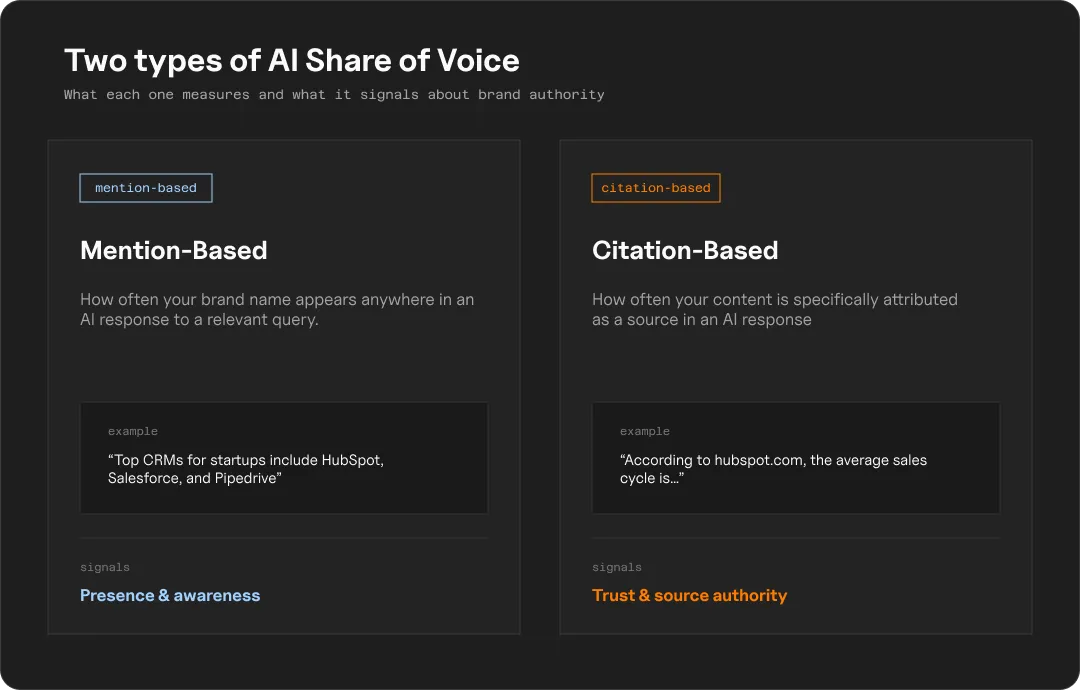
It’s worth being specific about what “in the answer” means, because AI SOV actually tracks two distinct states:
- Mention-based SOV: How often your brand name appears anywhere in an AI response to a relevant query. The AI knows you exist and associates you with the category.
- Citation-based SOV: How often your content is specifically attributed as a source (with a link or explicit credit) in an AI response. This is the stronger signal. It means AI systems trust your content enough to quote it directly.
Both matter, and they tell you different things:
- A brand with high mention SOV but low citation SOV has awareness without authority.
- A brand with rising citation SOV is building the kind of AI presence that drives traffic and conversion, not just recognition.
As of 2026, the average brand mention rate across AI platforms sits at just 17.2%, with top-performing companies reaching dramatically higher rates. If you’re sitting there reading this with no idea where your brand falls on that spectrum, that’s the problem AI SOV is designed to solve.
Does Share of Voice Matter in AI?
Yes, and it’s not just a vanity metric.
Here’s the thing about traditional share of voice: it measured presence across ad impressions, search rankings, or media coverage. You could be present without being influential. AI SOV is different because your presence in an AI answer is the influence.
Example: When Perplexity recommends your brand to someone asking “what’s the best [category] product for [use case],” that recommendation carries a weight that a fourth-place ranking on a SERP simply doesn’t.
AI visitors convert at 8x the rate compared to standard organic traffic according to Neil Patel. A user who arrives at your site after an AI platform cited you as a recommended source has already been effectively pre-qualified. The AI answered their question, mentioned your brand, and they chose to click through. That’s a fundamentally different intent signal than someone who stumbled upon and clicked a blue link.
There’s also a compounding dynamic worth understanding. Brands cited frequently in AI answers build entity authority, which translates to E-E-A-T signals that Google’s ranking algorithm rewards. Building AI SOV and building traditional domain authority are increasingly the same program. The brands building AI SOV now are compounding an advantage against competitors still waiting to see how things shake out.
Now is not the time to be a late adopter.
How to Calculate AI Share of Voice
The formula itself is simple. The execution takes some setup.
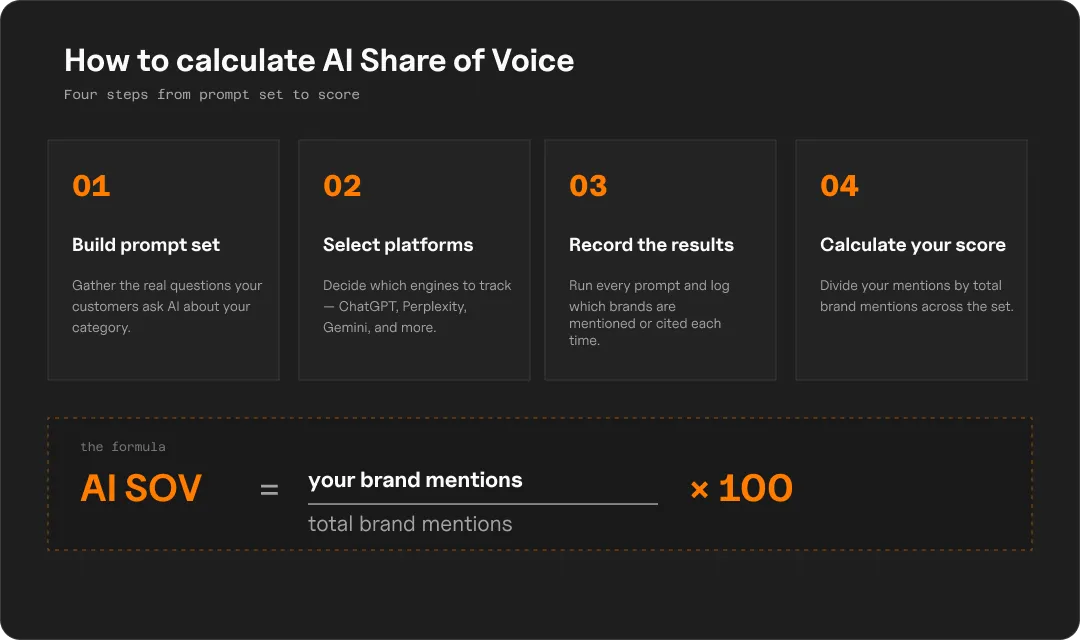
AI SOV = (Your brand citations ÷ Total category citations) × 100
In practice, that means: define a set of relevant prompts, run them across your target AI platforms, record which brands appear in each response, and calculate your share of total brand appearances.
Here’s what that looks like step by step.
Step 1: Build Your Prompt Set
Your prompt set should represent the real queries your target customers are asking AI. That means a mix of:
- Informational queries: “what is the best [product category] for [use case]”
- Comparison queries: “[your brand] vs [competitor]” or “compare [category] options”
- Recommendation queries: “recommend a [product/service] for [specific need]”
- Problem-first queries: “I need help with [problem], what should I use”
Aim for 20-50 prompts that represent your most important category territory. These should mirror real buyer language, not your internal keyword strategy.
Pro Tip: Goodie’s Prompt Research feature identifies the actual prompts your target customers are using across AI platforms, which tends to look very different from what teams assume internally.
Step 2: Choose Your Platforms
Run your prompt set across every AI engine that matters for your audience. At minimum: ChatGPT, Gemini, Perplexity, and Google AI Overviews. Depending on your category and audience, you may also want Copilot, Claude, Grok, Meta AI, and DeepSeek.
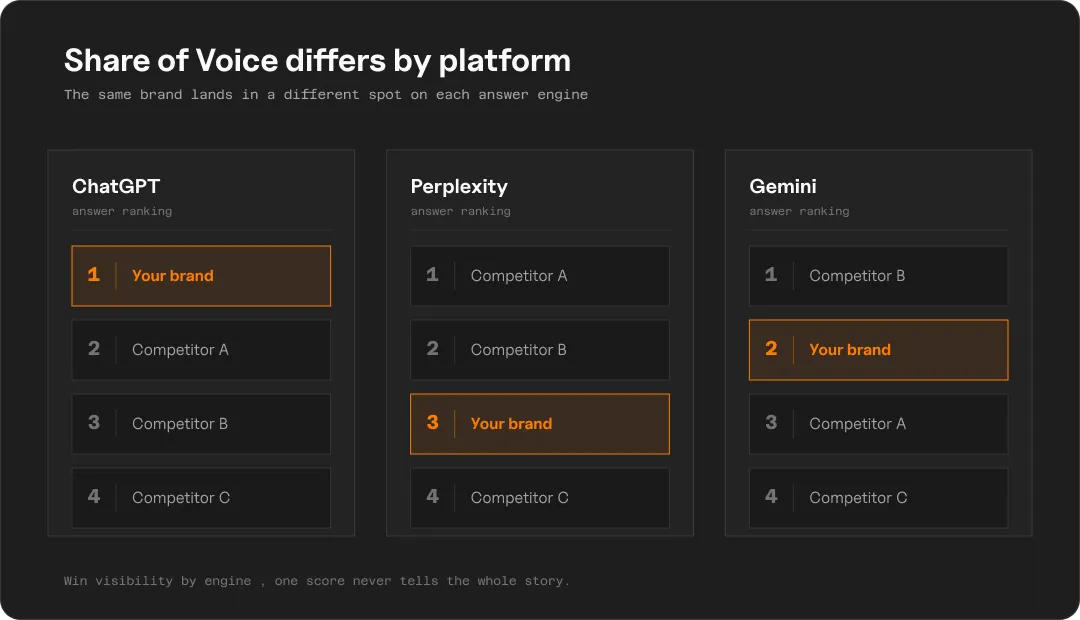
Track each platform separately. Our AEO ranking factors research has found that citation and brand mention behaviors vary widely by LLM. That means that a brand dominating on Perplexity may be nearly invisible on ChatGPT. Aggregating across platforms without breaking them out first gives you a number that’s too smooth to be useful.
Step 3: Record the Results
For each prompt on each platform, note:
- Which brands were mentioned (mention SOV)
- Which brands were cited as sources (citation SOV)
- Where in the response your brand appeared (beginning, middle, end)
- The sentiment and accuracy of any brand descriptions
Step 4: Calculate Your Score
Count your total brand appearances across all prompts and all platforms. Divide by the total brand appearances across all competitors in those same responses. Multiply by 100. That’s your AI SOV for that prompt set and time period.
Run this consistently (weekly or bi-weekly) and track the trend over 8-12 weeks rather than fixating on any single snapshot. AI retrieval patterns shift constantly as models update, so the trend line matters more than the point-in-time number.
How to Do an AI Share of Voice Competitor Analysis
Knowing your own AI SOV is useful. Knowing it relative to competitors is where it becomes actionable.
Define Your Competitive Set
Start with 2-4 direct competitors; the brands a buyer would realistically consider alongside yours. Don’t try to track the entire category at once; you’ll end up with a diluted number that’s hard to act on.
For enterprise brands with broader category footprints, Goodie’s Visibility Monitoring automates competitive SOV tracking across multiple engines simultaneously without the manual overhead.
Run the Same Prompts for All Competitors
The prompt set you built for your own SOV analysis is your competitive benchmark set. Run the same prompts, on the same platforms, in the same time window. Record where each competitor appears and in what context.
Pay attention to:
- Which competitors appear in responses where you don’t (prompt gaps)
- Which competitors are cited as sources while you’re only mentioned (authority gaps)
- Which competitors are described more favorably or in more detail (narrative gaps)
Each of these gap types points to a different optimization lever.
Identify the Pattern
Once you have a few weeks of data, look for patterns rather than individual data points. Questions worth asking:
- Are there specific prompt types where a competitor consistently outperforms you? (Likely a content or authority signal issue for that topic cluster)
- Are there platforms where your competitor dominates but you’re absent? (Platform-specific optimization opportunity)
- Are there prompts where nobody in your category is well-cited? (Open territory worth targeting)
Goodie’s research on the most cited domains in AI search found significant variation in citation patterns by industry, meaning that what earns citations in financial services looks very different from what earns citations in eCommerce. Understanding the citation behavior specific to your category shapes what you optimize for.
What Affects Your AI Share of Voice?
Understanding the formula is easy. Understanding what moves the number is where most teams get stuck.
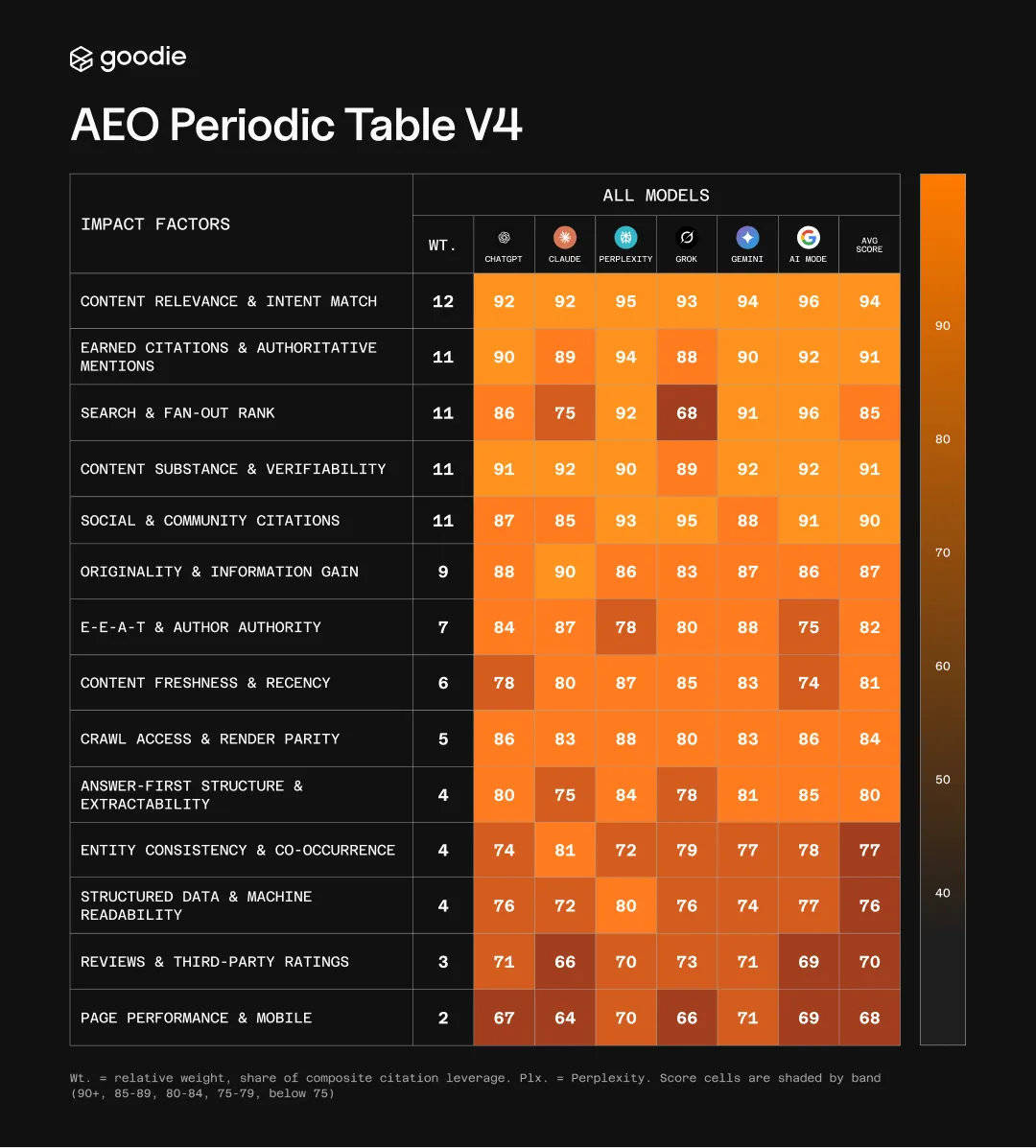
Our most recent AEO Periodic Table, built from analysis of 1.13 million prompts across ChatGPT, Claude, Perplexity, Grok, Gemini, and Google AI Mode, identified 14 elements that determine AI visibility. The ones that most directly influence SOV:
- Content structure and extractability: AI systems favor content with direct answers to specific questions, clear Q&A formatting, and self-contained passages that make sense when extracted from context. Dense narrative content gets cited less than structurally clear content that makes the AI’s job easy.
- Entity authority: How consistently and accurately your brand is represented across the web (your own site, but also review platforms, Wikipedia, LinkedIn, and community mentions). The AI model’s internal association of your brand with a relevant topic cluster is built from training data and live retrieval signals, and it’s hard to fake.
- Citation sources: The specific domains AI systems cite vary significantly by platform and category. Goodie’s research found that across ChatGPT, Perplexity, and Google AI Mode, Reddit and LinkedIn are among the most-cited domains globally.
- Freshness and publishing cadence: Especially relevant for Perplexity, which uses real-time web search and weights recency heavily. Brands with consistent publishing cadences (original research, updated content, regular thought leadership) tend to maintain higher SOV over time than brands that optimize once and wait.
- Off-site PR and third-party mentions: AI systems don’t just pull from your own website. High-authority coverage, credible third-party reviews, and consistent press presence all factor into how AI engines construct answers about your brand. This is the SEO-era concept of backlinks, reimagined for the world of AI search.
How to Improve Your AI Share of Voice
Knowing your SOV is only useful if you know what to do with it. Here’s where to start.
- Fix what’s blocking you first. Before optimizing for more citations, make sure AI systems can actually crawl your content. Check your robots.txt for inadvertently blocked AI crawlers (GPTBot, ClaudeBot, OAI-SearchBot, PerplexityBot). Set up LLMs.txt to guide AI agents toward your most important content.
- Pro Tip: You might also want to resolve structured data errors. Goodie’s Agent Experience Suite gives you visibility into how AI crawlers interact with your site (which pages they access, what they parse, and where crawl issues are limiting citation potential).
- Restructure existing content before creating new content. If you have high-traffic pages that AI systems are indexing but not citing, restructuring them for extractability tends to produce faster SOV improvements than publishing new content from scratch. Add direct Q&A formatting, FAQPage schema, and clear answer blocks to your most important category pages.
- Close your prompt gaps. Wherever a competitor consistently appears in responses where you don’t, that’s a content gap to close. Use Goodie’s Optimization Actions to surface these gaps and get specific, prioritized recommendations for closing them.
- Build off-site authority on the right platforms. Not all coverage is equal for AI SOV. Prioritize the publications, platforms, and communities that AI systems in your category actually cite. Our social citations study breaks down exactly which social platforms drive the most AI citations by category if you want to prioritize your off-site investment.
- Track sentiment alongside SOV. Appearing in AI answers is only good if AI is describing your brand accurately. Monitor entity sentiment accuracy alongside share of voice.
How to Track AI Share of Voice Over Time
SOV is a trend metric, not a snapshot. A single measurement tells you where you stand today. A consistent tracking program tells you whether your strategy is actually working.
A few rules that make tracking reliable:
- Use the Same Prompt Set Every Time: Changing prompts between periods makes it impossible to tell whether your SOV changed or your methodology did.
- Run Each Prompt Multiple Times per Session: AI responses vary even for identical inputs, and averaging across runs produces more stable numbers.
- Track Weekly, Not Monthly: Monthly measurement misses shifts that require a response.
- Don’t Panic About Single-Week Drops: What matters is the 8-12 week trend. Rising trend means the work is working. A flat trend means something needs to change.
Goodie’s Visibility Monitoring automates all of this across every major AI platform: daily updates, competitor benchmarking, and trend visualization without running prompts by hand.
AI Share of Voice: FAQs
It depends heavily on your category.
- In fragmented markets with many competitors, 15-20% SOV may represent category leadership.
- In categories with two or three dominant players, you’d expect leading brands to be at 40-50%+.
The more useful benchmark is your own trend over time and your position relative to direct competitors, not an abstract “good” number. That said, the average brand mention rate across AI platforms is just 17.2% according to AthenaHQ’s State of AI Search 2026 report, so if you’re above that, you’re ahead of the average brand in your category.
- Traditional SOV measured presence across ad impressions, organic rankings, or media coverage.
- AI SOV measures presence inside synthesized answers, which is increasingly where buying decisions begin.
The mechanics are different, too:
- Traditional SOV is heavily influenced by budget and backlink volume.
- AI SOV is more directly influenced by content quality, entity authority, and structural clarity.
A well-structured piece of content from a newer brand can out-cite a legacy competitor with massive domain authority if it’s more extractable and trustworthy to AI systems.
Yes… and this happens to be the zero-click reality of AI search. A brand can appear in a large percentage of relevant AI answers without generating significant referral traffic, because AI systems often satisfy user intent without requiring a click.
This is why tracking AI SOV separately from traffic metrics matters. SOV tells you about influence at the point of discovery; traffic tells you about the subset of those interactions where a user chose to visit your site. Both are worth tracking. See our guide on how to measure AI content performance for the full measurement framework.
- Weekly is the right cadence for the prompt-level data.
- Monthly for competitive benchmarking and trend analysis.
- Quarterly for connecting SOV trends to revenue outcomes.
More frequent than weekly is noise; less frequent than monthly means you’re missing shifts that require a strategic response.
- Fix crawl barriers first (unblock AI crawlers, set up LLMs.txt, resolve schema errors).
- Restructure your most important existing content for AI extractability (direct answers, FAQ schema, self-contained passages).
New content has a slower impact because AI systems need time to index and trust it. Off-site authority building (PR, research, third-party citations) takes the longest but produces the most durable SOV improvements. For a full breakdown of timelines by tactic, see our article on how long AEO takes to show results.