For years, the refresh vs. rewrite question had a clean answer: check Google Search Console (GSC). If a page was ranking but traffic was dropping, you refreshed it. If nobody had written about the topic yet, or you were targeting a new topic cluster, you wrote something new. This logic was intuitive and never required a tool stack beyond Ahrefs, Screaming Frog, and GSC. That’s changing, almost entirely because of AI search.
The old signals still matter. What’s changed is that a page can maintain its traditional ranking, keep its backlinks, and nail its keywords, and still quietly disappear from ChatGPT and AI Overviews, a surface that now carries outsized weight. How and when you choose to write new content vs. refresh content plays a huge role in this.
This article outlines the decision framework your team should use to reach an optimal split, followed by how to make that framework measurable and scalable.
How Do You Decide Whether to Refresh a Page or Create Something New?
TL;DR: Refresh when the asset already has something worth preserving. Create new when it doesn’t.
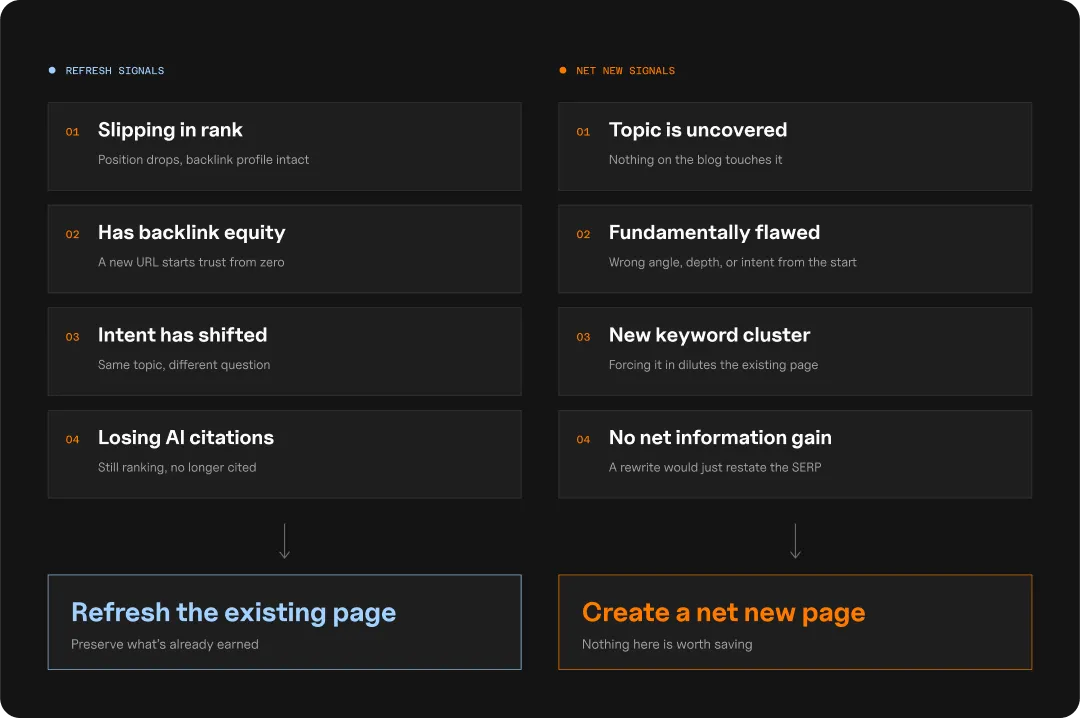
When to Refresh Existing Content
Refresh when a page shows any of these signals:
- It ranks, but it’s losing traffic. Slipping position with an intact backlink profile means the foundation is fine and the execution has gone stale.
- It has backlink equity worth protecting. A new URL starts every trust signal from zero. An existing one has already earned authority.
- Search intent has shifted under it. The topic hasn’t changed, but how people ask about it has. Update the framing instead of creating a whole new page.
- It’s losing AI citations while still ranking normally. This doesn’t show up in a traditional audit and requires AI visibility monitoring tools like Goodie’s Visibility Monitoring. More on why this matters below.
When to Create Net New Content
Create new content when:
- The topic is genuinely uncovered on your blog. Nothing you’ve published touches it, so there’s no existing asset to build on.
- The existing piece is fundamentally flawed. Wrong angle, wrong depth, wrong intent from the start. Inaccurate pieces can actively hurt your domain authority.
- You need a different keyword cluster entirely. Forcing new subtopics into an existing page dilutes it instead of expanding it.
- There’s genuine net new information gain. New research studies, op-eds, white papers, and POV pieces all warrant a page of their own rather than getting folded into something existing.
Not sure whether a page is “fundamentally flawed” or a candidate for net information gain? Ask yourself this: would a rewrite just restate what’s already ranking and what others have already covered in depth? If so, refreshing the structure alone won’t fix it. With any piece, you’re either the source or you’re replacing the source, and that comes from producing unique, valuable information people will come back to.
Does Refreshing Content Help With AI Citations, or Just Traditional Rankings?
Both, through different mechanisms.
Traditional ranking rewards accumulated authority. A page that earned trust six months ago keeps that trust even if nothing on it has changed. AI answer engines operate differently. They assemble an answer in real time, and they weigh active maintenance heavily when deciding what to pull from. For model-by-model comparisons, see the AEO Periodic Table V4.
Ahrefs analyzed roughly 17 million AI citations across ChatGPT, Perplexity, Gemini, Copilot, and Google AI Overviews and found that AI assistants prefer citing content that’s meaningfully fresher than what shows up in Google’s own top-10 organic results, with the gap landing at roughly 25.7% fresher on average. Roughly half of all AI citations point to content published or meaningfully updated within the past 13 weeks. That’s half of everything AI cites coming from one recent quarter, competing against the rest of the indexed web.
Imagine a page holds position #6 in Google for a year straight. Every traditional signal points to steady performance. Meanwhile, its AI citation share has been dropping every quarter because nothing about it has changed since it was published. The page isn’t failing. It’s aging out of a highly relevant, highly invisible surface: AI.
Tools exist to measure and counteract this. Structuring content correctly helps AI models extract an answer once they’ve decided to look at your page. Freshness is what gets you looked at in the first place. Traditional domain authority is what helps the models trust and cite you over time.
How Often Should You Refresh Content for AI Search?
Quarterly Micro-Refreshes
Quarterly micro-refreshes cover updating statistics, verifying sources, fixing broken links, and checking that named facts (pricing, features, dates) still match reality. They can also mean reorganizing a page for semantic chunking, clear Q&A headers, and other structural components that help AI models read your content better. Light lift, but frequent enough to keep freshness signals alive between bigger updates. Aim for every 12–13 weeks.
Annual Deep Refreshes
Annual deep refreshes are full rewrites of weak sections, competitive re-analysis against whatever’s currently ranking or getting cited, and a structural pass to make sure the piece still earns its place against the current SERP and AI Overview landscape. Deep refreshes are more strategic and require an additional data layer to see the gaps in your overall knowledge graph against trending topics.
Frequent micro-refreshes keep resetting the AI clock, while annual refreshes make sure your brand evolves as one cohesive unit, updating for accuracy and your unique POV across key topic clusters as your industry shifts.
What Percentage of Content Effort Should Go to Refreshes vs. New Content?
We recommend a 70/30 split: 70% of content resources toward refreshing established pages, 30% toward new semantic territory. Spending more time on refreshes surprises most teams, but those fixes are often the quickest, most under-exploited opportunities to improve your visibility, relevance, and authority.
The ratio isn’t the hard part. What’s harder is knowing which pages in your library deserve that 70%, and what topics deserve the other 30%. That’s where running on instinct starts costing you real growth.
How Goodie’s Optimization Actions Tool Removes the Guesswork
Everything above is a framework a team can apply by hand: pull rankings, check backlinks, guess at intent shift, and decide. It works, but it doesn’t scale. Tracking intent shift is an area marketers have historically struggled with. AI visibility data and prompt research is making that shift measurable.
Optimization Actions runs the same decision logic, except every input is a measured number instead of a judgment call.
How Goodie Scores the Refresh vs. New Content Breakdown
Three signals feed into one projection:
- Prompt volume: how many real queries across AI platforms actually touch this topic. This sets the ceiling on how much opportunity is on the table.
- Mention frequency: your current baseline citation rate for those prompts. This is where you’re starting from.
- Competitive gap size: how often a competitor gets cited for those same prompts instead of you. This is the specific, closeable distance between where you are and where you could be.
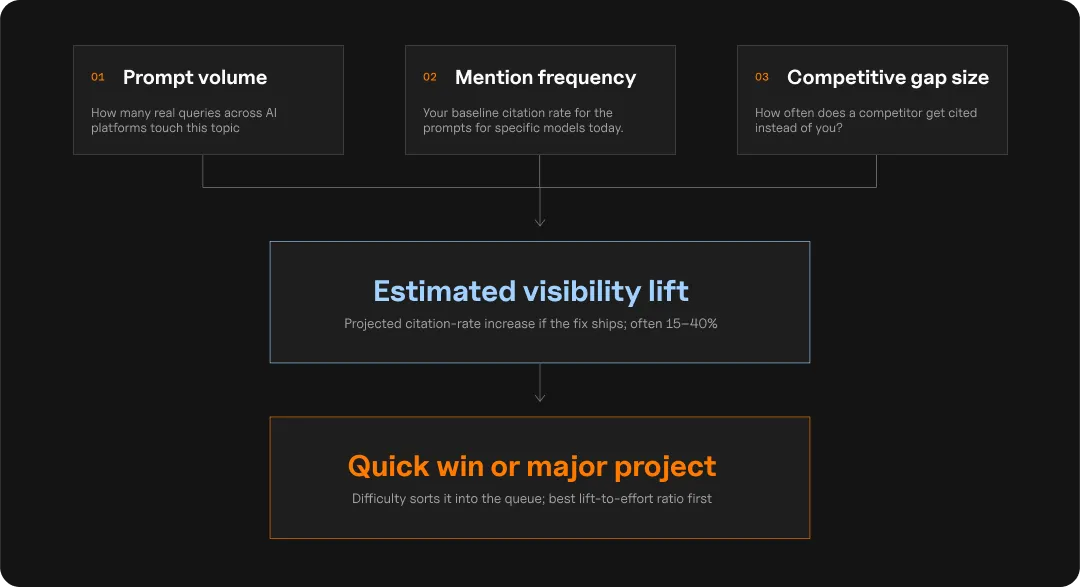
Those three converge into the estimated visibility lift: a projected increase in citation rate if the recommended change gets made. Goodie surfaces optimization recommendations that move citation rates (ex: by 15–40%), giving teams clear insight into which pages need attention and what changes are worth investing in.
Difficulty level then classifies the resulting recommendation as a quick win or a major project. A low-lift, low-effort fix is often overlooked but outperforms a high-lift, high-effort rebuild.
Ask which option has the better lift-to-effort ratio, measured the same way across every page in the library at once.
Turning the Decision Into an Action
Once a page is flagged, the recommendation comes with a specific fix beyond the score:
- Owned content: missing topic coverage, thin schema markup (Article, FAQPage, Organization, Product), unclear entity definitions, missing citation sources.
- Earned media: named publications and journalists to target based on where competitors are already winning topic authority.
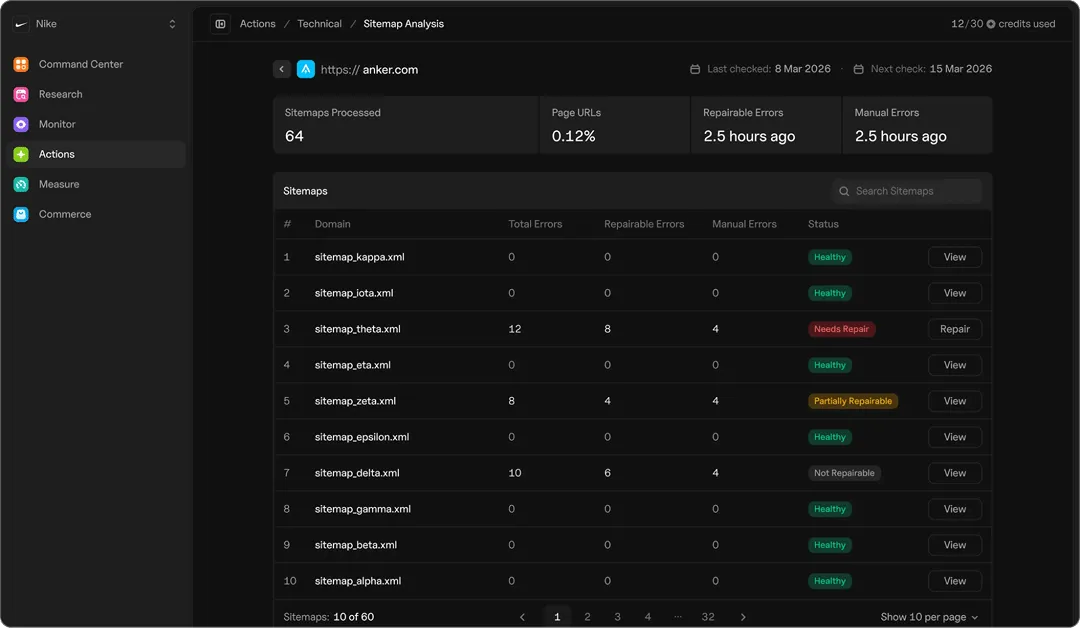
- Technical: crawl errors, page speed, structured data gaps, robots.txt issues.
- Social: entity verification and credential signals on the profiles AI models cross-reference against your site.
If the earned-media or PR side of AEO is new territory, how social, SEO, and PR fit together in an AEO strategy is worth a close read.
Prioritizing Quick Wins vs. Major Projects
Recommendations are filtered by action type, difficulty, projected impact, and affected prompt cluster, so content, SEO, and PR teams can each pull their own weight from a single prioritized list. Quick wins clear the backlog fast, while major projects get scheduled out with a clear payoff to justify the time and investment.
Stop Guessing on Refresh vs. New, Let the Data Decide
The fork in the road hasn’t gone away. Every content team still has to choose between fixing what exists and building something new. What’s changed is that the fork now has a new dimension that Search Console can’t show you, and guessing your way through it means leaving citations on the table without ever knowing if a mention or citation happened.
The framework above gets you most of the way. Optimization Actions gets you the rest by turning every refresh vs. new decision across your entire library into a ranked list of content recommendations for content, SEO, PR, and social teams.
Get a demo and find out which of your pages are closer to a citation than you think. Or you can try Goodie’s Explorer plan with a 7-day free trial.
To learn where this fits into a broader AI-discovery content strategy, see Content Marketing Strategy for AI Discovery.
Content Refresh vs. Net New In AEO: Frequently Asked Questions
Refresh if the page already has authority worth protecting: it ranks but is declining, has backlinks, or the core topic is sound even if the execution or intent has drifted. Create new content if the topic is entirely uncovered, the existing piece is fundamentally flawed, or you need to target a different keyword cluster entirely.
Run two cadences at once. Quarterly micro-refreshes handle updated stats, verified sources, and fixed links. Annual deep refreshes handle full rewrites and competitive re-analysis. Quarterly-touch pages consistently outperform pages that only get an annual pass, since freshness is a decaying signal that resets with every meaningful update.
Both, through different mechanisms. Traditional rankings reward accumulated authority that persists even without updates. AI answer engines weight active maintenance independently, so a page can hold its rank while its AI citation share quietly drops if nothing on it changes.
A common starting point in AEO circles is roughly 70% toward refreshing established pages and 30% toward new semantic territory. Treat it as a directional heuristic, not a fixed rule. The more useful question is which specific pages in your library have earned that 70%, which is what Optimization Actions is built to answer.