

Key Takeaways
- Ahrefs Brand Radar is a research tool built on an SEO index. Its 500M+ prompts come from Google’s People Also Ask data and Ahrefs’ keyword database. Goodie’s prompt data comes from how people actually use answer engines.
- Goodie’s data is daily; Brand Radar’s is mostly monthly. Brand Radar refreshes its ChatGPT, Perplexity, Gemini, and Copilot data monthly, on a 90-day reporting window. Daily tracking only covers custom prompts, which cost extra checks. Goodie collects data daily on every engine, on every plan.
- Ahrefs optimizes for Google; Goodie optimizes for AI citations. Ahrefs’ own research found only 12% of links cited by ChatGPT, Gemini, and Copilot rank in Google’s top 10, so tuning content to Google’s top 10 doesn’t get you cited in AI answers. Goodie’s Optimization Hub works from AI prompt gaps.
- Brand Radar models impressions; Goodie measures revenue. Brand Radar’s Estimated Impressions are modeled from Google search volume. Goodie connects AI visibility to sessions, conversions, and revenue through GA4, Search Console, and Bing Webmaster Tools.
- Full Ahrefs AI coverage costs about $828/mo, compared with $295/mo for Goodie Core. That’s a Lite plan plus Brand Radar All Platforms, before you add prompt checks or seats. Goodie Core includes daily tracking and the full optimization layer.
- Ahrefs fits SEO-first teams; Goodie fits teams running AEO as its own channel. Ahrefs is the better fit if you mainly need AI visibility research and source data (cited domains, YouTube, TikTok, Reddit). Goodie is the better fit for running AEO with its own KPIs and showing ROI.
Ahrefs has spent more than a decade building one of the largest link and keyword indexes on the web. Brand Radar is its answer to the AI search question, and Ahrefs calls it its fastest-growing product. If you want to research how any brand shows up across AI answers, backed by more than 500 million search-backed prompts, Brand Radar is a strong research tool.
Goodie was built for Answer Engine Optimization from day one. Both platforms show you AI visibility data. They differ on what that data is built on, how current it is, and whether the platform helps you change the outcome and prove it moved revenue.
Goodie vs. Ahrefs at a Glance
| Feature | Goodie | Ahrefs (Brand Radar) |
| Core Purpose | ||
| Platform Focus Primary design intent | Purpose-built for AEO | SEO suite + AI visibility add-on |
| Built for AI Search From Day One Architecture, not add-on | Yes | No |
| Prompt Data Source Where tracked prompts come from | AI-native prompts & topics | Search-backed (Google PAA + keyword data) |
| Visibility & Monitoring | ||
| Brand Mention & Citation Tracking | Yes | Yes |
| AI Share of Voice Competitor benchmarking | Yes | Yes |
| AI Sentiment Analysis | Yes | Limited |
| Custom Prompt Tracking | Yes, included | Small allowance on Lite+; paid packages for volume |
| Daily Data Across All Tracked Engines | Yes | Partial (custom prompts only; index refreshes monthly for ChatGPT, Perplexity, Gemini, Copilot) |
| Claude Tracking | Yes (Enterprise) | Custom prompts only (8 checks per update) |
| Meta AI, DeepSeek & Grok Tracking | Yes (Enterprise) | No |
| AI Crawler & Agent Analytics | Yes | No |
| Optimization & Actions | ||
| AEO Action Plans Tied to Prompt Gaps | Yes | No |
| Content Optimization | Yes, for AI citation | Partial (scored against top-ranking Google pages) |
| Technical AEO Agent llms.txt, sitemap repair | Yes | Partial (SEO-focused site audit) |
| Outreach & Social Agents | Yes | No |
| Closed-Loop AEO Flywheel Monitor → optimize → create → measure | Yes | No |
| Enterprise & Commerce | ||
| Agentic Commerce Tracking AI shopping visibility by SKU | Yes | No |
| AI → Revenue Attribution | Yes | No (modeled impressions) |
| Multi-Brand & Agency Support | Yes (Enterprise) | Yes |
| SSO | Yes (Enterprise) | Yes |
| SOC 2 Compliance | Yes (Enterprise) | Not publicly documented |
| MCP Access | Yes | Yes |
Notes on Each Platform
Goodie
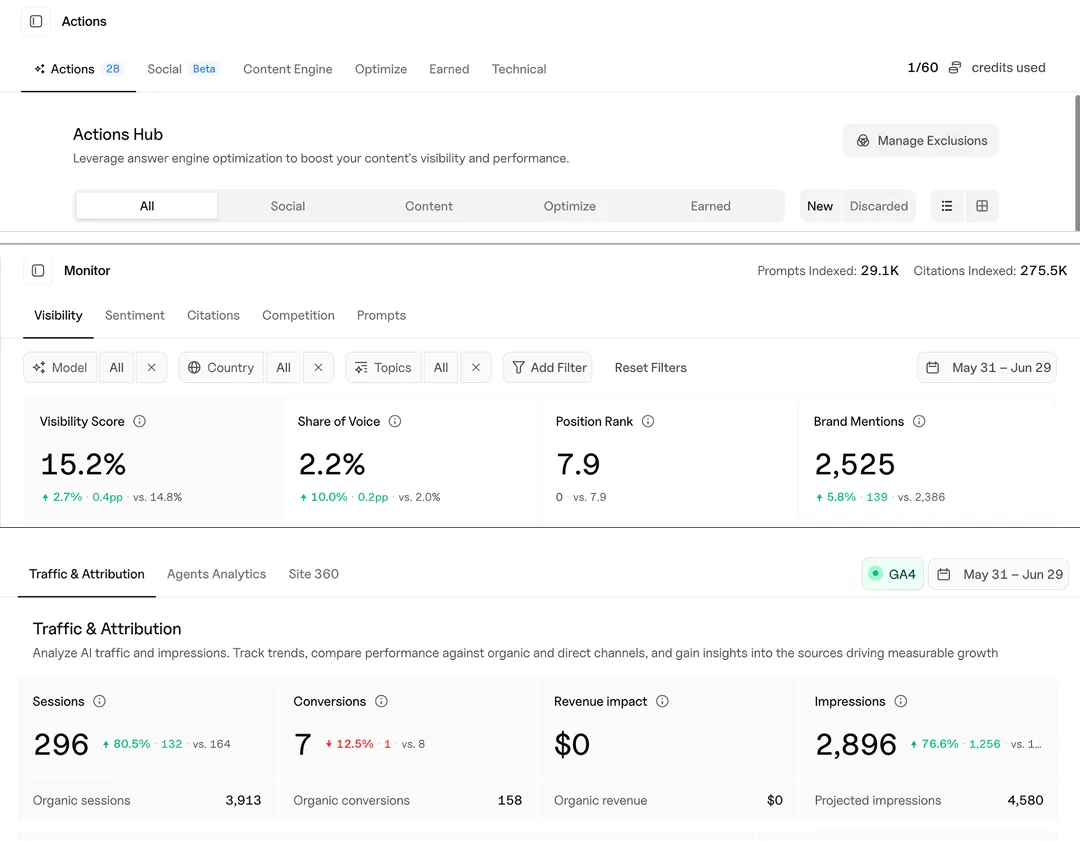
Goodie is an Answer Engine Optimization platform built to help brands understand, manage, and improve how AI systems describe them. Every feature serves one problem: closing the loop between what LLMs say about your brand and what you do about it.
- Monitor brand mentions, citations, sentiment, and AI share of voice daily across up to 14 answer engines
- Find AI-native prompts and trending topics in your category with Prompt Research
- Turn gaps into actions through the Optimization Hub (content, technical, outreach, and social agents)
- Track agentic commerce visibility at the SKU level
- Attribute AI search presence to traffic and revenue
- Built for mid-market and enterprise scale: multi-brand, multi-market, multi-language
Ahrefs
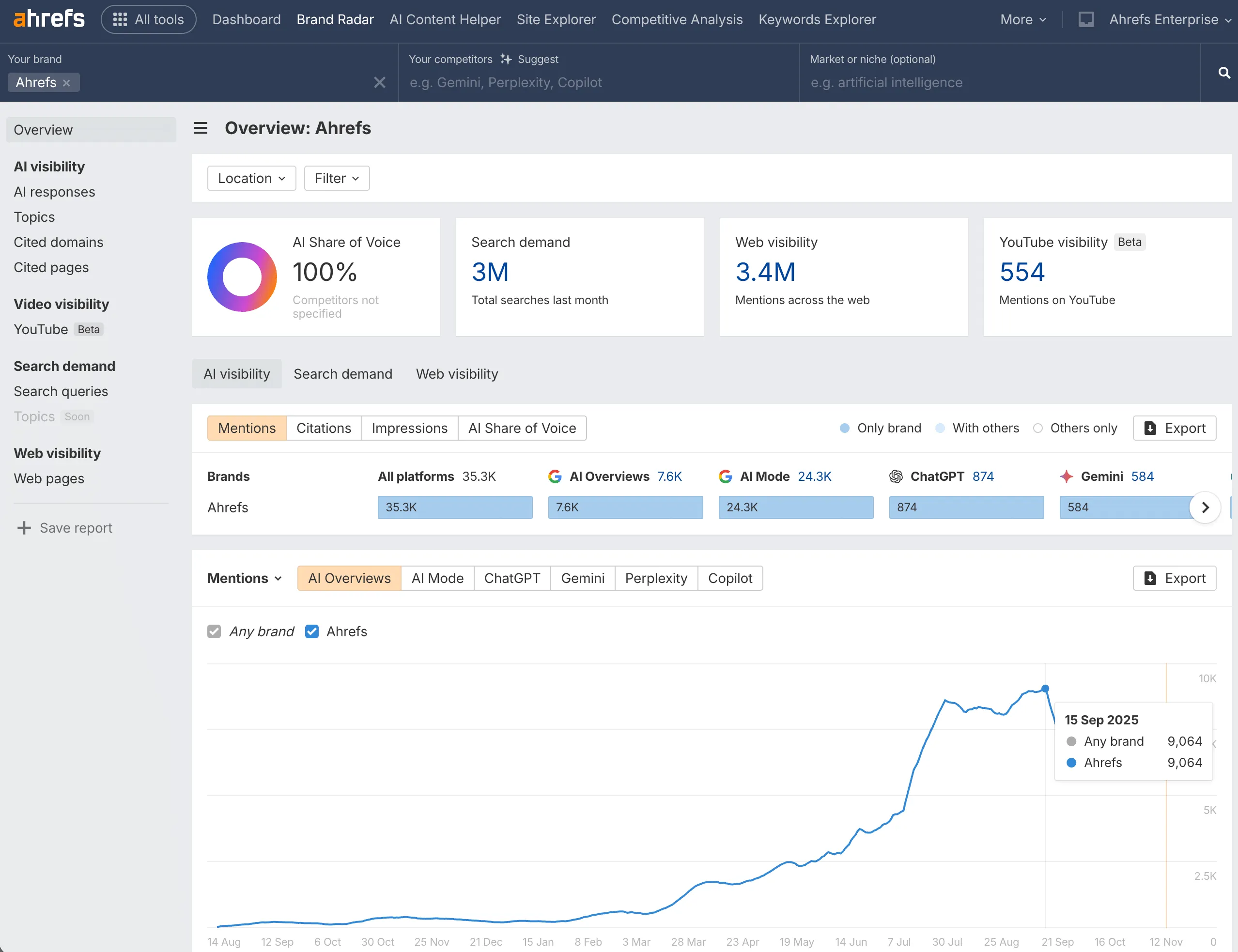
Ahrefs is one of the most respected SEO platforms in the market, known for its backlink index, Keywords Explorer, Site Explorer, and Site Audit. Brand Radar extends that index into AI search. It tracks brand mentions, citations, estimated impressions, and AI share of voice across Google AI Overviews and AI Mode, ChatGPT, Perplexity, Gemini, and Copilot, with Claude available through custom prompts. It also has beta coverage of YouTube, TikTok, and Reddit.
- Research any brand, topic, or competitor across a large search-backed prompt database
- Track custom prompts on ChatGPT, Gemini, Perplexity, Copilot, and Claude, with a small allowance on Lite and above and paid packages for volume
- Cited domains and cited pages reports, connected to Ahrefs’ web index
- AI Content Helper for content scoring and refreshes
- Used by SEO teams, agencies, and in-house marketers already running on Ahrefs
Where the Platforms Diverge
The table shows what exists. This section covers what the gaps mean for teams trying to improve their AI search performance, beyond measuring it.
Search-Backed vs. AI-Native Prompt Data
Brand Radar’s prompt database is enormous, and it’s anchored in search behavior. According to Ahrefs’ methodology, prompts are seeded from Google’s People Also Ask data and Ahrefs’ keyword database, then expanded using query fan-out. That is a legitimate methodology. It is also an SEO methodology, and it reflects how people search Google rather than how they talk to ChatGPT.
Goodie’s prompt and topic data is built around how people use answer engines: longer, conversational, multi-intent questions that often have no keyword equivalent at all. AI search conversations don’t map cleanly onto PAA boxes, and more of them will fall outside keyword data over time.
Why it matters: If your AI visibility data is built from Google search demand, you’re measuring AI search through an SEO lens. That misses the prompts unique to AI, and those are often the ones where buying decisions happen.
Monthly Snapshots vs. Daily Tracking
Ahrefs is transparent about its refresh cadence. Google AI Overviews and AI Mode update continuously. The ChatGPT, Perplexity, Gemini, and Copilot indexes refresh monthly on a 90-day reporting window. Daily tracking is available only for the custom prompts you pay for separately. Brand Radar also doesn’t track Claude, Meta AI, or DeepSeek.
Goodie collects data daily across every engine on every plan: five engines on Core, eight on Pro, and up to 13 on Enterprise, including Claude, Meta AI, DeepSeek, Grok, and commerce surfaces like Amazon Alexa and Walmart’s Sparky.
Why it matters: AI answers are non-deterministic and change constantly. A monthly snapshot is useful for market research. It’s too slow to tell you whether last week’s optimization worked, and a program depends on that feedback loop.
Optimizing for Google vs. Optimizing for Citations
Ahrefs does have an action layer, and it’s a good one for SEO. AI Content Helper scores drafts against top-ranking pages and highlights topic gaps. Site Audit and Patches handle technical SEO fixes. The limitation is the target. These tools optimize toward what ranks in Google, and ranking no longer predicts citation in AI answers. Ahrefs’ own research found that only 12% of links cited by ChatGPT, Gemini, and Copilot appear in Google’s top 10 for the same prompt.
Brand Radar shows you where you’re missing. It doesn’t generate a plan to fix it. Goodie’s Optimization Hub starts from the AI visibility gap and works toward the fix. The AEO Content Writer and Content Optimization tools target prompt gaps. The Technical Agent handles llms.txt and sitemap repair. The Outreach and Social agents build the third-party presence that AI engines cite. Every plan includes the full action layer.
Why it matters: Optimizing a page to match the Google top 10 and optimizing it to get cited by ChatGPT are increasingly different jobs. A tool that does the first well won’t automatically do the second.
Modeled Impressions vs. Measured Revenue
Credit to Ahrefs here, because it states its own limits openly. Brand Radar’s Estimated Impressions weight AI mentions by Google search volume, and Ahrefs says it doesn’t claim a validated link between Google search volume and how often a query is asked inside an AI tool. Its methodology describes the metrics as directional, modeled visibility signals rather than exact traffic counts.
That’s a reasonable choice for a research tool. It won’t hold up as the basis for a budget conversation. Goodie’s attribution layer connects AI visibility to sessions, conversions, and revenue through GA4, Search Console, and Bing Webmaster Tools integrations. Agent Analytics shows how AI crawlers and agents actually interact with your site.
Why it matters: Leadership doesn’t fund modeled impressions. An AEO program needs to show that AI visibility moved revenue, or it stays a cost center.
Agentic Commerce Is a Surface Brand Radar Doesn’t Track
AI assistants increasingly recommend and purchase products for users, which makes product-level visibility a new commercial surface. Brand Radar measures brand mentions. It doesn’t track how individual products appear in AI shopping experiences. Goodie’s Agentic Commerce Suite tracks SKU-level visibility across ChatGPT, Perplexity, AI Mode, Alexa for Shopping, and Sparky.
Why it matters: For retail and ecommerce brands, the next lost sale won’t show up as a ranking drop. It will show up as an AI agent recommending a competitor’s product. You can’t optimize a surface you can’t see.
Where Ahrefs Genuinely Leads: The Web Index Behind the Answers
Ahrefs has an advantage no AEO-native platform can easily copy: its web index. Brand Radar connects AI citations to the domains and pages behind them, and to backlink and web-mention data built over more than a decade. Its beta coverage of YouTube, TikTok, and Reddit also stands out, since those are often the sources AI answers draw from. If you’re researching which sources shape AI answers in your category, few tools match it.
Why it matters: Knowing which sources influence AI answers is valuable. Knowing what to do about them, and whether your changes worked, is what builds a program. The two tools complement each other well.
Goodie vs. Ahrefs Pricing
Goodie (View Full Pricing)
- Core, $399/mo: Self-serve, 7-day free trial. Core models: ChatGPT, AI Overviews, Perplexity, AI Mode, Copilot. 100 prompts, 10 optimization actions/mo. Full closed-loop AEO system included. Revenue attribution via Google Analytics. MCP server access. 3 seats, email support.
- Pro, $999/mo: Core models plus Gemini, Alexa for Shopping, and Sparky. 250 prompts, 30 optimization actions/mo. Agentic commerce visibility at SKU level. Full revenue attribution. 5 seats, priority support.
- Enterprise, Custom: Up to 12 models, including Claude, AI Mode, Meta AI, DeepSeek, and Grok. 500+ prompts, 60+ optimization actions/mo. Custom revenue modeling, dedicated AEO strategist, multi-brand workspaces, full API and export. 10+ seats.
Ahrefs (View Full Pricing)
- Base plans: Lite $129/mo, Standard $249/mo, Advanced $449/mo, Enterprise $1,499/mo. These include small AI prompt allowances. Extra seats cost 40–100 per user per month, depending on plan.
- Brand Radar AI: From $199/mo. The All Platforms tier is $699/mo and includes 2,500 custom prompt checks per month.
- Custom prompt packages: $50/mo (2,500 checks), $100/mo (7,000 checks), and $250/mo (25,000 checks), with per-check overage.
Pricing In Context
The key unit in Ahrefs’ pricing is the “check”: one prompt, run once, on one platform, in one location. The All Platforms tier’s 2,500 monthly checks cover about 80 prompts tracked daily on a single platform. Tracking 120 prompts daily across ChatGPT, Gemini, Perplexity, and Copilot works out to roughly 14,400 checks a month. Add Claude, which uses 8 checks per update, and the same 120 prompts need another 28,800 checks. That requires an additional prompt package on top of the base subscription and the Brand Radar tier.
Pair a Lite plan with All Platforms, and you’re at about $828/mo before additional prompts or seats. Goodie Core is $295/mo and includes daily tracking, the full optimization layer, and attribution. If you’re already paying for Ahrefs for SEO, Brand Radar is a natural research add-on. If you’re building AEO as its own channel, you’re comparing a research subscription with a complete program.
Who Should Use Each Platform?
Choose Ahrefs If…
- Backlinks, keyword research, and technical SEO are still the core of your search strategy
- You want market-level AI visibility research inside a tool your SEO team already uses
- Source intelligence (cited domains, Reddit, YouTube, TikTok) is your primary AI search need
Choose Goodie If…
- You’re running AEO as a standalone program with its own KPIs
- You need daily data across every engine your buyers use, including Claude, Meta AI, and commerce assistants
- You want prescriptive actions tied to AI prompt gaps instead of Google rankings
- You need to prove ROI by connecting AI visibility to sessions, conversions, and revenue
- You sell products and need SKU-level visibility in AI shopping
- You’re an enterprise or agency managing multiple brands, markets, or languages
Match the Platform to the Job You Need Done
Ahrefs has built the best SEO index on the market and pointed it at AI search with real skill. For research into how brands and sources show up across AI answers, Brand Radar is a strong tool, and Ahrefs deserves credit for being candid about what its metrics mean.
AEO requires more than research. You need to know which prompts matter in AI, beyond the ones that matter in Google. You need to see how your brand is framed today, not last month. You need to know what to change, and you need proof that the change moved revenue. Brand Radar answers the first question well. Goodie is built to answer all of them, continuously, in one system.
Ahrefs shows you where you stand in AI search. Goodie runs the program that moves you.
Ready to See the Difference?
Feature tables only go so far. A 30-minute demo shows you what a closed-loop AEO program looks like on your own brand’s prompts.
Goodie vs. Ahrefs: FAQs
Ahrefs is an SEO platform that added AI visibility through Brand Radar, built on search-derived prompt data and its web index. Goodie was built for Answer Engine Optimization and covers monitoring, optimization, and revenue attribution in a single closed-loop system.
Yes. Ahrefs handles traditional SEO and source research. Goodie runs the AEO program: daily AI monitoring, optimization actions, agentic commerce tracking, and attribution. The overlap is mainly in AI visibility monitoring.
Only through custom prompts. The Brand Radar index covers Google AI Overviews and AI Mode, ChatGPT, Perplexity, Gemini, and Copilot. Claude is available as a custom prompt platform, at 8 checks per update. Goodie tracks Claude, Meta AI, DeepSeek, and Grok daily on Enterprise, alongside the core engines.
AI Overviews and AI Mode data update continuously. ChatGPT, Perplexity, Gemini, and Copilot index data refresh monthly on a 90-day reporting window. Custom prompts can be tracked daily through check allowances and paid packages. Goodie collects data daily across every tracked engine on every plan.
It depends on scope. Brand Radar starts at $199/mo, but it sits on top of an Ahrefs base subscription. Full coverage with a Lite plan runs about $828/mo before extra prompt checks. Goodie Core is $295/mo and includes the full AEO loop.
No. Goodie doesn’t offer a backlink index or traditional keyword research, and it isn’t trying to. It’s built for AI search, which increasingly rewards different signals than traditional rankings do.