

When AI engines cite a LinkedIn feed post, they cite a personal profile 73% of the time. Long-form articles split effectively even between people and company pages.
That’s the headline from Goodie’s analysis of 219,351 AI citations to LinkedIn across nine engines and 32 industries, January through September 2026. Our study of how social content formats shape AI visibility showed AI engines cite LinkedIn articles more often than feed posts. This round answers the question it left open: whose name is on the content AI cites?
TL;DR
We analyzed 219,351 citations from AI engines pointing to LinkedIn content, across 32 industries and nine engines.
When an AI engine cites a LinkedIn feed post, it is usually citing a person’s profile: personal profiles take 73% of feed post citations. Pulse articles split 51% personal profile and 49% company page, a gap small enough that we treat it as even. Inside each vertical the picture changes. Some industries lean hard toward articles from people, and others toward company pages.
The key numbers:
- 73% of feed post citations go to personal profiles.
- Pulse articles split effectively even: 51% personal profiles, 49% company pages.
- Pulse articles draw 3.6x as many citations as feed posts.
- In 16 of the 32 industries we measured, personal profiles lead both feed posts and articles.
- Google AI Overviews shows the widest format gap: 86% of its feed post citations go to personal profiles.
Who Counts as an Individual on LinkedIn?
When we say “individual,” we mean a personal profile: someone posting under their own name instead of under a brand. On LinkedIn, those profiles mostly consist of:
- Employees writing in their professional capacity (engineers, PMs, the account exec)
- Executives sharing thought leadership (CEOs, founders, VPs)
- Independent professionals, such as consultants, freelancers, and researchers
Many of these people don’t work for the brand they write about. The study measures personal profiles, so a citation in the individual column can belong to a consultant, a creator, or a reviewer just as easily as to your own staff.
How Did We Measure LinkedIn AI Citations?
The data covers nine AI engines (Google AI Overviews, Google AI Mode, Perplexity, ChatGPT, Grok, Copilot, DeepSeek, Meta AI, Claude) and their citations to LinkedIn feed posts and Pulse articles across 32 industry verticals, January through September 2026. Each citation is credited to the personal profile or company page that published the cited content. For how citation sources differ across verticals beyond LinkedIn, see our breakdown of most cited domains by industry.
One number to keep in mind throughout the rest of this report: Pulse articles get cited 3.6x as often as feed posts. In our dataset, Pulse pulled in 171,762 citations and feed posts 47,589. Posts are the smaller piece of the pie.
We also crawled a sample of cited URLs to check whether each author was a personal profile or a company page. The results of that check are in the verification section below.
Does AI Cite Individuals or Company Pages on LinkedIn?
It depends on the format. Personal profiles dominate feed post citations, while Pulse article citations split evenly.
- Feed posts: 73% of citations go to personal profiles.
- Articles: 51% of citations go to personal profiles and 49% to company pages. Our author labels carry an estimated 4.6% error rate, so a two-point gap is too close to call.
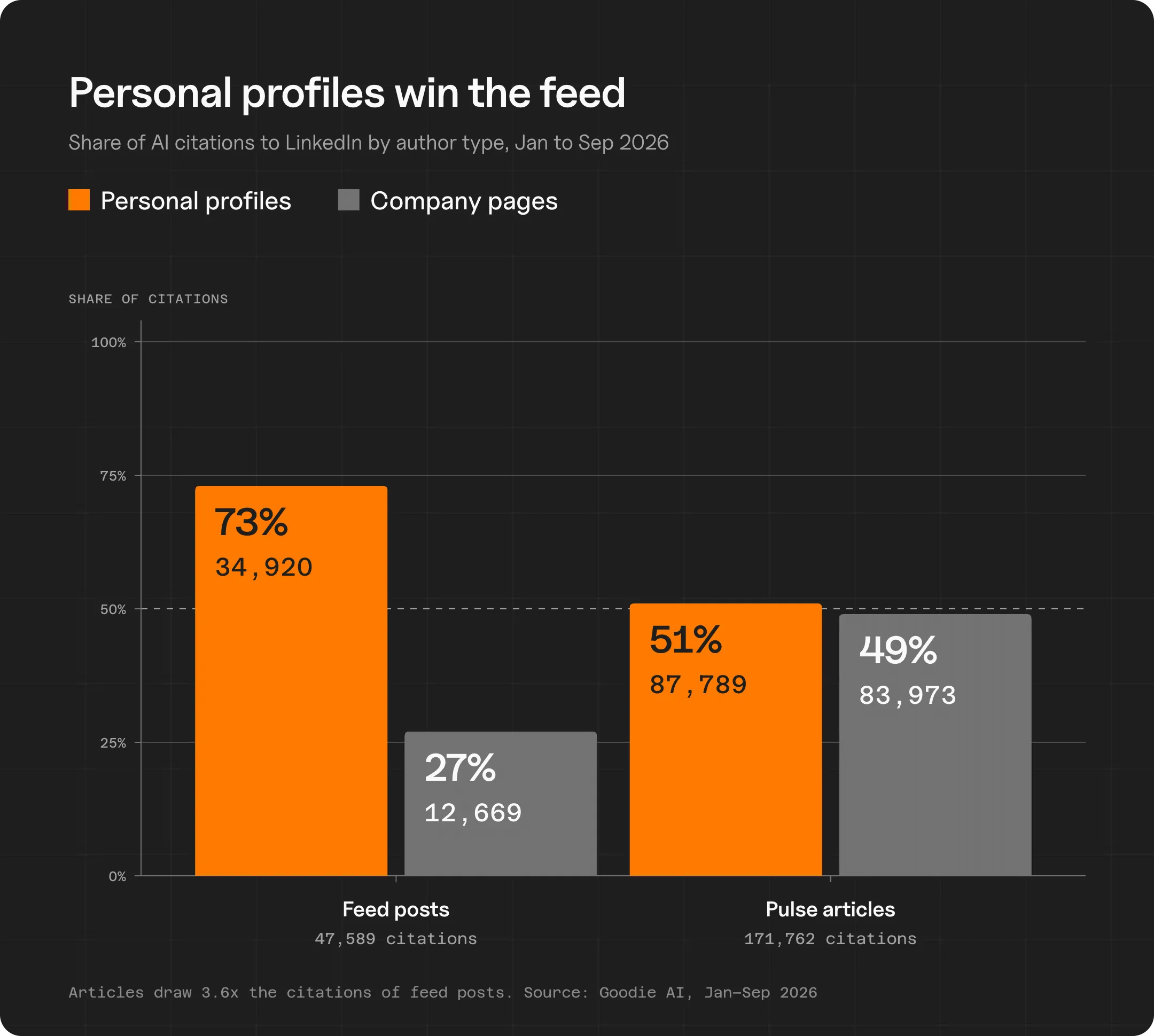
(Spoiler: if the goal is getting cited, you’ll still need both formats and both kinds of accounts.)
Publish all your long-form content from personal profiles, and you give up the 49% of article citations that go to company pages, in a pool 3.6x the size of the feed. Limit feed content to the company page, and you’re competing for 27% of feed post citations.
Which Industries Break the Pattern?
In half the 32 industries we measured, personal profiles take the majority on both formats, not just feed posts. This is the single most common pattern in our data.
One rule before the breakdown: when an industry’s personal profile share rounds to 50% on a format, we call that format a tie and give neither side the win. Three industries tie on one format, and they’re covered under the outliers.
Where Individuals Lead Both Formats
In 16 industries, personal profiles take the majority on both short-form and long-form. Among them:
- Marketing Services
- B2B SaaS (Enterprise Operations and Data & Analytics), which also shows up in our list of the most cited B2B SaaS domains
- Healthcare Providers
- Asset Management & Wealth
- Credit Cards
- Skincare & Cosmetics
- Fragrance
- Wireless Carriers
- Streaming
- Insurance
Some of these reward personal authority: Healthcare Providers, Asset Management & Wealth, Insurance. Others, like Fragrance, Streaming, and Wireless Carriers, point to a different driver in our read: reviewers and creators writing about brands under their own names.
Where Individuals Take the Feed, and Companies Take Articles
In 9 verticals, format and author lined up: personal profiles lead on feed posts, company pages lead on articles.
This is the version of LinkedIn most people picture. Feed posts reward speed and personal voice, which individuals produce easily. Articles reward polish and editorial consistency, which companies have the infrastructure to deliver. Cloud Computing, Cybersecurity, Pharmaceuticals, Packaged Foods, and Airlines were among the categories where that mapping held.
The categories where companies lead articles share a profile: they tend to be regulated, technical, or institutional categories that publish long-form content carrying legal exposure, like corporate research reports or regulatory guides. In those spaces, a vendor name carries more credibility than any individual byline.
Where Companies Lead Both Formats
In three industries, company pages lead on both formats: Retail Banking, Gaming Equipment, and Personal Care. These are categories where trust already sits with the brand name rather than any one person behind it. (Who would you rather ask about monitor specs: the product page, or a LinkedInfluencer?)
The Outliers
E-Commerce Platforms break the pattern completely: company pages lead on feed posts, but personal profiles lead on articles.
Three more industries tie on one format, so we don’t name a winner there:
- Oil & Gas: personal profiles lead feed posts (68%); articles tie at 50%.
- Specialty Retail: company pages lead feed posts (52%); articles tie at 50%.
- Consumer Electronics (Wearables): feed posts tie at 50%; personal profiles lead articles (76%).
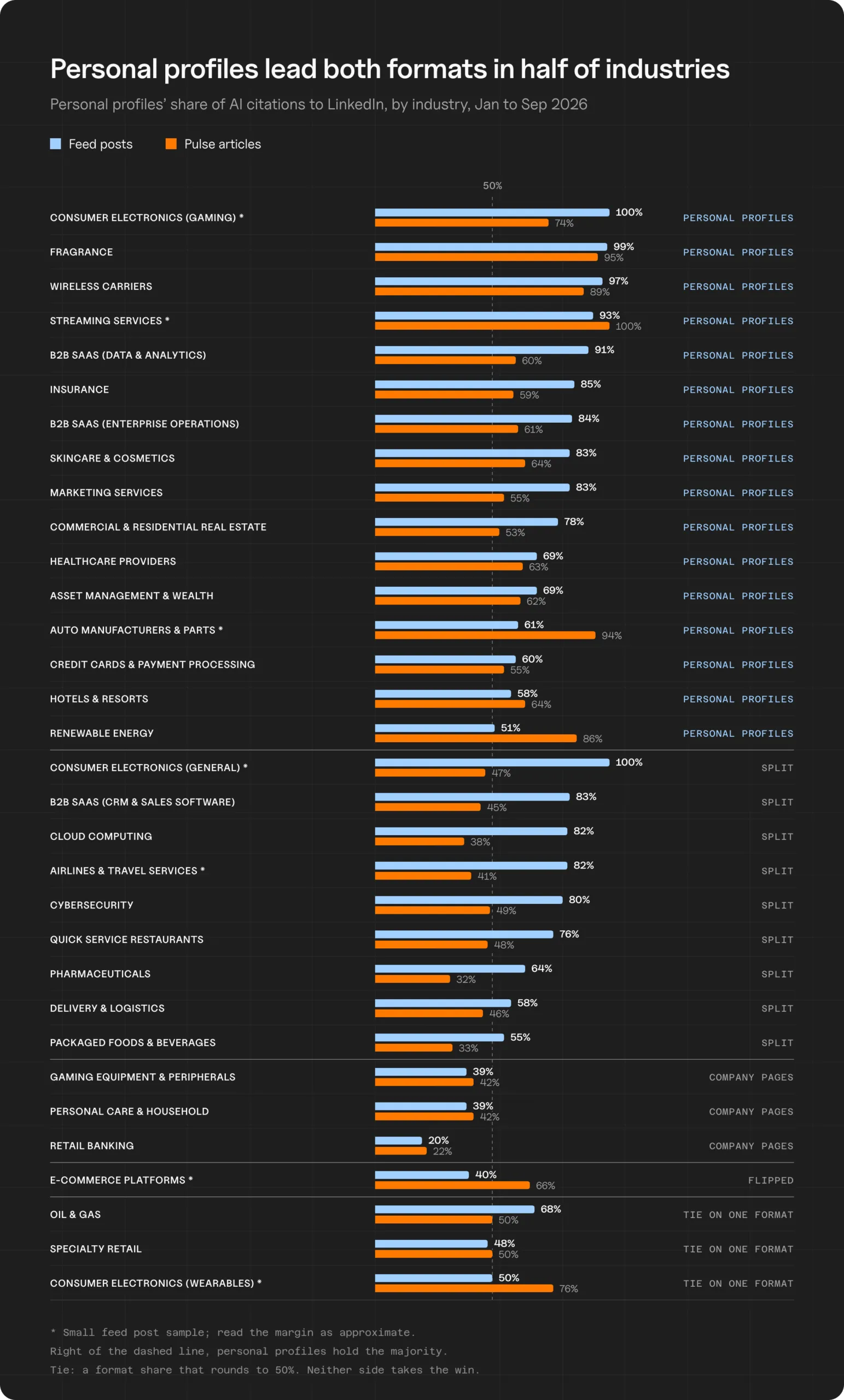
A few caveats on the exceptions: several have small sample sizes in one format, including Airlines, Streaming, Auto, E-Commerce, and the three Consumer Electronics categories on feed posts. Our label errors also run almost entirely toward personal profiles, so an industry within a few points of 50% leans further toward company pages than these numbers show. Read those margins as approximate.
Do AI Engines Differ in Who They Cite?
Yes, and most of the format gap comes from Google. Most other engines favor personal profiles regardless of format.
Google Splits the Ticket
Google AI Overviews shows the widest format gap of any engine we measured: 86% of its feed post citations go to personal profiles, while its article citations split close to 50/50. AI Mode leans the same way with a smaller gap.
The Voice of the People
Perplexity, DeepSeek, and Meta AI cite personal profiles more than company pages for every content type. On all three, who published matters more than the format they chose.
A Note on Grok
On feed posts, every other engine cites personal profiles at least 57% of the time. Grok cites them 47% of the time, which makes it the only engine where company pages lead feed post citations. Over half of Grok’s feed post citations in our analysis came from a single industry, Credit Cards, so one industry carries much of its result. (More on how Grok selects its sources.)
As usual, “Optimize for AI” isn’t a singular target, and we’ve written before about why AI engines cite different sources. If Google is your priority, have personal profiles publish feed posts. On Perplexity, DeepSeek, and Meta AI, who publishes matters more than the format, so moving more content under personal profiles lines up with what those engines cite, long-form or short-form.
How Does This Compare to Semrush’s LinkedIn Study?
Semrush’s analysis of 89,000 unique LinkedIn URLs cited by ChatGPT Search, Google AI Mode, and Perplexity is a widely cited reference on this question. Our data agrees with most of it and splits on one engine.
Articles outdraw posts in both datasets. Semrush found articles made up 50% to 66% of cited LinkedIn content, against 15% to 28% for feed posts, depending on the engine. In ours, articles took 78% of citations between the two formats.
ChatGPT and Google AI Mode lean toward people in both. Semrush found individual members made up 59% of LinkedIn citations on each. In our data, both engines credit personal profiles with at least 57% of their feed post citations.
Perplexity is where we differ. Semrush found Company Pages took 59% of Perplexity’s LinkedIn citations. In our data, Perplexity cites personal profiles more across both formats.
Scope is the likeliest explanation. Semrush ran 325,000 prompts across three engines in January and February 2026, counted unique URLs, and classified content types that included Company Pages and job listings. We covered nine engines over nine months and counted citations to feed posts and Pulse articles. Perplexity also overhauled its social sourcing in June: it tested four social platforms and kept one, LinkedIn, which now makes up roughly a third of its social citations. A February snapshot and a September dataset can both be right.
Why Do AI Engines Favor Personal Profiles in the Feed?
Our data shows what gets cited. It can’t prove why. Our proposed explanation: citation share correlates with signals that personal profiles carry, and company pages don’t.
- A named author with a stated role. A post from a payments CFO attaches the claim to a credentialed identity. A brand update attaches it to a logo.
- Consistent output. In Semrush’s data, about three-quarters of cited post authors had published 5+ posts in the previous four weeks. More posts give engines more candidate URLs.
- Original takes. About 95% of cited posts in Semrush’s data were original, and reshares made up just 5% of citations.
Engagement matters less than most teams assume: the median cited post in Semrush’s study had 15 to 25 reactions and no more than one comment.
How Should You Split LinkedIn Publishing Between People and the Brand?
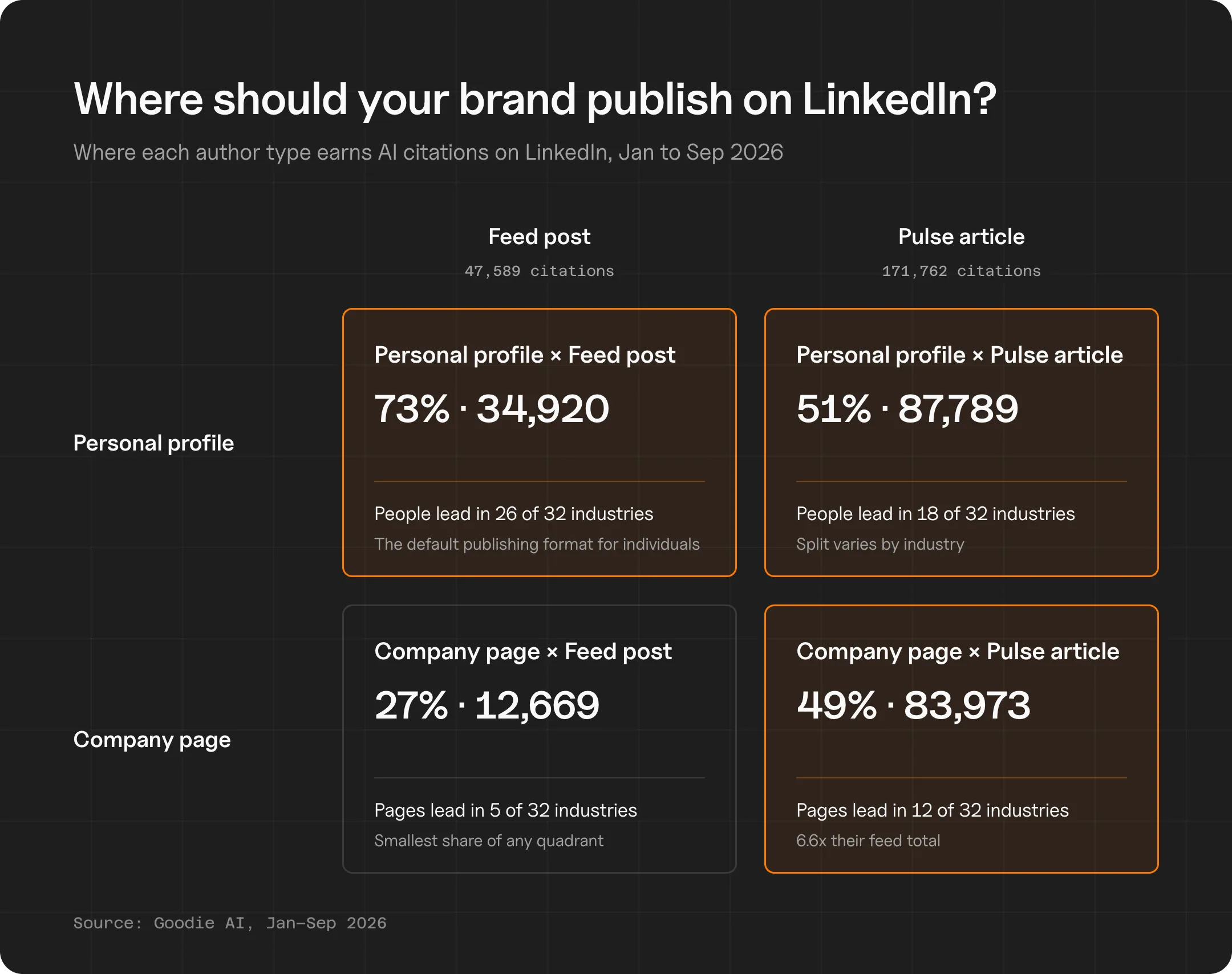
Feed posts go out from personal profiles. Personal profiles take 73% of feed post citations and lead the feed in 26 of 32 industries. A company page posting to the feed is competing for 27% of the smaller pool. If you’re starting this lane, our guide to turning original research into social posts AI will cite covers what to post.
Articles go out from both, weighted by industry. The article pool is 3.6x the feed and splits effectively even, so your industry decides which side gets more effort. For the brand itself, articles are still the bigger lane: company pages earned 83,973 article citations against 12,669 feed post citations, about 6.6x as many.
Then calibrate on three dimensions:
- Industry. In 16 of 32 industries, personal profiles lead both formats. In 9, personal profiles lead the feed and company pages lead articles. In three (Retail Banking, Gaming Equipment, Personal Care), company pages lead both. E-Commerce Platforms flips the split, and Oil & Gas, Specialty Retail, and Consumer Electronics (Wearables) tie on one format. Pin down your industry before building the posting plan.
- Target AI engine. Google shows the widest gap between formats. Grok’s feed numbers rest heavily on a single industry. On Perplexity, DeepSeek, and Meta AI, who publishes matters more than the format.
- Capacity. Articles hold 78% of citations, so long-form is where the volume sits. Feed posts are faster to produce, which makes them the quickest way for a new employee program to start earning citations.
Most teams treat authorship as a brand safety call. This data makes it a visibility call too.
How Did We Verify Who Authored Each Citation?
Author labels in the dataset come from automated classification, so we checked them against the live pages. We crawled 2,396 unique cited LinkedIn URLs, covering 11,732 rows and 29,208 citations, and recorded whether each author was a personal profile or a company page.
- 6.1% of crawled rows carried the wrong label. Those corrections touch 1,342 citations, or 4.6% of the crawled citations.
- The errors ran almost entirely one way: 705 of the 719 mislabeled rows were tagged as personal profiles but belonged to company pages.
That direction matters. If the same error rate holds across the full dataset, personal profile shares in this report run slightly high, and company page shares slightly low. The feed post finding holds with a 46-point gap. The 51/49 article split does not, which is why we treat articles as even.
What Are the Limitations of This Study?
- The data is a snapshot across a fixed time window. AI engine behavior shifts, and this will move with it.
- Some exception industries have small sample sizes in one format. Future rounds should deepen coverage in those categories.
- The tie rule uses shares rounded to whole percentages. Unrounded figures could move the three tied industries in either direction.
- Coverage is English-language and US-weighted. Multilingual coverage is lighter.
- Edge cases (newsletter accounts, employee advocacy aggregators) are counted in whichever bucket the automated classification assigned them.
What Do the Terms in This Study Mean?
- Personal profile (individual): A LinkedIn profile belonging to a person, whether or not they work for the brand they write about.
- Employee-generated content (EGC): Content published under an employee’s name, sometimes ghostwritten or editorially supported by a content team.
- Feed post: A short-form LinkedIn post, usually text or text plus image, published to the main feed.
- Pulse article: LinkedIn’s long-form publishing format. Byline sits on an author or a company page.
- Citation: A reference from an AI-generated answer back to a source URL. The unit used in this study.
- AI engine: The nine products included here: Google AI Overviews, Google AI Mode, Perplexity, ChatGPT, Grok, Copilot, DeepSeek, Meta AI, Claude.
Find Out Which LinkedIn Lane Your Category Rewards
These splits are averages across 32 industries. Your category and the engines your buyers use set your real numbers. Goodie’s AI Visibility Monitoring tracks citation mix at the platform and model level, so you can see whether your employees’ posts or your company page earn citations before shifting budget.
LinkedIn AI Visibility FAQs
On feed posts, yes. Personal profiles take 73% of AI citations to LinkedIn feed posts. Pulse articles split effectively even, 51% to 49%, and personal profiles lead both formats in 16 of the 32 industries we measured.
Pulse articles. In our data, they drew 171,762 citations against 47,589 for feed posts, a 3.6x difference.
Publish feed posts from personal profiles, which take 73% of feed post citations. Publish articles from both personal profiles and the company page, weighted by your industry: personal profiles lead article citations in 18 of 32 industries and company pages in 12. Then track which posts earn citations and shift effort toward what works.
Run the questions your buyers ask through the AI engines they use and record which URLs each answer cites. Doing this by hand gets slow past a few dozen prompts. A citation tracking platform like Goodie runs the prompts across engines on a schedule and shows which of your pages, profiles, and posts get cited.
In this data, feed post citation share correlates strongly with personal profile authorship. Posts from personal profiles take most feed post citations in 26 of the 32 industries we measured. Those profiles include consultants, creators, and reviewers outside your company, so treat EGC as a lane with a strong track record rather than a guaranteed result.
Feed posts are the safest default: personal profiles lead feed post citations in 26 of 32 industries.
Articles depend on the industry. Personal profiles lead article citations in 18 industries, including Marketing Services, Fragrance, and Healthcare Providers. Company pages lead in 12, including Pharmaceuticals, Cloud Computing, and Retail Banking, and two more tie.
Google AI Overviews. 86% of its feed post citations go to personal profiles, while its articles split close to even, the widest gap between posts and articles of the nine engines. Grok is the only engine where company pages lead feed post citations, and over half of its feed post citations come from a single industry.
The 4-1-1 rule is a content mix guideline credited to Andrew Davis and Joe Pulizzi. In its original form, for every promotional post, you share one reshare and four pieces of relevant content from others. A later variant swaps the reshare for an original piece. If you follow it on LinkedIn, post your original pieces from personal profiles, which take 73% of feed post citations in our data.