Close visibility gaps with prioritized, specific actions, projected to improve citation rates by 15–40%, then execute the fix directly in the platform.



Close visibility gaps with prioritized, specific actions, projected to improve citation rates by 15–40%, then execute the fix directly in the platform.
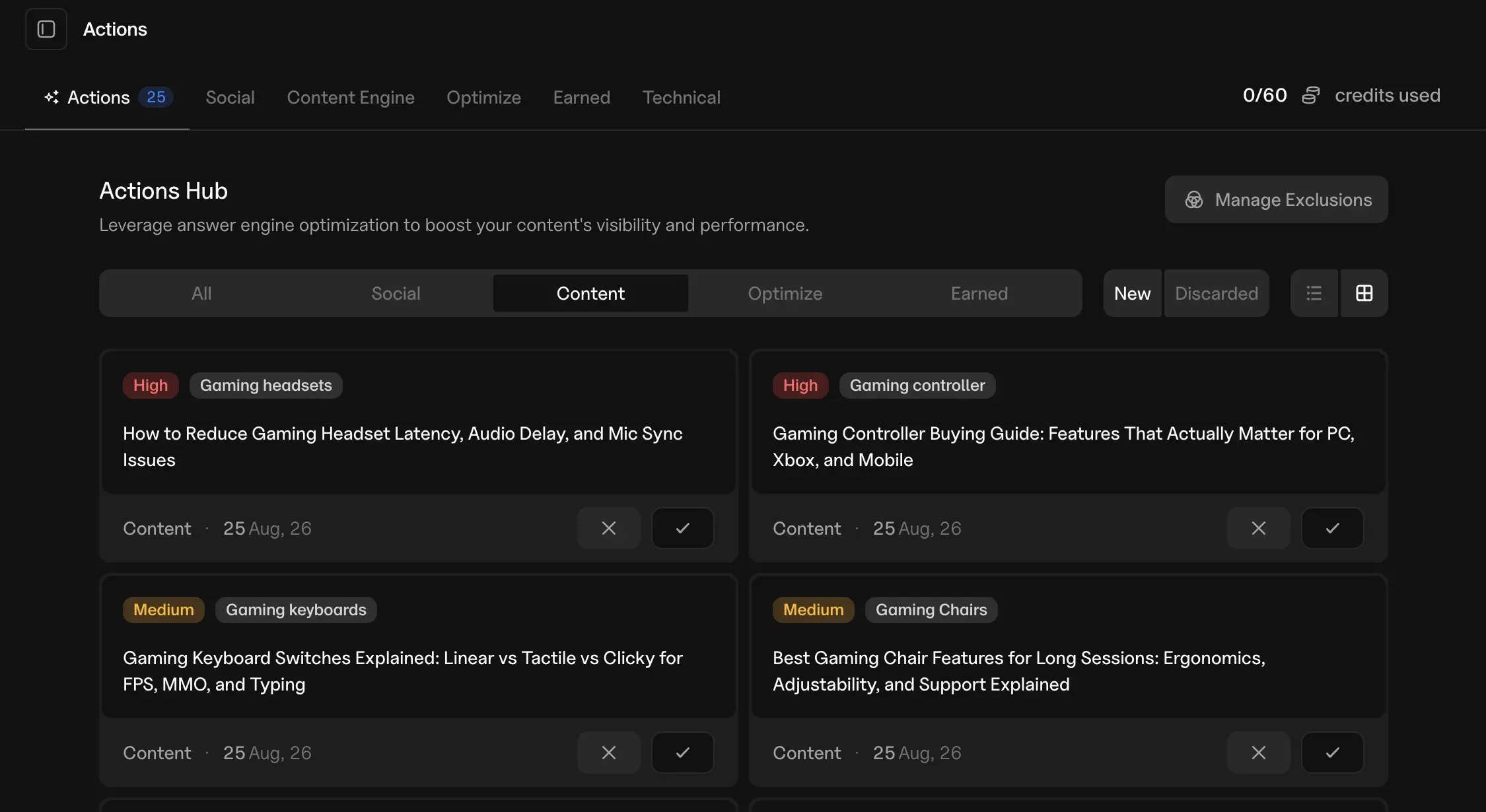
The platform compares your owned assets to the sources AI references when citing competitors, identifying missing topic coverage, weak authority signals, unclear entity definitions, and technical gaps.
You receive targeted improvements with difficulty level, estimated timeline, and projected impact on citation rate.
Implement changes directly for owned content, track outreach status for earned opportunities, and monitor how visibility metrics change following implementation.


Owned content: Add missing topic coverage, strengthen author credentials, implement schema markup (Article, FAQPage, Organization, Product), improve entity clarity, add citation sources.
The platform calculates potential visibility lift by analyzing competitive gap size (how often competitors get cited for prompts you miss), current baseline mention rate, prompt volume for the topic, and difficulty of the fix. A recommendation to add FAQ schema on a high-volume topic where three competitors have it shows higher estimated impact than minor wording changes.
Optimization Actions gives distributed teams a shared, prioritized playbook rather than a fragmented list of to-dos. Each recommendation includes difficulty level, estimated timeline, and projected impact on citation rate, all so that Content, SEO, PR, and Technical teams all know what to tackle first and why. Owned content updates, earned media outreach, technical fixes, and social optimizations are organized by type and effort level, making it straightforward to assign work across functions and track progress as visibility metrics shift.
Yes. Filter by action type (content, technical, earned, social), difficulty (quick wins vs. major projects), estimated impact (high/medium/low), or affected prompt clusters.
Traditional SEO tools tell you where you rank on a results page and give you keyword-based recommendations. Optimization Actions works off a different signal entirely: what AI models actually cite when they answer a question, not what ranks on a search results page. Recommendations are prioritized by citation impact instead of keyword difficulty, and they span more than content, they also cover technical fixes, earned media targets, and social signals in one list, not four separate tools.