The brands holding ground right now aren’t choosing between SEO, AEO, AIO, and GEO. They’re running all four as a single compounding system, where each layer makes the next one more effective. The ones losing ground are treating them as separate workstreams, or ignoring three of them entirely.
This guide covers what each discipline actually is, how they relate to each other, and what it takes to win across all four surfaces where your customers are searching.
The Four Disciplines at a Glance
Before diving into each discipline, one clarification worth making upfront: AIO (AI Overview Optimization) earns its own row because it sits at the unique intersection of SEO and AEO. Unlike broader AEO, it is Google-specific, SERP-native, and already trackable in tools like Ahrefs and SEMrush, making it the most actionable and immediately measurable AI surface for most marketing teams today.
| Type | Definition | How It’s Done | Why it Matters |
| SEO (Search Engine Optimization) | Optimizing web pages so search engine crawlers rank them higher in traditional blue-link results. | ✓ On-page content ✓ Technical hygiene ✓ Backlink authority | Still the dominant source of top-of-funnel discovery. Strong SEO is table stakes for everything else. |
| AEO (Answer Engine Optimization) | Structuring content so that LLMs and answer engines cite your brand as the source in their generated responses, often without requiring a click. | ✓ Sound on-page structure for machine readability ✓ Technical hygiene ✓ Clear brand messaging ✓ Organized site-map and content structure | Win mid-funnel trust in a zero-click world. If you’re not cited, you’re invisible at the moment of highest intent. |
| AIO (AI Overview Optimization) | Specifically optimizing content to appear as a cited source within Google’s AI Overviews. A subset of AEO focused on Google’s SERP surface. | ✓ H-E-E-A-T Signals ✓ Schema & Technical ✓ Allow AI Bots to crawl ✓ Sound Content Structure ✓ Topical Authority | Never ignore AIO, as it is Google’s new prime real estate. AI Overviews reached 2B, monthly users. Being cited drives high-intent traffic. Being uncited is an active disadvantage. |
| GEO (Generative Engine Optimization) | Structuring brand knowledge so AI agents can not only cite you, but also fetch and act on your data to complete tasks on the users’ behalf. | ✓ Structured data & schema ✓llms.txt + robots.txt (allow AI Bots) file presence ✓Core Web Vitals (TTFB, LCP) + site crawlability ✓Content & EEAT Signals | As agents book, buy, and schedule autonomously, brands that aren’t GEO-ready will simply be skipped. |
The overlap between these four disciplines is the good news. A well-structured blog post with clear headings, a visible author, and outbound citations to credible sources doesn’t just rank better in traditional search. It’s also more likely to be cited in an AI Overview, cited by ChatGPT or Perplexity, and ingested by an agent as a trusted data source.
Every improvement you make to your content’s clarity, credibility, and structure pays dividends across all four surfaces simultaneously. This is why the strongest teams aren’t building separate SEO, AEO, AIO, and GEO workflows. They’re building one unified content standard that satisfies all four at once, then layering in the more technical GEO requirements — APIs, vector databases, structured data infrastructure — as a second phase once the content foundation is solid.
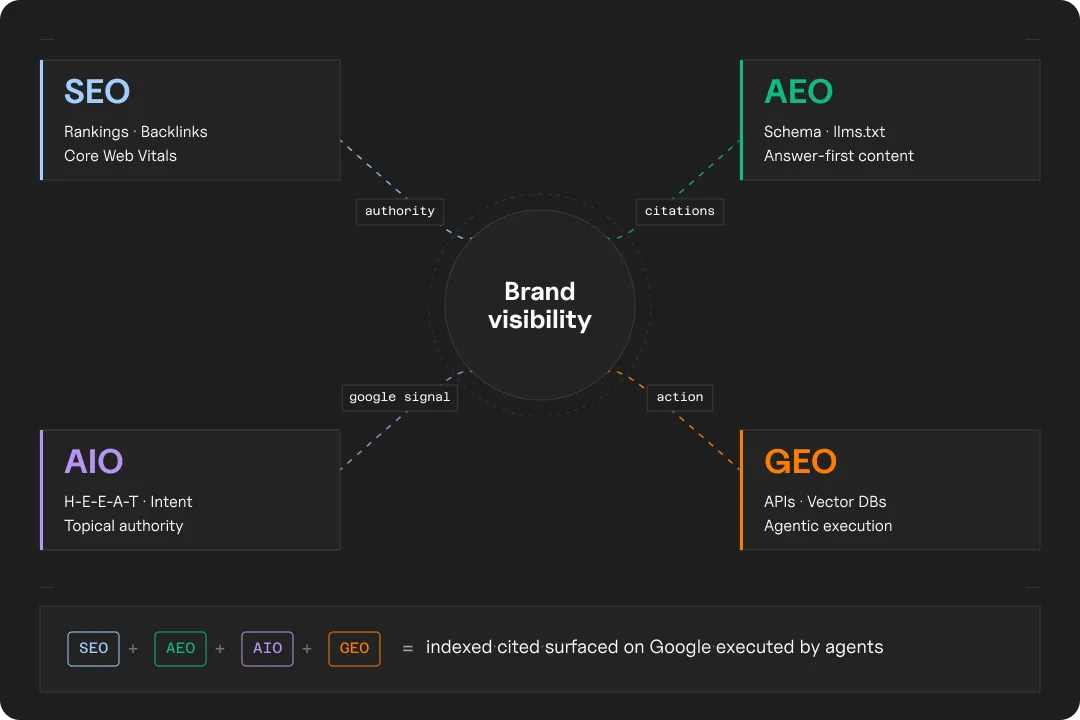
The rest of this guide covers each discipline in sequence, starting with the foundation everything else depends on.
SEO, AEO, GEO, & AIO Deep Dive
SEO: Get the Foundation Right First
Before any AI engine can cite you, quote you, or execute on your behalf, a search engine bot needs to be able to find, crawl, and trust your content. That means getting the basics right and keeping them right. Three areas matter most:
- Technical hygiene. Pass Core Web Vitals, keep TTFB under 200ms, and make sure your pages aren’t buried behind redirect chains or blocked in robots.txt.
- Topical authority. Build tightly interconnected topic clusters where a strong pillar page links out to deeper supporting content and every supporting page links back. Every page you publish should have clear intent and connect to the broader picture. Isolated posts that don’t tie into a topic cluster signal to Google and LLMs that your site covers a subject tangentially, not comprehensively.
- H-E-E-A-T. Visible authors with credentials, outbound links to primary sources, and transparent sourcing throughout. Treat this as a baseline filter every AI engine applies before considering your content as a citation source at all.
These three aren’t just SEO best practices — they’re the same habits that make content citable by AI engines. According to Superlines’ analysis of 34,234 AI responses across 10 platforms, content with statistics, citations, and quotations achieves 30-40% higher visibility in AI responses, and pages updated within two months earn 28% more citations than older content.
AEO: Optimized to Be Cited
Once your SEO foundation is solid, the next layer is engineering your content to be quoted or cited directly in AI answers. The single most impactful change you can make is answer-first formatting.
- Answer-first formatting means leading every page, section, and subheading with a direct, concise answer before expanding into detail. AI engines retrieve passages, not pages, so your content needs to work in 40-60 word extracts that stand on their own without surrounding context.
- Question-subhead formatting means phrasing your H2s and H3s as the exact questions your audience is asking, then answering them immediately beneath those headings.
Together, these two habits do most of the structural work. Layer in schema markup on top (FAQPage and HowTo are the highest priority) so the structure of your content is machine-readable, not just human-readable. Pair this with an LLMs.txt file that signals to AI crawlers which sections of your site carry the most authoritative, citable content, and which low-value pages they can safely skip.
The goal isn’t just to appear in an answer. It’s to be the source a model returns to repeatedly because your content is consistently the clearest, most direct, and most trustworthy answer available.
That distinction matters more than most brands realize. According to Ahrefs, roughly 80% of URLs cited in ChatGPT, Perplexity, Copilot, and AI Mode do not rank in Google’s top 100 results for the same query. Citations are not a byproduct of ranking. AEO is a genuinely distinct discipline, and it rewards different habits.
AIO: Win Google’s SERP Surface Specifically
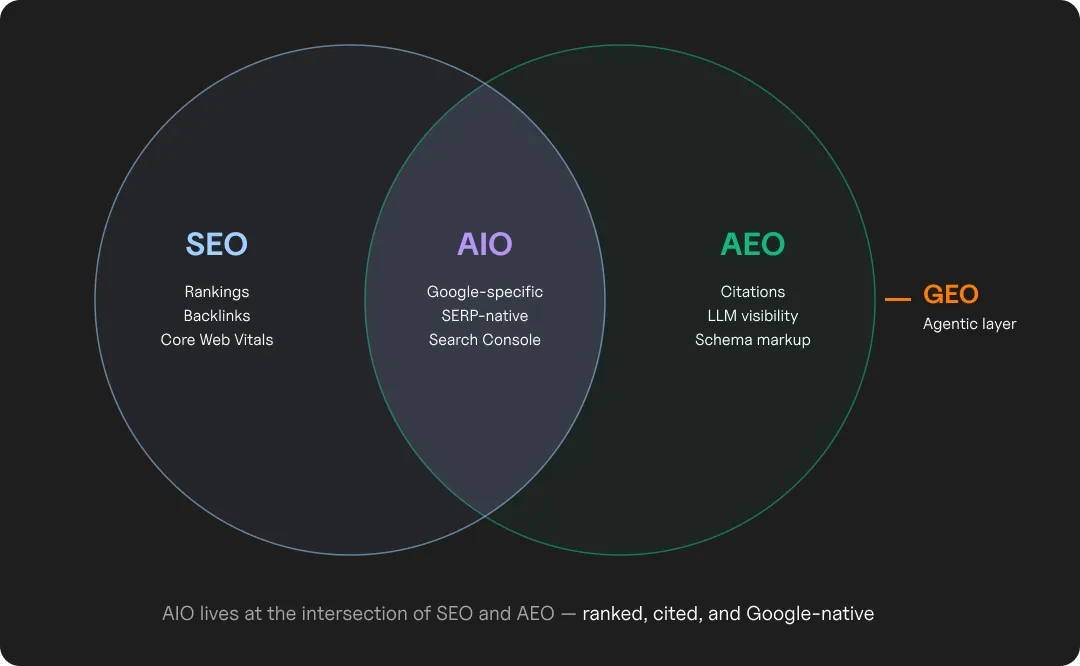
AIO strategy is AEO with a Google-specific lens applied on top. Everything that makes your content citation-ready for broader answer engines also makes it AIO-ready. Three factors determine whether you make it into an AI Overview:
- Topical depth. Google’s AI Overviews consistently pull from sources that cover a topic end-to-end. Thin coverage of a subject, even well-written thin coverage, rarely gets cited.
- Intent alignment. AIO is query-specific. Google is matching your content to a precise question, and a mismatch in intent eliminates you regardless of content quality.
- Existing ranking signals. Ranking in the top ten still carries significant weight here. According to Ahrefs, 76.1% of URLs cited in AI Overviews also rank in Google’s top ten organic results for the same query.
The commercial case for getting this right is significant. Cited pages within AI Overviews receive approximately 120% more clicks per impression than uncited pages on the same SERP, along with 35% higher organic CTRs and 91% higher paid CTRs compared to uncited brands.
The flip side is equally stark. Pew Research found that only 8% of searches result in any click when an AI Overview is present, down from 15% when one isn’t. Being uncited in an AI Overview isn’t neutral. It’s an active disadvantage on queries where your brand should be visible.
The most practical starting point: open Google Search Console and identify your highest-impression, lowest-CTR pages. These are the pages being surfaced in AI Overviews where users aren’t clicking through — and your highest-priority candidates for AIO optimization.
GEO: Become the Dataset, Not Just the Answer
Most definitions of GEO stop at content. Structure your pages well, demonstrate expertise, earn citations from AI. That definition is correct, but incomplete.
Content citation is the first layer of GEO, and if you’re already running an AEO strategy, you’re already doing it. The second layer is infrastructure: making your brand not just citable, but queryable, transactable, and executable by agents acting autonomously on a user’s behalf.
Consumer appetite for this is already forming. 16% of consumers report being very comfortable allowing AI to complete purchases and use their payment information if it saves them money, with another 21% open to AI-assisted shopping provided they can review transactions first.
- Content composability. Start by auditing your existing content for how well it works in pieces. Can it be broken into discrete, self-contained knowledge objects like JSON files or CSV exports? Can an agent retrieve a specific answer without reading an entire article? If not, restructuring for composability is the first GEO investment worth making.
- API accessibility. If an agent wanted to check your pricing, verify availability, or initiate a transaction, could it do so programmatically without human intervention? If the answer is no, building a basic public-facing API for your core product or service data is the highest-leverage GEO investment available right now.
- Multimodal readiness. Every image needs descriptive alt-text. Every video needs a timestamped transcript. Every chart needs an accompanying raw data file. These aren’t nice-to-haves — they’re the difference between an agent being able to read your content and having to skip it entirely.
Brands investing in GEO infrastructure are already seeing measurable results. Steelseries, a gaming brand that invested in GEO infrastructure, saw AI search conversion grow 27x. AI-sourced revenue grow 3.7x over about ten months, becoming the top-retrieved gaming brand across ChatGPT, Gemini, and Perplexity (per the case study’s (award submission to The Drum) GEO is the longest game of the four disciplines. Still, it also has the least competition right now, making it the highest-upside investment for brands willing to move early.
The Cost of Optimizing in Isolation
Each discipline in the quartet depends on the one before it. Without a solid SEO foundation, AEO citation rates become inconsistent and hard to sustain — AI engines keep returning to the same handful of authoritative, technically sound sources, and a site with crawl issues, weak H-E-E-A-T signals, or thin content doesn’t make that shortlist regardless of how well its schema markup is configured.
The same logic extends to GEO. Brands that invest in APIs and vector infrastructure without first earning citation authority through AEO are building an execution layer with nothing to execute on. Agents prioritize sources they already trust, and that trust is built through consistent, credible content long before any agentic transaction takes place.
This is why the sequence matters as much as the strategy:
- SEO earns crawlability and authority
- AEO converts that authority into citations
- AIO focuses those citations onto Google’s most trafficked surface
- GEO turns citations into action
Skip a step and the system underperforms — not catastrophically, but consistently enough that the gap between you and brands running all four compounds into a visibility deficit that becomes increasingly expensive to close.
| Discovery | Citation | Amplification | Action |
| SEO | AEO | AIO | GEO |
| Crawlability and domain authority | AI citations across every LLM | Google’s 2B-user surface | Trust converted to transaction |
Measuring What Actually Matters
Rankings, sessions, and CTR tell you how visible you are in traditional search. They say nothing about whether an AI engine is citing you, whether Google’s AI Overview is surfacing your content, or whether an agent is executing transactions on your behalf. Measuring performance across all four disciplines requires expanding your framework — building from the familiar toward the frontier.
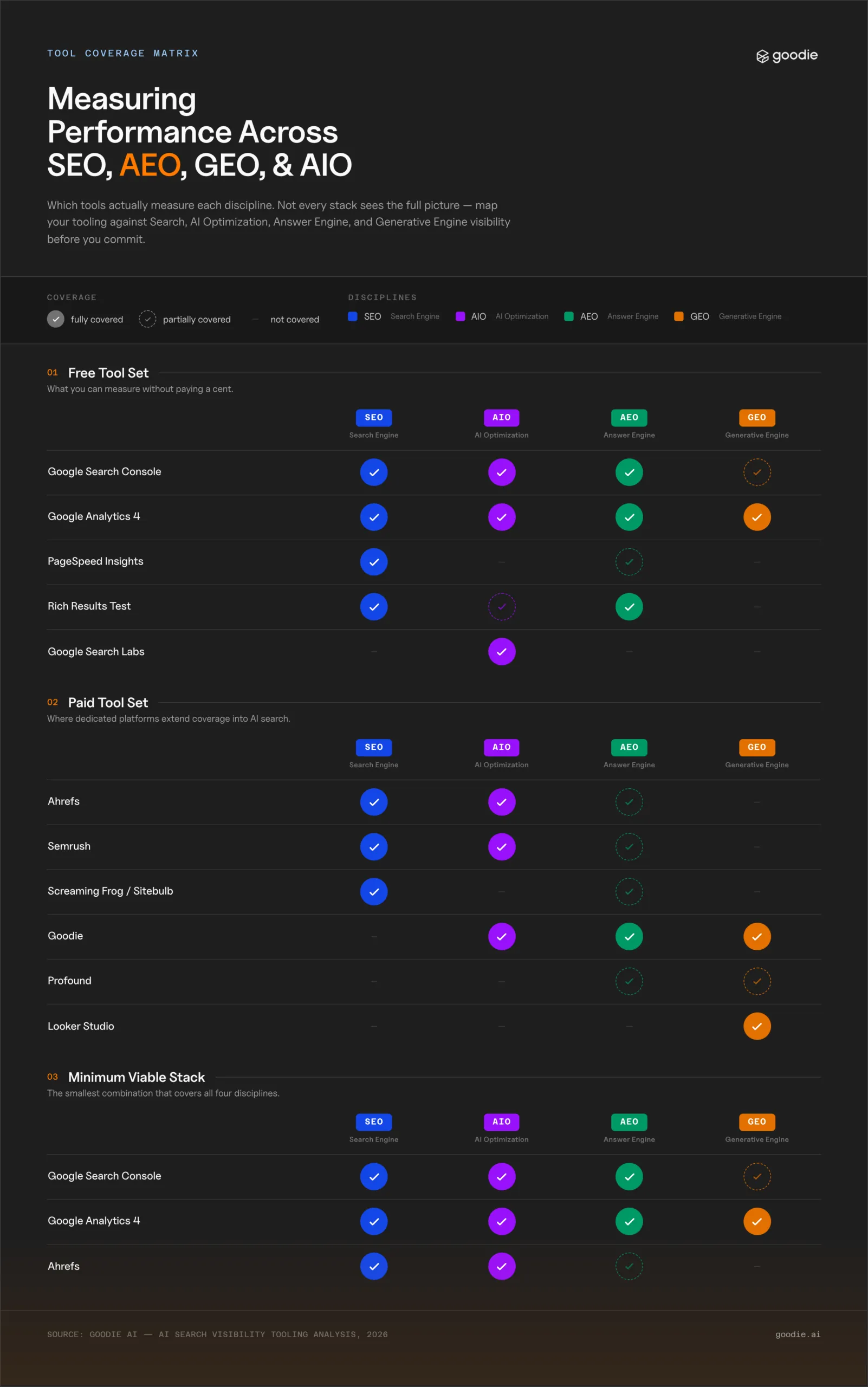
The Tools You Actually Need
Most teams overbuild their measurement stack before they have a baseline to measure from. Five tools cover the vast majority of what you need across all four disciplines. Three of them are free.
- Google Search Console and GA4. Between these two, you get SEO rankings, AIO impression data, AI-referred session tracking, and agent referral attribution. If you only ever had these two tools, you’d still have more measurement coverage than most brands right now.
- Ahrefs. Your one paid SEO platform. Handles backlinks, keyword tracking with AIO filtering, and technical audits.
- Rich Results Test. Run this before publishing anything with schema markup. Schema errors are the single most common reason content gets passed over by AI engines, and this check takes two minutes.
- Google Search Labs (AI Mode). Paste your most important pages directly into AI Mode and see exactly how Google’s AI summarizes and cites them. Five minutes per page will tell you more about your AIO readiness than most automated tools. If the AI rewrites your content entirely rather than citing it, your answer-first formatting needs work before anything else.
- SERP scraping (custom). For teams who want granular query-level AIO data that standard tools don’t yet surface, a lightweight scraping setup gives you full visibility into which pages are appearing as sources, at which position, and for which queries. Optional at the start, but essential as your AIO strategy matures.
- Goodie. The one tool in the stack no combination of free tools can replicate. It’s the only platform that tracks citation share across ChatGPT, Gemini, Perplexity, and Claude simultaneously, monitors AIO source inclusion on Google, and tracks brand mentions, sentiment, and competitive visibility across AEO and GEO surfaces. Where the rest of the stack tells you how you rank, Goodie tells you how you’re represented — which is the metric that matters most in an AI-first search landscape.
Add Semrush if you need deeper competitive intelligence. Add Screaming Frog or Sitebulb for technical crawls at scale. Start with five and build from there.
SEO, AEO, GEO & AIO: Frequently Asked Questions
Not necessarily all at once, but you need a plan for all four. The most practical approach is to sequence them: get your SEO foundation solid first since it underpins everything else, then layer in AEO and AIO simultaneously since they share most of the same content requirements. GEO runs best as a second phase once your content foundation is established. The key is not treating any one of them as optional.
AEO and AIO results tend to move faster than traditional SEO, but the timeline varies significantly depending on your starting point.
- Brands with strong existing domain authority and well-structured content often see citation rate improvements within four to eight weeks of implementing answer-first formatting, schema markup, and H-E-E-A-T signals.
- Brands starting from a weaker foundation should expect three to six months before citation share becomes consistently measurable.
The single fastest win is adding FAQPage schema to your highest-traffic pages; this is the optimization most commonly associated with rapid AIO inclusion and can show results within a crawl cycle.
No. GEO is relevant for any brand that wants to remain visible as AI agents become the primary interface between users and the internet. A B2B SaaS company with a well-structured API and a hosted knowledge base is just as GEO-ready as an eCommerce brand with a product catalog API. The mechanism is the same; the use case is different. Any brand that wants an AI agent to recommend, reference, or route users to their business needs to be thinking about GEO now, regardless of industry.
Yes, but their role has shifted. Backlinks remain a meaningful signal for SEO and still contribute indirectly to how LLMs perceive domain authority. However, AI engines now weigh entity-level trust signals alongside traditional backlink metrics — third-party mentions, Wikipedia and Wikidata presence, consistent brand representation across the web, and the quality of your outbound citations.
A brand with fewer but higher-quality backlinks, strong entity presence, and well-sourced content will consistently outperform a brand with high volumes of low-quality links in both AEO citation rates and AIO source inclusion.
This is one of the most underappreciated questions in AI search optimization. An AI engine can mention your brand in a generated answer while misrepresenting your product, misstating your pricing, or attributing a claim you never made. Without active monitoring, you’d never know it was happening. The manual approach is regular adversarial testing — prompting major LLMs with questions about your brand and category to audit how they describe you. At scale, this is where purpose-built tooling like Goodie becomes a brand protection imperative, not just a nice-to-have.
Add FAQPage schema to your top ten pages and rewrite the opening paragraph of each to lead with a direct, 40-60 word answer to the primary question that page targets. This addresses the two most common reasons content gets passed over by AI engines and improves your chances of appearing in AEO citations, AIO source panels, and GEO knowledge retrieval simultaneously. It takes less than a day to implement and pays dividends across all four disciplines from the moment Google next crawls those pages.