Key Takeaways
- Conversational search rewards content built around natural-language questions and direct, self-contained answers.
- Every section should answer its own heading within the first 40 to 60 words, name its subject explicitly, and avoid depending on the paragraph before it.
- Tables, lists, and short paragraphs get extracted more reliably than long narrative blocks.
- Structured data/schema markup removes ambiguity that would otherwise cost a page its citation.
- Depth in a handful of topics beats shallow coverage spread across many, both for readers and for the models retrieving from a site.
A shopper used to type “waterproof hiking boots women’s” into Google, scan ten blue links, and click into two or three product pages to compare. Flash forward to today: that same shopper works the whole decision inside a single chat thread, one turn building on the last:
- Learning: “What should I look for in a waterproof hiking boot?”
- Clarifying: “Does any of that change if I have wide feet?”
- Evaluating: “Okay, so how do Salomon and Merrell compare on wide-fit waterproof boots?”
- Committing: “Which of those two holds up best on wet rock and scree, not just mud? I’m doing a week in the Rockies in October.”
- Buying: “Go with the Salomon then. What’s it cost in a size 9 wide, and where can I get it?”
Five turns, one session, zero visits to a search results page. Each question only makes sense because the model retained everything said before it, and at every turn it returns a single synthesized answer built from whichever two or three sources it trusts enough to cite. A brand that only optimized for “waterproof hiking boots women’s” as a keyword has nothing that answers any of these five actual questions, and it doesn’t get cited at the stage that matters, whichever stage that turns out to be.
That’s the shift conversational search optimization exists to solve. It’s the practice of structuring content so it gets surfaced and cited when people ask questions in natural language, whether typed into ChatGPT and Perplexity, spoken to a voice assistant, or entered into Google’s AI Overviews. It replaces keyword matching with answer matching: the model isn’t deciding where to rank your page, it’s deciding whether to recommend it at all.
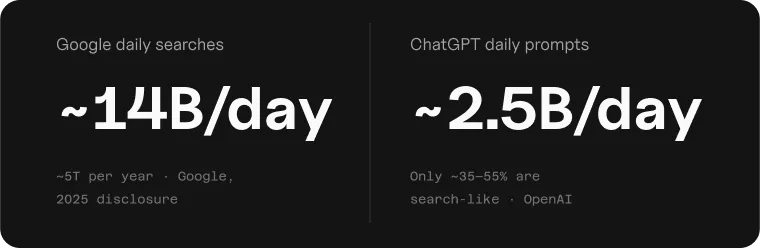
Businesses across every industry now have to account for this shift in every product consideration, whether they’re selling enterprise software or hiking boots. A meaningful and growing share of buying decisions now get resolved inside a single AI-generated answer, before a shopper ever reaches a results page. Winning a spot in that answer takes a different content strategy than winning a ranking position ever did, and treating it as a bolt-on to existing SEO work is the fastest way to stay invisible. Surviving this shift means writing pages that answer a specific question, in the specific way a person or a model would ask it.
What Is Conversational Search?
Conversational search is a search method built on natural language queries instead of short keyword fragments. Someone typing “cheap flights NYC to LA” is using traditional search syntax. Someone typing or saying “what’s the cheapest way to fly from New York to LA next weekend” is using conversational search, and they expect an answer that accounts for the full context of the question.
Three things distinguish conversational search from keyword search:
- Query length and structure. Conversational queries run longer and follow natural grammar: full questions, comparisons, and multi-part requests instead of two- or three-word fragments.
- Context retention. Voice assistants and chat interfaces remember prior turns in a session. A follow-up like “what about with a layover?” only makes sense because the system retained context from the question before it.
- Answer-first retrieval. Traditional search returns a ranked list of pages. Conversational search returns a synthesized answer, often pulled from multiple sources and compressed into a few sentences, with the source links treated as secondary.
This is why conversational search engine optimization requires a different content structure than classic SEO. The unit being retrieved is a passage, sized far smaller than a full page.
What Does Conversational Search Optimization Look Like for Humans vs. Models?
The same structural choices tend to serve both audiences at once, but for different reasons. Knowing why each element works for each reader makes the tactics easier to prioritize.
| Element | What it does for a human reader | What it does for a model |
| Answer-first opening | Respects the reader’s time; the point lands before they scroll away | Gives retrieval a clean passage to lift without extra parsing |
| Full-sentence headings | Matches the question a person is silently asking while scanning | Maps directly onto the follow-up questions a model generates from a prompt |
| Named subjects, no pronouns | Removes ambiguity for anyone who lands mid-page from a link or search | Prevents entity confusion during chunk-level extraction |
| Tables and lists | Easier to scan on any device, especially mobile | Extracted far more reliably than prose; rows map cleanly to structured data |
| Inline sourcing and visible dates | Builds trust and lets a reader verify a claim themselves | Signals recency and credibility, both of which affect citation likelihood |
| Schema markup | Invisible to a human reader | Confirms identity and structure with certainty instead of inference |
How to Optimize for Conversational Search
Optimizing for conversational search means writing and structuring content so a model can lift a self-contained, accurate answer out of it without needing the rest of the page for context. Here’s the shift, tactic by tactic, old habit versus the fix:
| Tactic | Old habit (SEO era) | The fix (conversational search) | Quick example |
| Answer placement | Build up to the point across several paragraphs | Answer the heading in the first 40–60 words | H2: “How much does it cost?” → First sentence gives the price range |
| Heading phrasing | Short keyword fragments as headers | Full questions, phrased the way someone would actually ask | “CRM Pricing” → “How much does CRM software cost for a small team?” |
| Content unit | Optimize the page as a whole | Optimize each 150–400 word section as a standalone chunk | Every H2 names its subject explicitly; none open with “However” or “As mentioned above” |
| Formatting | Long narrative paragraphs | Tables for comparisons, lists for steps or features, 2–4 sentence paragraphs | A “best tools for X” section becomes a table |
| Machine-readability | Rely on the copy alone | Add FAQPage, Article, and Organization/Person schema with matching visible dates | dateModified in schema matches the “Updated” line rendered on the page |
| Voice phrasing | Text-first phrasing only | Include a plain, sayable answer early, since assistants read back one passage | “The nearest one is on 5th and Main, open until 9pm” reads naturally out loud |
| Site structure | Scatter coverage across many thin pages | Concentrate depth into pillar + cluster pages on 3–5 core topics | One thorough guide plus five focused cluster pages beats twenty shallow posts |
Two of these deserve more room, because getting them wrong quietly undermines everything else on the list.
Self-Contained Chunks Are Your Foundation
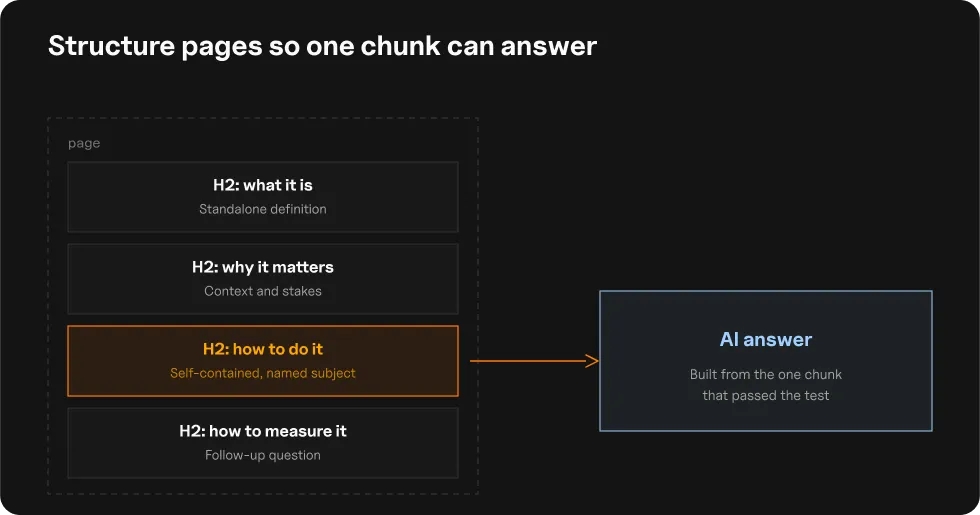
AI systems retrieve content in chunks, not full pages, so each section has to work in isolation. A section fails this test the moment it depends on something said three paragraphs earlier, and once it fails, it gets skipped during retrieval even when the information in it is accurate.
Schema Removes Ambiguity
Structured data tells a crawler what a page is about with 100% certainty. Schema layered onto thin or generic content just makes the weakness easier for a model to confirm. Implement it on key pages that already pass the answer-first test.
How Do You Know If Your Content Is Actually Optimized?
Run a direct test: take the exact question your page is supposed to answer, ask it to an AI assistant without supplying the URL, and check whether your content, or a paraphrase of it, comes back. If it doesn’t, the page isn’t structured for retrieval yet, regardless of how well it ranks in traditional search.
A few numbers are worth measuring beyond page views. AI-referred shoppers converted 31% more than non-AI traffic through the 2025 holiday season, and that gap widened to 42% by March 2026, per Adobe Analytics research covering more than a trillion U.S. retail site visits. Visitors from AI platforms also tend to spend more time on-site than those from traditional organic search, per Master of Code’s 2026 analysis. Traffic volume from AI answer engines is still small for most sites, but the visitors who arrive tend to be further along in their decision, since they’ve already done comparison research inside the chat.
What’s the Difference Between Conversational Search Optimization and Traditional SEO?
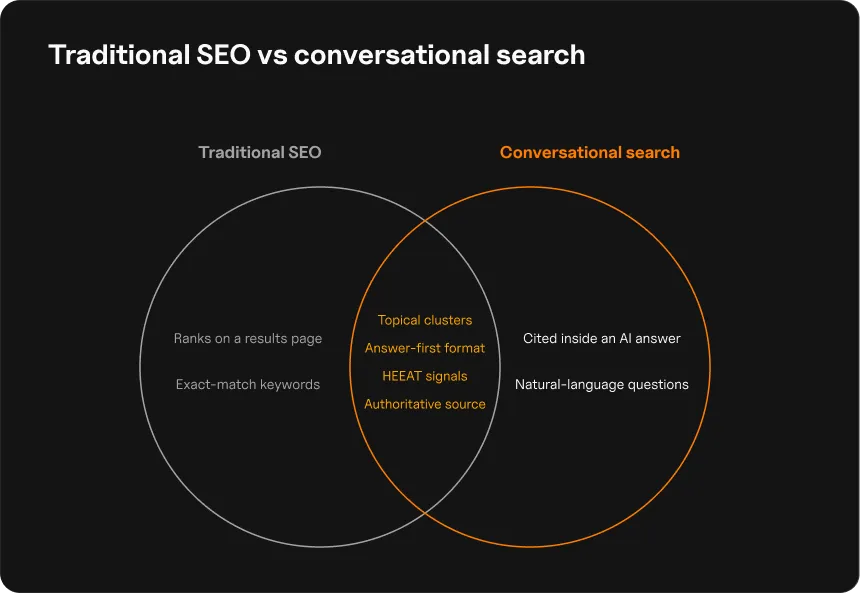
Traditional SEO optimizes a page to rank on a results page competing against other ranked pages. Conversational search optimization competes for inclusion in a single synthesized answer, alongside content from other sites that the model blends together. This is one piece of a broader shift across SEO, AEO, GEO, and AIO, and the practical differences show up in three places: content structure favors short, standalone, question-answering blocks over long narrative pages; keyword targeting favors natural phrasing over exact-match fragments; and success metrics shift from click-through rate and ranking position toward citation frequency and share of voice inside AI answers, since a well-optimized page might get cited without ever generating a click.
Both disciplines still depend on the same foundation: accurate, well-sourced, genuinely useful content. Conversational search optimization changes how that writing needs to be organized so a machine can find and trust it.
What Tools Help With Conversational Search Optimization?
Three categories of tools cover most of what a team needs (see our full rundown of AEO tools for a deeper comparison):
- AI visibility platforms (Goodie’s Visibility Monitoring and similar tools) track whether and how often a brand gets cited across ChatGPT, Perplexity, Gemini, and AI Overviews, and surface which competitors are showing up in the same answers.
- Traditional SEO platforms (Google Search Console, Ahrefs, Semrush) still matter, since AI Overviews and AI Mode draw on the same underlying index as classic Google Search.
- Schema and technical auditing tools confirm that structured data, crawlability, and page rendering meet the baseline AI crawlers need to parse a page correctly.
None of these tools substitute for the underlying content work. They tell a team where visibility is weak and which pages to fix first; the fix itself is still the structural and editorial work covered above.
How Long Does Conversational Search Optimization Take to Show Results?
Most sites see measurable movement in AI citation rates within 60 to 90 days of restructuring a batch of high-intent pages, assuming no major technical blockers like crawler access issues or heavy client-side rendering. Sites starting from thin content or entity inconsistencies across the homepage, schema markup, and their About page will need a longer runway, since models have to resolve brand identity before they’ll cite a source confidently. Treat the first quarter as a diagnostic pass: fix the highest-traffic pages first, confirm the format with the direct-question test, and expand from there.
Build Pages That Answer, Not Just Rank
Conversational search doesn’t reward the best page anymore. It rewards the page a model can lift a clean answer from without extra work. That’s the entire shift: self-contained chunks, full-question headings, schema that removes doubt, and answers that land in the first 40 to 60 words.
None of this replaces the SEO fundamentals your team already runs. It adds a structural layer on top, one built for a reader that scans a passage instead of a page. Sites that make this shift now are building the citation history that compounds; sites that wait are handing that citation to whoever gets there first.
Start with your highest-traffic pages, run the direct-question test, and expand from there.
See Where You’re Losing Citations
Goodie’s Visibility Monitoring shows exactly how your pages show up, get cited, and get skipped across ChatGPT, Perplexity, and AI Overviews, so you know which pages to fix first instead of guessing.
Conversational Search Optimization: FAQs
They overlap but aren’t identical. Voice search optimization is a subset focused on spoken queries and audio-first answers, things like concise, sayable phrasing and local intent. Conversational search optimization covers that plus typed multi-turn queries in tools like ChatGPT and Perplexity, where context carries across several questions instead of resetting with each search.
Restructure first. Most pages already contain the right information; it’s just buried in narrative paragraphs that don’t answer a heading in the first 40 to 60 words. Pull the direct answer to the top of each section, add full-question headings, and break up long paragraphs before you consider writing anything from scratch.
Aim for 150 to 400 words per section, with each one written to stand alone. That’s short enough for a model to retrieve as a single clean chunk, but long enough to actually answer the question instead of just gesturing at it.
ChatGPT, Perplexity, Google’s AI Overviews and AI Mode, and Microsoft Copilot all retrieve and synthesize answers from multi-turn context rather than returning a static ranked list. Each platform weighs sourcing and structure a little differently. Perplexity in particular leans heavily on citation transparency, which makes it a useful platform to benchmark against first.
Build Pages That Answer, Not Just Rank
Conversational search doesn’t reward the best page anymore. It rewards the page a model can lift a clean answer from without extra work. That’s the entire shift: self-contained chunks, full-question headings, schema that removes doubt, and answers that land in the first 40 to 60 words.
None of this replaces the SEO fundamentals your team already runs. It adds a structural layer on top, one built for a reader that scans a passage instead of a page. Sites that make this shift now are building the citation history that compounds; sites that wait are handing that citation to whoever gets there first.
Start with your highest-traffic pages, run the direct-question test, and expand from there.
No. The two disciplines share the same foundation of accurate, well-sourced content; conversational search optimization just adds structure on top (full-question headings, self-contained chunks, schema) that traditional SEO doesn’t require. Pages built this way tend to perform better in classic search too, since scannable, answer-first content is also what Google’s ranking systems favor.
Build Pages That Answer, Not Just Rank
Conversational search doesn’t reward the best page anymore. It rewards the page a model can lift a clean answer from without extra work. That’s the entire shift: self-contained chunks, full-question headings, schema that removes doubt, and answers that land in the first 40 to 60 words.
None of this replaces the SEO fundamentals your team already runs. It adds a structural layer on top, one built for a reader that scans a passage instead of a page. Sites that make this shift now are building the citation history that compounds; sites that wait are handing that citation to whoever gets there first.
Start with your highest-traffic pages, run the direct-question test, and expand from there.