

Key Takeaways
- Three things separate AEO platforms: how they collect data, which AI models they cover, and whether they help you act on findings and measure the result.
- Pick your buyer type before you book a demo. Watchers, Competitor Trackers, and Revenue Builders need different criteria weighted most, and your team and budget shift those weights further.
- Ask about data collection first. Answers pulled through an API can differ from what buyers see in the chat window, so a vendor should state its method, model by model, and whether web search is on.
- Monitoring is table stakes. Most platforms track mentions, citations, and share of voice; the real split is whether they tell you what to fix and tie the results to revenue.
- Make vendors prove it on your brand. Run your own prompts live in the demo, get the scoring method in writing, and pilot before you sign.
- Compare pricing models before prices. Prompt-, credit-, and seat-based plans scale differently, so ask every vendor for year-one total cost of ownership.
Sit through a few AEO platform demos in one week, and they start to blur together (every one shows the models it tracks, an AI visibility score, a share of voice chart, and a list of citations, often in nearly the same layout). Three things separate them: how the platform collects its data, which AI models it covers, and whether it helps you act on what it finds and measure the result.
There is no single best platform, though. The right one depends on your business, your team, your budget, and what you want the tool to do for you. Are you curious how your brand shows up in ChatGPT? Do you want to keep tabs on two or three specific competitors? Or are you trying to turn AI search into a revenue channel you can influence? Those are different buyers, and they need different checklists.
Below: 11 criteria, a scorecard you can weight for your goal, demo questions for your RFP, red flags, and a pilot plan. If you want specific tool names instead, our roundup of the best AEO software covers that.
What Is an AEO Platform?
An AEO platform (you’ll also see “AI visibility platform,” “AEO software,” “LLM visibility tools,” or “generative engine optimization tool”) tracks how AI answer engines talk about your brand and helps you change it. It runs the prompts your buyers ask in ChatGPT, Gemini, Perplexity, Claude, Copilot, and Google AI Overviews, then records whether you’re mentioned, whether you’re cited, and how you compare with competitors.
It helps to think of it in two halves. The first half is AI visibility monitoring: mentions, citations, share of voice, sentiment. The second half is action: what to fix, and whether fixing it moved traffic or revenue. Almost every platform covers the first half. The second half is where they split, and it’s where most of your evaluation time should go.
Our post on query fan-out explains how AI picks its sources, and our comparison of LLMs shows how differently each model behaves (which is why coverage matters so much).
Do You Need an AEO Platform, an Agency, or Both?
It depends on who will do the work. A platform tells you where you stand and what to fix. It doesn’t rewrite the pages, pitch the journalists, or push changes through your CMS, so someone on your side still has to.
- Platform only: You have an in-house SEO or content lead with real hours each week, and your goal is monitoring or competitor tracking.
- Agency only: No one internally can own AEO, and you want a partner to run it end to end, tooling included.
- Both: You want AI search to become a revenue channel, and your team is already stretched. The platform supplies the data, and an agency or a dedicated strategist does the work.
Here’s the slightly unpopular part. If you only want to see how your brand shows up, you don’t need an agency. If you want to build a channel, you’ll need hands-on work either way, and the real question is whose hands. Our guide to AEO agencies covers that side.
How to Choose an AEO Platform: Start With Your Goal
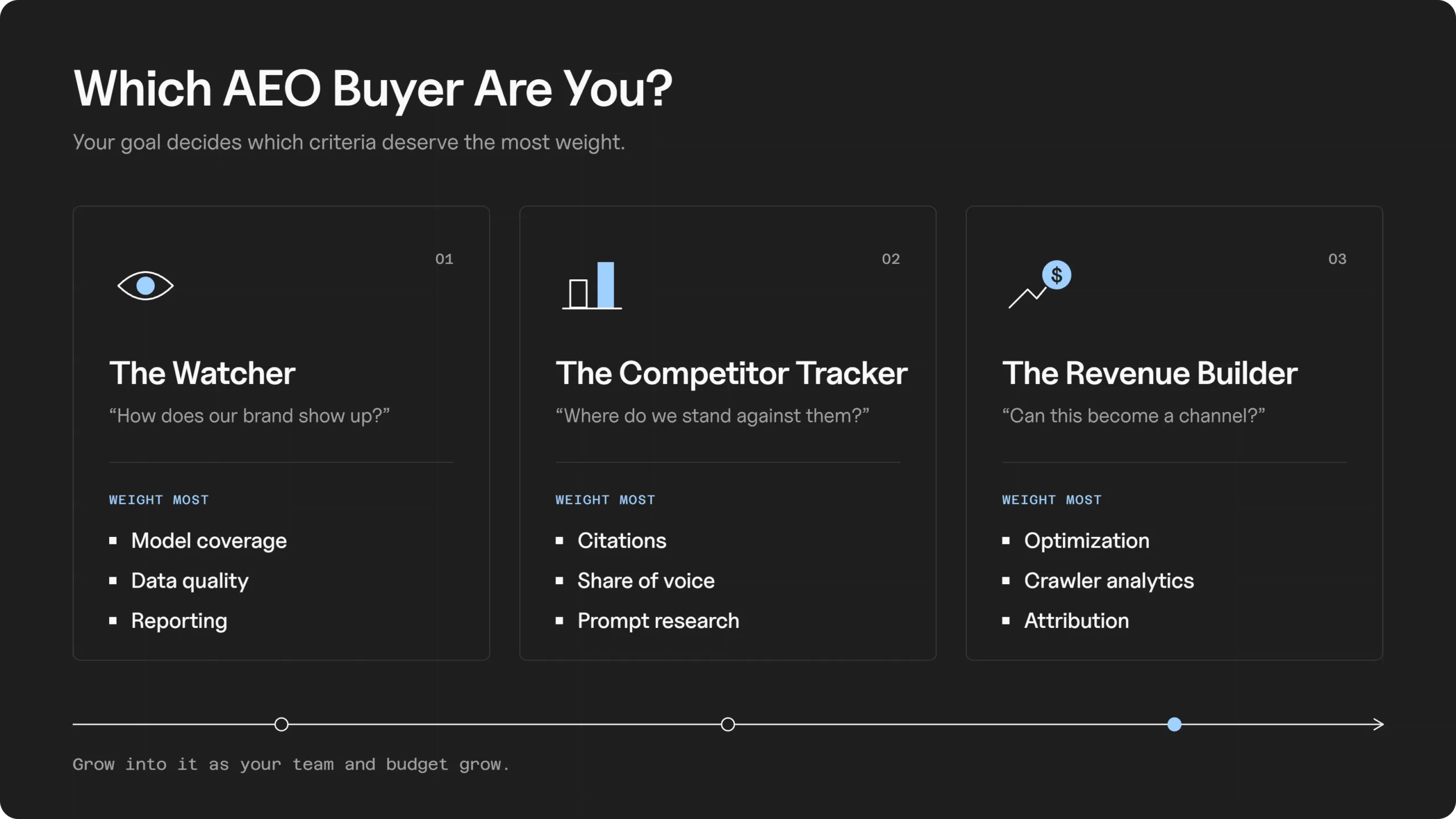
Start with what you want the tool to do, because your goal decides which criteria deserve the most weight. Most buyers fall into one of three groups:
- The Watcher (“How does our brand show up?”): You want a clear, trustworthy picture of your AI search visibility. Data quality, model coverage, and simple reporting matter most, and optimization can wait.
- The Competitor Tracker (“Where do we stand against them?”): You want competitive benchmarking against named rivals. Citation analysis, AI share of voice, and prompt research matter most.
- The Revenue Builder (“Can this become a channel?”): You want to influence AI answers and tie them to pipeline. Optimization workflows, crawler analytics, and revenue attribution matter most.
Your team and budget then adjust the weights. A two-person marketing team with no developer should favor a platform that tells you what to fix, in order, over one that hands you a beautiful dashboard and wishes you luck. An agency or a multi-brand company should move security and workspace support up the list.
A tight budget is a perfectly good reason to start as a Watcher and grow into a Revenue Builder. Paying for workflows nobody has time to run is the expensive way to learn that lesson.
What Criteria Should You Use to Evaluate an AEO Platform?
Weight data collection, model coverage, and the ability to act and measure above everything else, then let your buyer type rank the rest.
Model and Surface Coverage
Your buyers don’t pick one AI tool and stay loyal to it, and the models don’t agree with each other either. A platform that only covers ChatGPT is showing you one room of a much bigger house.
- What good looks like: ChatGPT, Gemini, Perplexity, Claude, Copilot, Google AI Overviews, and AI Mode as the baseline, plus Grok, Meta AI, and DeepSeek if your audience uses them. Commerce brands should also ask about shopping assistants like Amazon’s Alexa for Shopping and Walmart’s Sparky. Results should filter by model, country, and language.
- Ask: Which models and surfaces do you cover today, and how do you decide when to add a new one?
- Matters most for: Everyone.
Data Collection Method (API vs. Front End, With Web Search Enabled)
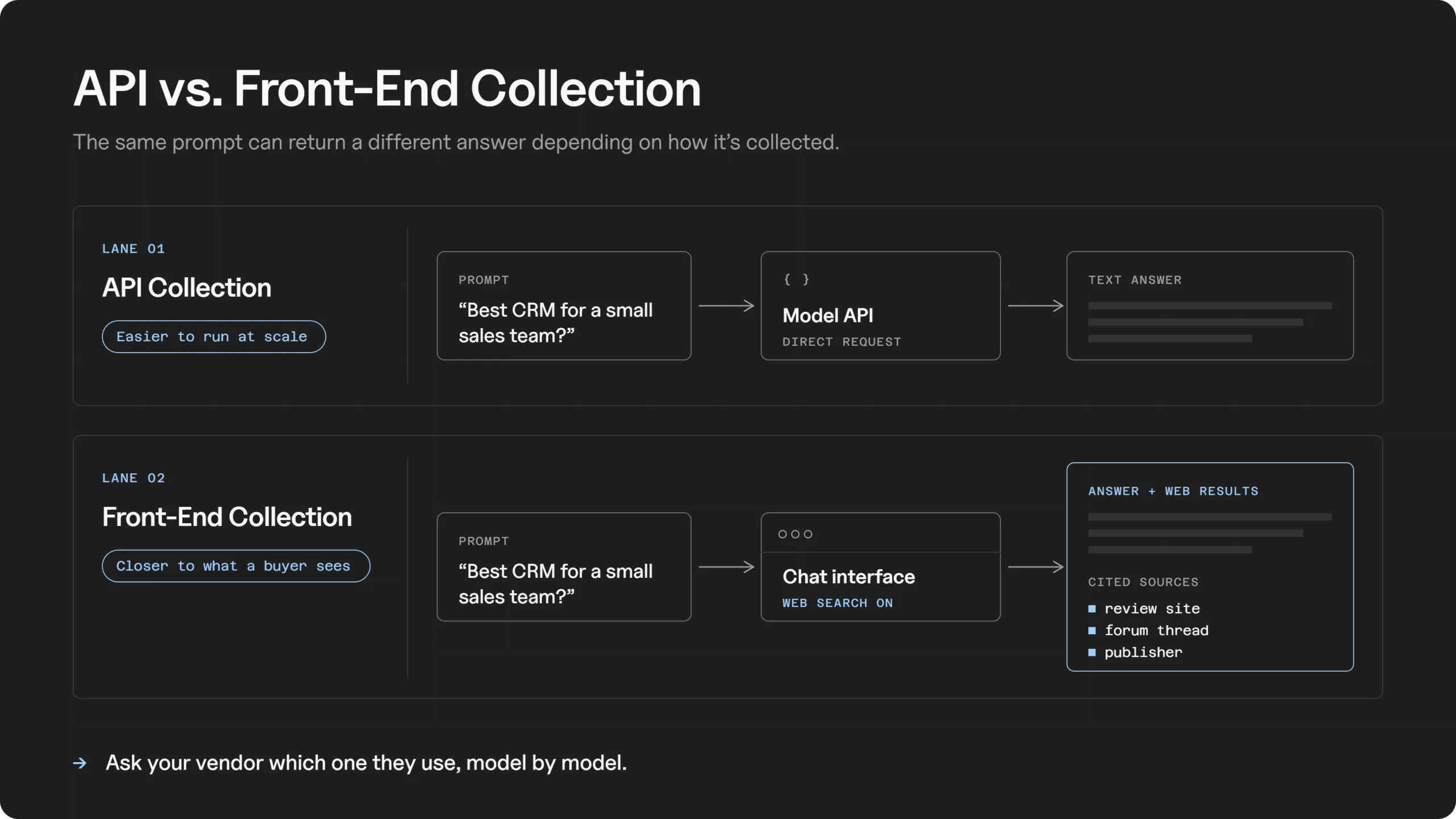
This is the question vendors least like answering, which is why it belongs near the top of your list. Answers pulled through a model’s API can differ from what a person sees in the chat window, especially when web search is on, and that changes which sources get cited.
- What good looks like: The vendor states the method for each model, whether web search is on, and why it chose that setup.
- Ask: For each model, do you collect answers through the API or the front end, and is web search enabled?
- Matters most for: Everyone, especially Revenue Builders.
Refresh Frequency, Response Sampling, and Methodology Transparency
Ask the same AI the same question twice, and you can get two different answers. A platform that runs each prompt once and reports a tidy percentage is presenting a guess with a lot of confidence.
- What good looks like: A documented refresh schedule (so you can judge data freshness), several samples per prompt, a written explanation of how those samples become a score, and trends over time instead of one-off snapshots. Our post on probabilistic vs. deterministic AEO metrics explains which numbers to treat as facts and which as trends.
- Ask: How often does each prompt run, how many samples do you take, and can we see the scoring method in writing?
- Matters most for: Watchers and Competitor Trackers.
Prompt Research and Prompt Volume Data
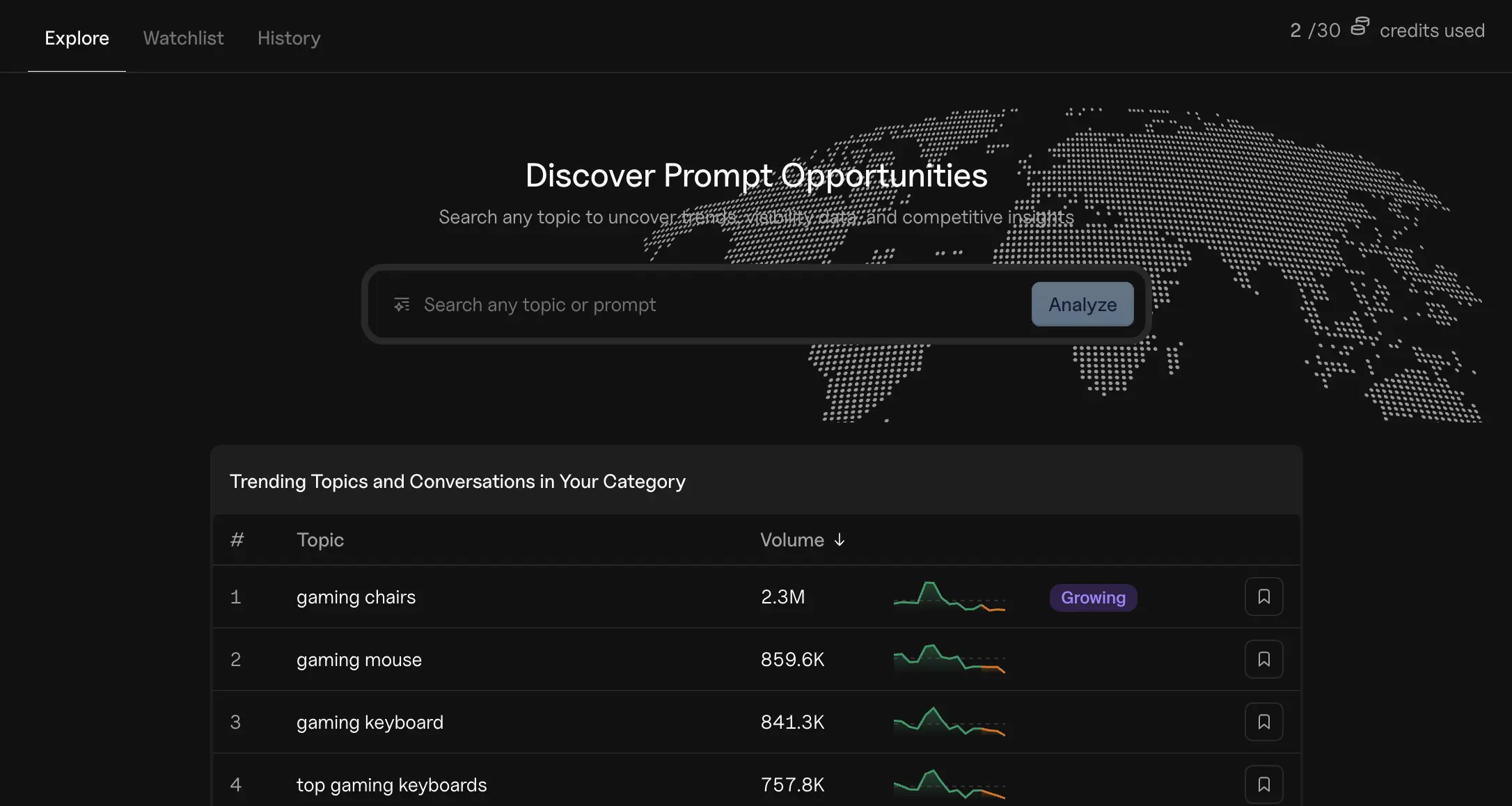
Tracking the wrong prompts gives you a very precise answer to a question nobody asked. Before you set up prompt tracking, you need to know what buyers actually type into these tools.
- What good looks like: A clear source for how prompts are discovered, prompts grouped into topics, some signal of demand, the freedom to add your own, and estimates labeled as estimates.
- Ask: Where does your prompt volume data come from, and which parts are measured versus modeled?
- Matters most for: Competitor Trackers and Revenue Builders.
This is the problem we built Goodie’s prompt research to solve. It groups related questions into prompt clusters, looks at conversation volume, seasonality, and intent, and scores competitive opportunity, so you start with the prompts worth winning instead of the ones you guessed.
Citation and Source Analysis
If brand mentions tell you whether you’re in the answer, citations tell you why. They show which publications, review sites, and forums AI trusts in your category, which also maps where to publish and who to pitch.
- What good looks like: Citation tracking that shows the exact sources behind each answer, by model, with a competitor comparison and a split between owned, earned, and social sources.
- Ask: Can we see the sources behind every answer, and the prompts where a competitor is cited and we’re not?
- Matters most for: Competitor Trackers.
Once you have that source list, an earned media audit of the sites AI cites for your brand turns it into an outreach plan.
Sentiment and Accuracy Monitoring
Being mentioned isn’t much of a win if the answer gets your pricing wrong. An inaccurate mention puts a false fact in front of a buyer who has no reason to doubt it, which can do more harm than no mention at all.
- What good looks like: Sentiment scored per mention, a way to flag and review inaccurate statements against facts you’ve approved, and alerts when the tone around your brand shifts.
- Ask: How do you catch an AI answer that states something wrong about us, and what happens next?
- Matters most for: Watchers and anyone in a regulated industry.
Goodie’s Brand Command works this way: your team approves a set of brand facts once, every AI answer gets checked against them, and false claims come back ranked by reach, so you fix the most-seen error first.
AI Crawler and Agent Analytics
If AI crawlers and agents can’t reach your pages, you’re making citations harder to earn, and no amount of content work fixes a blocked bot.
- What good looks like: Which AI bots visit your site (GPTBot, OAI-SearchBot, ClaudeBot, PerplexityBot), which pages they read, how that changes over time, and an alert when one gets blocked. Agent analytics (visits from AI agents acting for a user) is a bonus.
- Ask: Can we see which AI crawlers and agents reach our site, which pages they read, and when access is blocked?
- Matters most for: Revenue Builders.
One trap to know before the demo: Google-Extended is a robots.txt control token, not a separate crawler, so it never shows up in your logs. A vendor that reports “Google-Extended visits” is misreading the data.
Optimization Workflows
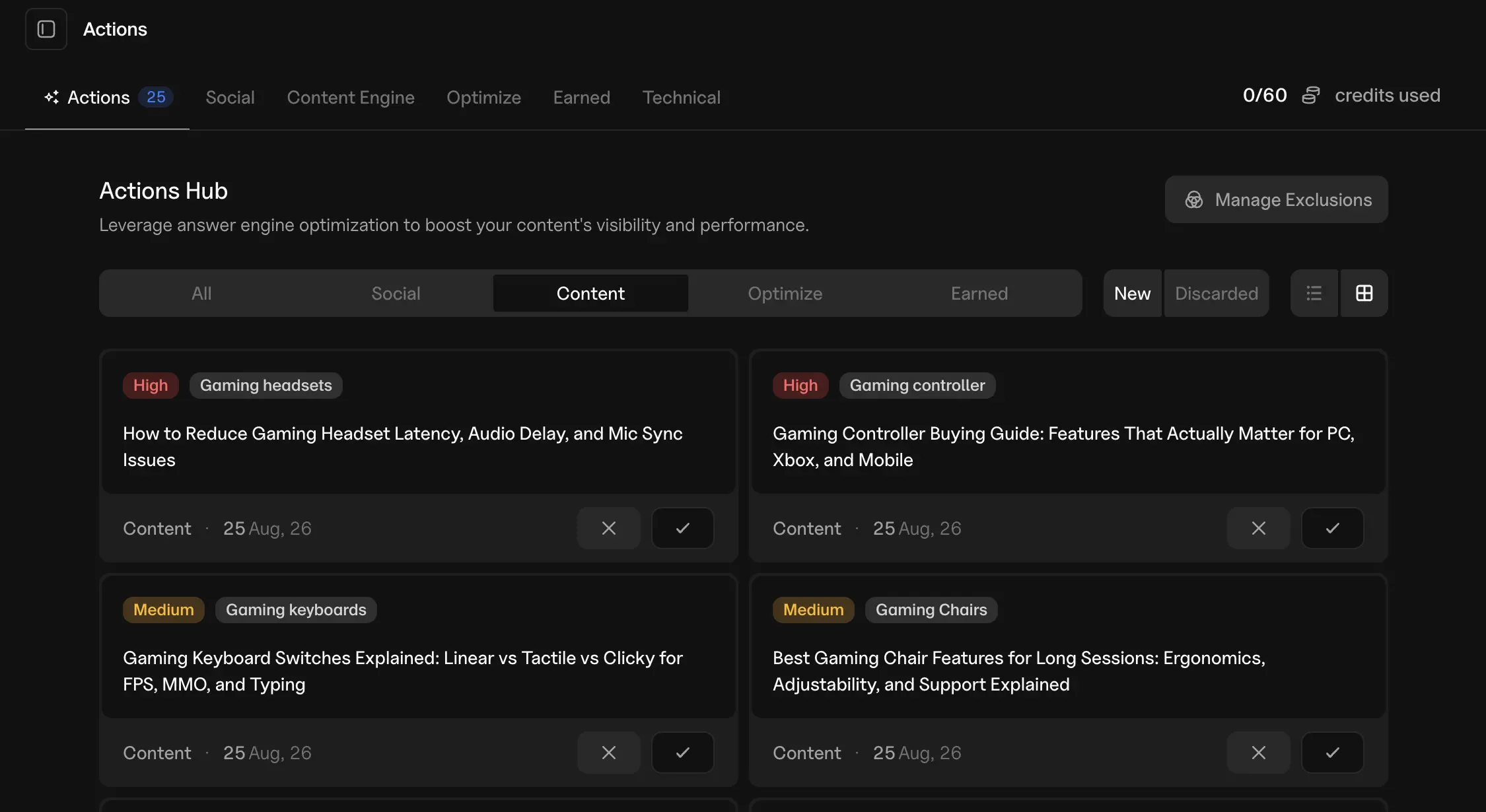
Monitoring without a next step is just a very expensive way to feel anxious. If you’re a Revenue Builder, the real question is whether the platform tells you what to fix and in what order.
- What good looks like: Specific recommendations (this page, this change), ranked by effort and impact, that fit your content workflows and track what happens after you act.
- Ask: Show us a recommendation from a real account. What evidence is behind it, and how do you know if it worked?
- Matters most for: Revenue Builders and small teams.
This is where Goodie’s Optimization Actions come in. Each recommendation carries a difficulty level, an estimated timeline, and a projected impact on citation rate, and you can filter by action type (content, technical, earned, or social) to match the hours your team has. UK wealth manager Rathbones used it to decide which technical fixes and outreach targets to tackle first, and grew total AI citations by 106% (Rathbones case study).
Revenue Attribution and Integrations
This is the criterion that separates curiosity from a channel. If you can’t connect AI visibility to traffic and pipeline, AEO stays a line in a slide deck instead of a line in the budget.
- What good looks like: Integrations with your analytics (GA4) and CRM, API access or exports into tools like Looker Studio, a split between AI referral traffic and influenced demand, and estimates clearly labeled.
- Ask: Which analytics and CRM systems do you integrate with, and how do you separate measured revenue from modeled revenue?
- Matters most for: Revenue Builders.
Goodie’s Analytics & Attribution connects to Google Analytics to identify AI visits, follows that traffic through lead generation and CRM data, and models the influenced revenue that clicks alone would miss.
Security, Compliance, and Multi-Brand or Agency Support
Nobody gets excited about this section until procurement sends over a long security questionnaire. The platform holds your prompts and competitive research, so it deserves the same scrutiny as any marketing system.
- What good looks like: A SOC 2 Type II report the vendor will share (Type I confirms controls exist at a point in time; Type II confirms they worked over a period), single sign-on (SSO), role-based access, an audit trail, and separate workspaces for each brand or client.
- Ask: Which certifications do you hold, can we see the report, and how do permissions work across brands or client workspaces?
- Matters most for: Agencies, multi-brand companies, and enterprise teams.
For reference, Goodie holds SOC 2 Type I and Type II attestations and supports SAML-based SSO, SCIM user provisioning, and role-based access.
Compliance Review and Claims Accuracy for Regulated Industries
In healthcare, finance, insurance, or legal services, an inaccurate AI answer can become a compliance problem, so add two lines to the checklist (your legal team sets the actual bar).
- Claims accuracy monitoring: The platform should help you spot AI answers that misstate rates, eligibility, outcomes, or product claims, so a person can review them.
- Compliance review workflows: Any change the platform recommends should pass an approval step before it goes live, with a record of who signed off.
- Ask: Can our compliance team review recommended changes before they publish, and can you flag AI answers that make claims we would never approve?
Our guide to AEO for healthcare brands covers how this plays out in one of the strictest categories.
Onboarding, Support, and Pricing Model
The best feature set in the world loses to a tool nobody on your team opens. And the cheapest sticker price rarely means the lowest total cost of ownership.
- What good looks like: A named onboarding plan, a dedicated strategist if you need one, unlimited seats (or a clear per-seat price), and pricing that shows what each prompt, seat, or credit costs.
- Ask: What does year one cost in total, including prompts, seats, models, and support, and what would change the price?
- Matters most for: Small teams and anyone on a tight budget.
Score Every Vendor on the Same Scorecard
Use this as your buyer’s checklist for a side-by-side AEO platform comparison. Score each vendor from 1 to 5 on every criterion, multiply by the weight for your buyer type, and add it up. Weights run from 1 (nice to have) to 3 (must have), so adjust them to fit your team.
| Criterion | Watcher Weight | Competitor Tracker Weight | Revenue Builder Weight | Score (1-5) |
| Model and surface coverage | 3 | 3 | 3 | |
| Data collection method | 3 | 3 | 3 | |
| Refresh, sampling, and methodology transparency | 3 | 3 | 2 | |
| Prompt research and prompt volume data | 1 | 3 | 3 | |
| Citation and source analysis | 2 | 3 | 3 | |
| Sentiment and accuracy monitoring | 3 | 2 | 2 | |
| AI crawler and agent analytics | 1 | 1 | 3 | |
| Optimization workflows | 1 | 2 | 3 | |
| Revenue attribution and integrations | 1 | 1 | 3 | |
| Security, compliance, and multi-brand support (3 if regulated or agency) | 2 | 2 | 2 | |
| Onboarding, support, and pricing model | 3 | 2 | 2 |
What Questions Should You Ask AEO Vendors During a Demo?
Ask every vendor the same questions, ideally in writing, so your vendor evaluation compares like with like, and score the answers on the scorecard above. The set below is built to paste straight into an RFP.
Data and Methodology
- Which models and surfaces do you cover today, and what’s on the roadmap?
- For each model, do you collect answers through the API or the front end, and is web search on?
- How many samples do you take per prompt, and how do those samples become a visibility score? Can we see the method in writing?
- Where does your prompt volume data come from, and which parts are modeled?
A good answer sounds specific and a little boring, something like: “Front end for these models, API for that one, web search on, five samples per prompt, here’s the doc.” “It’s proprietary” is not an answer.
Action and Measurement
- Show us a real recommendation from a real account (anonymized is fine). What evidence is behind it?
- How do you measure whether a change worked?
- Which analytics and CRM systems do you integrate with, and can we export the data?
A good answer happens on screen, inside the product.
Security, Support, and Cost
- Do you support SSO, role-based access, and separate workspaces per brand or client?
- (Regulated industries) Can our compliance team approve changes before they publish?
- Who is our point of contact, and what happens in the first 30 days?
- What does year one cost in total, and what would change the price?
- If we leave, can we take our data with us?
A good answer names a person, a timeline, and a number.
What Are the Red Flags When Evaluating AEO Platforms?
The biggest red flag is a vendor that can’t explain how its numbers are made. Almost everything else on this list is a variation on that.
- Dodging the collection question: If the vendor can’t or won’t say whether answers come from the API or the front end, you can’t judge how close the data is to what buyers see.
- No answer on sampling: A vendor that can’t tell you how many runs sit behind a score is presenting a guess as a precise number.
- Vanity dashboards: Mentions and rankings with no sources and no next step. You’ll know how you’re doing and have no idea what to do about it.
- Projections nobody can explain: Any lift or ROI figure should come with the inputs behind it when you ask.
- A meter you can’t read: No clear answer on what counts as a prompt, seat, or credit, or what happens when you go over.
- Canned demos only: The vendor won’t run your brand, and your prompts live.
- Security answers that come “later”: Certifications and access controls should be easy to document before you sign.
- Pressure to skip the pilot: A vendor confident in its product will let you test it.
How Do You Run a Pilot Before Committing to an AEO Platform?
Run a short proof of concept on your own prompts, with pass or fail criteria written down before day one. A demo shows you what the vendor wants you to see. A pilot shows you what the product does with your brand.
- Name your goal. Pick your buyer type so you know which criteria carry the weight.
- Pick your prompts. Use a set you care about, including a few where you already know what a good answer looks like.
- Spot-check by hand. Run some prompts yourself in the real chat interfaces and compare with what the platform reports.
- Write the pass criteria. For example: the data matches your spot checks, the team opens the tool every week, and at least one recommendation becomes a shipped change.
- Ship one fix. Then watch whether the platform notices.
- Score and decide. Use the scorecard, and if you’re piloting two vendors, give them the same prompts.
How long to run it depends on how fast answers move in your category. Our post on how long AEO takes to show results covers realistic timelines.
Pick the Platform That Fits the Buyer You Are
The platform worth signing is the one that fits what you’re trying to do, the team you have, and a budget you can defend to someone who has never heard the word “AEO.” A longer feature list doesn’t change that math.
So decide which buyer you are before you book a single demo, and let that set your weights. Use the scorecard and bring it to every call.
Here’s where to go next:
- Use the scorecard. Use the checklist and bring it to every demo.
- Get the numbers right first. Read our guide to probabilistic vs. deterministic AEO metrics before your first vendor call, so you know what a trustworthy score looks like.
- Put Goodie on the scorecard. Book a demo and grade us against the checklist. We’d rather you score us than take our word for it.
Put Goodie on Your Scorecard
Bring your checklist to your demo and grade us on every criterion. We’d rather you score us than take our word for it.
How to Choose an AEO Platform: FAQs
Self-serve plans from vendors that publish prices run from about $29 to just under $500 a month, and enterprise plans are almost always custom. How a platform meters usage matters more than the sticker price, so compare pricing models first. Based on vendors’ own pricing pages in October 2026:
- Prompt-based: You pay for the prompts you track. Entry plans start around $29 to $99 a month for 15 to 50 prompts, and larger plans run up to about $495 a month for 350 to 400 prompts.
- Prompts plus seats: Some platforms bundle a set number of prompts with a few user seats, starting around $250 a month for 125 prompts and five users, with extra seats at about $25 a month each.
- Credit-based: Each AI response or engine query uses credits. Published plans run from about $99 to $295 a month at the entry level and up to $780 for 12,000 credits.
- Sales-led: Many enterprise-focused platforms don’t publish prices at all, so the number comes from a sales call.
Annual billing knocks 15% to 17% off on the pages we checked. Whatever the model, ask for the total cost of ownership for year one, because extra models, extra prompts, overages, and support add up fast.
The front end gets you closer to what a buyer sees, and the API is easier to run at scale. Some vendors mix the two by model. Ask for the same prompt collected both ways: if the cited sources differ, you’ll see how much the method matters in your category.
Weekly is enough for most Watchers, and daily matters if you’re shipping changes or tracking a launch. Ask about prompt volume data separately, since demand data and visibility data can run on different schedules. More samples per prompt will do more for your accuracy than more frequent runs.
Sometimes, if all you need is light monitoring on whether you appear. Some SEO suites sell AI tracking as an add-on (around $99 a month for 25 tracked prompts), and for a Watcher that can be plenty. Run it through the same scorecard: if it can’t show sources or tell you what to fix, it isn’t enough for a Revenue Builder.
At minimum, a SOC 2 Type II report the vendor will share, plus SSO and role-based access. Ask how they handle your data under rules like GDPR, whether your data is ever used to train models, and check with your compliance team first if you’re in a regulated industry.
Compare what you can measure against what you pay, and keep estimates labeled as estimates:
- Set a baseline for visibility and AI referral traffic before you start.
- Track AI referral traffic in your analytics, with a channel group that keeps AI referrals out of “Direct,” and follow it to leads and pipeline in your CRM.
- Ask buyers directly. A “how did you hear about us” field on your lead form recovers AI exposure that no tracking pixel sees.
- Report influenced demand separately, since many AI answers never produce a click.
- Count the full cost, including the platform and the hours your team spends acting on it.
Our AI search revenue attribution guide lays out the full ladder, from referral clicks up to holdout tests.