The SEO community has gotten query fan-out mostly wrong.
I’ve watched marketers treat every synthetic query like a new keyword to target, building separate pages for variants that will never drive meaningful visibility. I’ve seen tools pitch fan-out tracking as “the solution” without explaining what to actually do with the data. And I’ve witnessed agencies charge premium rates to optimize for queries that shift every time the model runs.
The reality is this: query fan-out represents the single most significant shift in how search systems retrieve and rank content since the introduction of semantic search. But it’s not about chasing individual queries. It’s about understanding how AI systems think, what they look for, and how to build content that consistently appears across thousands of probabilistic retrieval paths.
This guide breaks down exactly how query fan-out works, how to access the data yourself, and (most importantly) how to use it strategically without falling into the hyper long-tail trap that’s already burning through optimization budgets across the industry.
What Is Query Fan-Out?
Query fan-out is the process where AI search systems expand a single user query into multiple sub-queries, executing them in parallel to gather comprehensive information before synthesizing a final response.
When you ask ChatGPT, “what’s the best project management tool for remote teams?”, it doesn’t just search for that exact phrase. Behind the scenes, it generates and executes 5-15 related queries:
- “project management software remote teams 2025”
- “Asana vs Monday for distributed teams”
- “project management tools with time tracking”
- “best collaboration software for remote work”
- “project management pricing comparison”
Each of these queries retrieves information from different sources. The model then selects the most relevant passages (note: passages are very important here) from across all results, synthesizes them into a coherent answer, and cites the sources it deemed most authoritative for each specific claim.
This practice isn’t just unique to ChatGPT. Google’s AI Overviews and AI Mode use the same approach. So do Perplexity, Gemini, and Microsoft Copilot. Query fan-out is now the standard architecture for how AI search systems ground their responses in web data.
Why Query Fan-Out Changes Everything
The shift from single-query to multi-query retrieval fundamentally breaks traditional SEO assumptions.
- Old model: One query → One SERP → Pages ranked 1-10 get traffic
- New model: One query → 10-20 synthetic queries → Hundreds of pages retrieved → AI selects best passages → Synthesizes answer → Cites 3-8 sources
Your visibility is no longer determined by where you rank for a primary keyword. It’s determined by whether you have the best passage for any of the sub-queries the model generates (and whether that passage gets selected for the final synthesis).
This creates several critical implications:
1. Ranking #1 Doesn’t Guarantee Visibility
You can rank #1 for “best CRM software,” but if the AI generates sub-queries around “CRM with email automation” or “HubSpot vs Salesforce for SMBs” and your content doesn’t address those angles, you’re invisible in the AI answer.
2. Passage-Level Selection Trumps Page-Level Authority
AI systems chunk content into semantic passages and evaluate each independently. A single paragraph from a smaller site can win over your comprehensive 5,000-word guide if that paragraph better answers a specific sub-query.
3. Topical Coverage Becomes the Unit of Optimization
You’re not optimizing for keywords anymore. You’re optimizing for topical clusters that address the full constellation of sub-queries a user’s question might generate.
4. Attribution Becomes Probabilistic
Traditional analytics show which keywords drove traffic. AI search creates a probabilistic visibility model where your content might be retrieved for dozens of synthetic queries you’re not tracking, with citation rates that vary 40-60% month-to-month even for the same prompts.
The Technical Mechanics: How Query Fan-Out Actually Works
Query fan-out sits within the broader Retrieval-Augmented Generation (RAG) pipeline. Understanding this architecture is critical to knowing where optimization actually matters.
Step 1: Query Analysis
When a user submits a prompt, the system analyzes:
- Intent Complexity: Simple factual queries might not trigger fan-out. Complex, exploratory, or comparative queries do.
- Recency Requirements: Queries asking about “latest,” “current,” or time-sensitive information trigger web grounding.
- Confidence Score: If the model’s parametric knowledge (training data) scores below a threshold, it triggers web search.
For Google’s Gemini models, this confidence score threshold can be configured via the dynamic_retrieval_config with a dynamicThreshold parameter. Set it to 0.7, and the model only searches when confidence drops below 70%.
Step 2: Synthetic Query Generation
If fan-out is triggered, an LLM generates multiple sub-queries. Google’s patent lists eight distinct query types:
| Query Type | Definition |
|---|---|
| Equivalent Query | Alternative phrasings of the same question |
| Broader Query | Higher-level category or concept |
| Parallel Query | Related sibling topics |
| Related Query | Semantically adjacent concepts |
| Narrower Query | More specific sub-topics |
| Personalized Query | Tailored to user context, location, history |
| Comparative Query | Side-by-side evaluations (A vs B) |
| Implicit Query | Unstated but likely underlying needs |
The system uses structured prompting to generate these variants, with instructions like: “Generate comparative queries for this search intent” or “What implicit questions might this user have?”
Step 3: Parallel Retrieval
All synthetic queries execute simultaneously across multiple data sources:
- Live web (via Google or Bing APIs)
- Knowledge graphs
- Specialized databases (Shopping Graph, Finance, Maps, etc.)
- Internal indices (if using private data sources)
For ChatGPT, this happens through Bing. For Google AI Mode, it’s Google’s own infrastructure. The key insight: parallel execution is critical. If queries ran sequentially, response time would explode. Running 15 queries in parallel takes roughly the same time as one.
Step 4: Chunking & Embedding
Retrieved documents get processed:
- Chunking: Split into semantic passages (typically 200-500 tokens)
- Embedding: Convert to vector representations
- Dense Retrieval: Similarity search to find most relevant chunks
Chunking strategies vary. Some systems use fixed-size windows. Others use recursive splitting or layout-aware parsing. The goal: Create semantically coherent passages that can be evaluated independently.
Step 5: Filtering & Ranking
This is where selection happens. The system applies multiple filters:
Reciprocal Rank Fusion (RRF)
Passages appearing across multiple sub-queries get boosted. If a chunk ranks in the top 10 for both “project management software” and “team collaboration tools,” it scores higher than content ranking for just one.
Pairwise Ranking
An LLM compares passages head-to-head. “Which better answers this question: Passage A or Passage B?” This happens across many pairs to build a ranked list.
Grounding Confidence
For each claim in the candidate answer, the model scores how well available passages support it. Low-confidence claims might trigger additional queries or get dropped entirely.
Freshness Scoring
Newer content gets preference for time-sensitive queries. Research shows AI systems cite content that’s 25.7% fresher than traditional search results.
Step 6: Synthesis & Citation
The model generates a final response, weaving together information from selected passages. Not all retrieved sources get cited; only those that directly support specific claims in the answer.
Critical Distinction: Google tends to ground a single fact with multiple sources. OpenAI often maps one fact to one URL. This affects optimization strategy:
- For Google, you need passage-level excellence across multiple angles
- For OpenAI, you need comprehensive coverage in single sources
Accessing Query Fan-Out Data
The transformative moment for practitioners came when we discovered we could actually see the synthetic queries AI systems generate. Here are the primary methods:
Method 1: Chrome DevTools (ChatGPT)
ChatGPT exposes fan-out queries in its network traffic. Here’s exactly how to access them:
- Open ChatGPT and start a conversation that will trigger web search
- Open Chrome DevTools: Right-click → Inspect (or Ctrl+Shift+I / Cmd+Option+I)
- Go to Network tab
- Submit your prompt that requires web search
- Filter requests: In the Network panel, type your conversation ID from the URL
- Find the response: Look for fetch/XHR requests, click one
- Go to Response tab
- Search for queries by pressing Ctrl+F and searching for search_model_queries
You’ll find JSON like this:
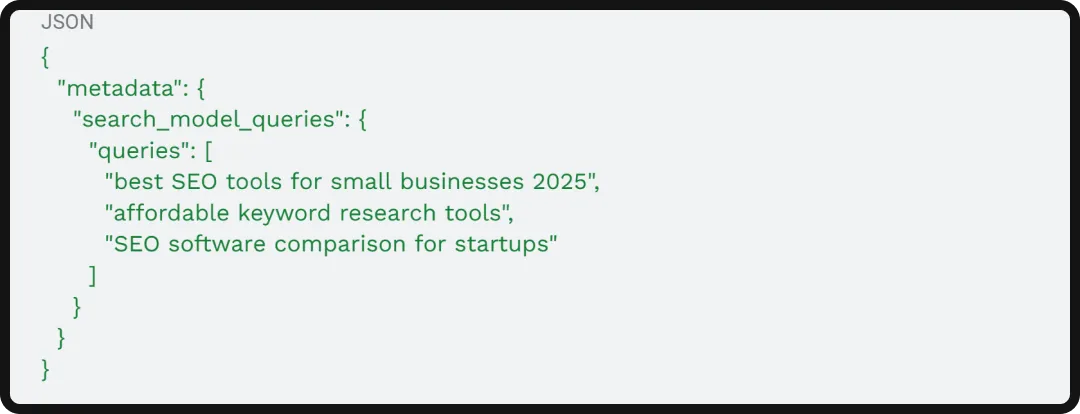
These are the actual queries ChatGPT sent to Bing before generating your answer.
Important notes:
- This only works when ChatGPT triggers web search
- Not all OpenAI models expose this data
- The queries are probabilistic (run the same prompt twice and you’ll get different variants)
Several Chrome extensions now automate this extraction:
- LLMrefs ChatGPT Search Query Extractor (free)
- ChatGPT Query Fan-Out Inspector by Spotlight
- AI Search Fan-Out Tracker
- Keyword Surfer (shows fan-outs with search volume data)
Method 2: Gemini Grounding API
Google provides first-party access to fan-out queries through the Gemini API’s grounding metadata.
When you enable google_search or google_search_retrieval as a tool, the API response includes:
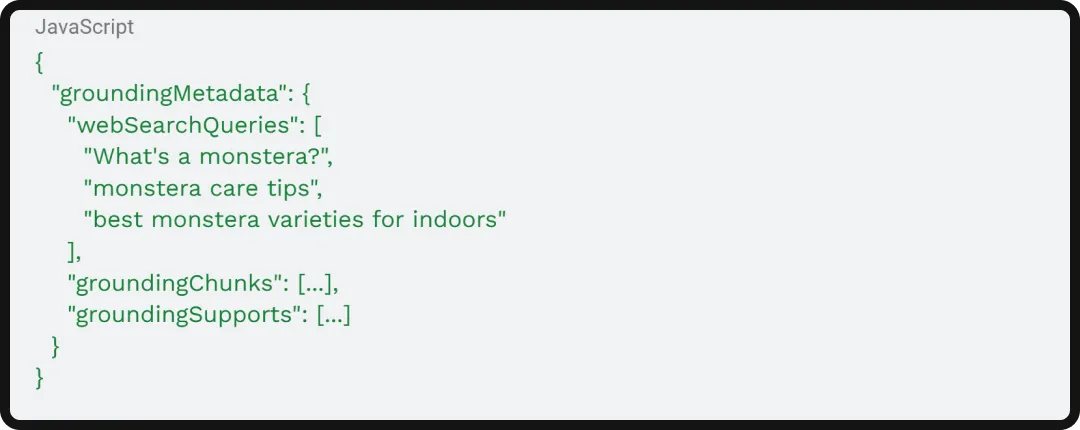
The webSearchQueries field shows exactly what Google searched to ground the response.
Setup example:
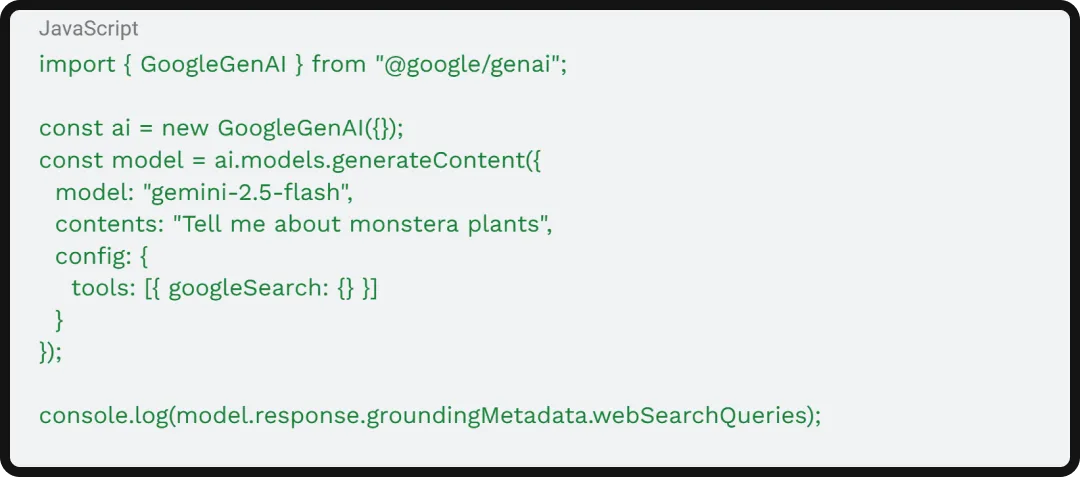
Why this matters:
This is the most accurate window into how Google’s models deconstruct queries. If you’re optimizing for AI Overviews or AI Mode, this is the exact behavior you need to understand.
Limitations:
- Requires a paid Gemini API key
- Adds latency and cost to each request
- Still probabilistic (the same query can generate different fan-outs)
Method 3: AI Mode “Thoughts” in Google AI Studio
Google AI Studio (formerly MakerSuite) provides a “Thoughts” panel that shows Gemini 2.5’s internal reasoning process.
Access it at aistudio.google.com:
- Select Gemini 2.5 Pro or Gemini 2.5 Flash
- Enable the “Show thoughts” toggle
- Submit your query
- Review the Thoughts panel
You’ll see how the model:
- Breaks down your question
- Identifies sub-intents
- Decides what information to retrieve
- Structures its search strategy
This doesn’t give you the exact queries (those are in the API response), but it shows the reasoning behind query generation; invaluable for understanding intent decomposition.
The Query Fan-Out Tool Landscape
The market has responded with several purpose-built tools. Here’s an honest assessment of each (plus a handy overview):
| Tool | What It Is | Strength | Weakness | Best For |
|---|---|---|---|---|
| Gemini Grounding API | First-party access to Google’s query decomposition through the Gemini API | Official Google data, not reverse-engineered | Requires developer setup | Teams with technical resources who need authoritative Google-specific data |
| DEJAN’s Queryfanout.ai & Query Fan-Out Generator | Generates query variants based on Google’s patent architecture | Free tool at dejan.ai/tools/fanout/ | Generates predictions, not actual ChatGPT or Gemini queries | Gap analysis and discovering blind spots in your content clusters |
| Goodie’s Query Fanouts (Platform Feature) | Built into Goodie’s AEO platform, automatically captures fan-outs from millions of daily prompts across ChatGPT, Gemini, and more | Only tool that tracks real fan-outs at scale (millions per day) | Requires paid Goodie subscription (starts at $495 per month) | Enterprises serious about AI search visibility who need systematic monitoring and competitive intelligence |
| Qforia | Gemini-powered tool that simulates query fan-out for both AI Overviews and AI Mode | Built by one of the industry’s leading AI search researchers | Requires manual API key setup | Content strategists planning multi-format campaigns who need to understand the full intent landscape |
Gemini Grounding API (Google)
What It Is: First-party access to Google’s query decomposition through the Gemini API.
Strengths:
- Most accurate for Google AI Overviews and AI Mode optimization
- Official Google data, not reverse-engineered
- Includes full grounding metadata (sources, confidence scores)
Weaknesses:
- Requires developer setup
- Costs per API call ($25 per 1,000 grounded prompts)
- No built-in analysis or recommendations
Best For: Teams with technical resources who need authoritative Google-specific data.
DEJAN’s Queryfanout.ai & Query Fan-Out Generator
What It Is: One of the earliest purpose-built tools, developed by AI SEO pioneer Dan Petrovic. Generates query variants based on Google’s patent architecture.
Strengths:
- Free tool at dejan.ai/tools/fanout/
- Trained on Google’s actual query generation patterns
- Includes “High Effort” mode for deep fan-out analysis
- Provides query demand estimates using deep learning
Weaknesses:
- Generates predictions, not actual ChatGPT/Gemini queries
- No tracking or monitoring features
- Limited to query generation (no content analysis)
Best For: Gap analysis and discovering blind spots in your content clusters.
Goodie’s Query Fanouts (Platform Feature)
What It Is: Built into Goodie’s AEO platform, this tool automatically captures fan-outs from millions of daily prompts across ChatGPT, Gemini, and other engines.
Strengths:
- Only tool that tracks real fan-outs at scale (millions per day)
- Shows query frequency across time
- Identifies trending variations
- Integrated with citation tracking and content optimization workflows
- No manual setup required
Output:
- Top query variations by frequency
- Word-level transformations
- Temporal trends in query generation
- Gap analysis vs. your current content
Weaknesses:
- Requires paid Goodie subscription ($399+/month)
- Limited to prompts you’re actively tracking
- Can’t generate fan-outs for arbitrary queries on demand
Best For: Enterprises serious about AI search visibility who need systematic monitoring and competitive intelligence.
Qforia (by iPullRank’s Mike King)
What It Is: Gemini-powered tool that simulates query fan-out for both AI Overviews and AI Mode. Can be accessed at ipullrank.com/tools/qforia (free, requires paid Gemini API key).
Strengths:
- Built by one of the industry’s leading AI search researchers
- Distinguishes between AI Overview vs AI Mode behavior
- Shows query type classification (comparative, implicit, personalized, etc.)
- Includes user intent analysis and content format recommendations
Weaknesses:
- Requires manual API key setup
- No automated tracking or alerts
- Results are probabilistic (varies per run)
Best For: Content strategists planning multi-format campaigns who need to understand the full intent landscape.
Other Notable Tools:
- Locomotive’s Query Fan-Out Tool (aicoverage.locomotive.agency): Uses embeddings to compare your content against top-ranking pages and identify semantic gaps.
- Wellows Query Fan-Out Generator: Free tool that generates variants across eight query types with popularity, relevance, and prominence scoring.
- Surfer’s Keyword Extension: Chrome extension that shows ChatGPT fan-outs with search volume data (when available).
The Hyper Long-Tail Trap: Why You Shouldn’t Chase Individual Fan-Outs
This is where most teams get it wrong.
You discover that ChatGPT generates queries like:
- “best project management software for remote teams 2025”
- “Asana vs Monday for distributed teams”
- “project management tools with time tracking integration”
The temptation: Create individual pages targeting each query.
This is the hyper long-tail trap, and it will waste your entire optimization budget.
Here’s why:
1. Fan-Outs Are Inherently Probabilistic
Run the same prompt three times, and you’ll more than likely get three completely different sets of queries. Research shows that only 27% of fan-out queries remain consistent across multiple runs for the same prompt.
Surfer’s study also found that 66% of fan-out queries appear only once across 10 test runs.
The takeaway? You can’t optimize for a target that shifts every time the model runs.
2. Fan-Outs Are Personalized
Google’s patent explicitly describes personalization mechanisms:
- User location
- Search history
- Device type
- Time of day
- Previous conversation context
The fan-out queries generated for you running a test are different from what gets generated for actual users.
3. Volume Is Almost Always Zero
Fan-out queries are synthetic: generated by the model, not typed by users. Most have zero traditional search volume because no human has ever searched for that exact phrase.
Therefore, chasing these in traditional SEO tools is pointless.
4. You’re Playing Whack-a-Mole
Even if you build pages for every fan-out you discover today, the model will generate different queries tomorrow. You’ll be constantly creating new pages for variants that may never appear again.
This is a losing game.
The Right Way to Use Query Fan-Out Data
Query fan-out data is incredibly valuable (when used correctly). The goal isn’t to target individual queries. It’s to aggregate signals and identify topical themes that consistently emerge.
Framework: Topic Cluster Aggregation
Step 1: Collect fan-outs at scale
Don’t rely on 1-2 manual tests. Generate fan-outs for:
- 20-30 related prompts in your category
- Multiple time runs per prompt (minimum 3)
- Different tools (Goodie, Qforia, Dejan)
Example: For “project management software,” run fan-out analysis for:
- “best project management software”
- “project management tools for remote teams”
- “how to choose project management software”
- “project management software comparison”
- “affordable project management tools for startups”
- etc.
Step 2: Identify recurring themes
Look for patterns across all fan-outs:
- Which entities appear repeatedly? (Asana, Monday, ClickUp, Trello)
- Which attributes get mentioned? (pricing, integrations, ease of use, mobile apps)
- Which comparisons emerge? (Asana vs Monday, project management vs task management)
- Which use cases surface? (remote teams, creative agencies, software development)
Use clustering algorithms or manual tagging to group fan-outs by theme.
Step 3: Map themes to content architecture
Build your content structure around these themes, not individual queries:
Pillar page: Comprehensive guide covering the full topic
- Address all major entities
- Cover all key attributes
- Include primary comparisons
Cluster pages: Deep dives on specific themes
- Entity-specific pages (in-depth Asana review)
- Attribute pages (project management software pricing comparison)
- Use case pages (project management for remote teams)
- Comparison pages (Asana vs Monday vs ClickUp)
Supporting content:
- FAQs addressing common questions
- How-to guides
- Case studies and examples
Framework: Passage-Level Optimization
Remember: AI systems select content at the passage level, not page level.
Step 1: Identify core intent units
Break your topic into discrete intent units that can be answered in 1-3 paragraphs:
- What is X?
- How does X work?
- What are the benefits of X?
- How much does X cost?
- X vs Y comparison
- Best X for [use case]
Step 2: Create standalone passages
Each passage should:
- Address one specific intent completely
- Be semantically self-contained
- Include relevant entities and attributes
- Support claims with data/examples
Wrong Approach: Long flowing prose that requires reading 5+ paragraphs to understand any single point.
Right Approach: Modular sections with clear H2/H3 headers where each section independently answers a question.
Step 3: Use structured formats
AI systems preferentially select certain formats:
- Tables for comparisons and specifications
- Lists for features, steps, or options
- FAQ schema for question-answer pairs
- How-to schema for procedural content
Framework: Entity-Attribute Coverage
Fan-out analysis reveals which entities (products, companies, people, concepts) and attributes (features, specs, prices, benefits) matter for your topic.
Step 1: Extract entities and attributes
From all fan-outs, identify:
- Entities: Specific things mentioned (Asana, Monday, remote teams, startups)
- Attributes: Properties discussed (pricing, integrations, ease of use, mobile app)
Step 2: Build coverage matrix
Create a matrix:
| Platform | Pricing | Integrations | Ease of Use | Mobile App | Team Size |
|---|---|---|---|---|---|
| Asana | ✓ | ✓ | ✓ | ✓ | ✓ |
| Monday | ✓ | ✓ | ✓ | ✓ | ✓ |
| ClickUp | ✓ | ✓ | ? | ✓ | ? |
Gaps = optimization opportunities.
Step 3: Fill systematically
Create content that completes the matrix. This ensures you’re discoverable regardless of which specific fan-out query gets generated.
Measuring Success in a Probabilistic World
Traditional SEO metrics break in AI search. Here’s what to track instead:
1. Citation Rate
- What It Is: Percentage of tracked prompts where your content gets cited in AI answers.
- How to Track: Tools like Goodie, BrightEdge, or custom monitoring setups.
- Target: 15-25% citation rate for relevant prompts in your category.
2. Share of Citations
- What It Is: Your citations as a percentage of total citations across all sources.
- Calculation: Your citations / Total citations in answer
- Target: 20%+ share in your core category.
3. Position in Citation List
- What It Is: Where your citation appears (1st, 2nd, 3rd, etc.).
- Why It Matters: Earlier citations get more visibility and credibility.
- Target: Top 3 positioning for priority prompts.
4. Passage Selection Rate
- What It Is: Of the times your content is retrieved (appears in RAG results), how often does it get selected for the final answer?
- How to Track: Requires access to RAG logs or tools like Goodie’s Agent Analytics.
- Target: 40%+ selection rate when retrieved.
5. Topic Coverage Score
- What It Is: Percentage of identified topic themes/entities your content addresses.
- How to Calculate:
- Generate 50+ fan-outs for your category
- Identify 20-30 core themes
- Audit your content for coverage
- Score: (Themes addressed / Total themes) × 100
- Target: 80%+ coverage of core themes.
Advanced Considerations
Personalization Impact
Fan-out queries are personalized based on user context. This creates some challenges:
- Problem: You can’t know exactly which queries will be generated for each user.
- Solution: Build comprehensive coverage so you’re relevant across multiple personalization paths. Think of it like having more raffle tickets—you’re increasing probability, not guaranteeing outcomes.
Model Evolution
AI models update constantly. Fan-out patterns that work today might change tomorrow.
- Problem: Optimization targets shift as models improve.
- Solution: Focus on fundamental topic coverage rather than model-specific optimization. Core themes remain stable even as specific query generation evolves.
Content Cannibalization
When you build comprehensive coverage, you risk multiple pages competing for the same fan-outs.
- Problem: Semantic similarity between pages confuses retrieval systems.
- Solution: Use internal linking to establish hierarchies. Make it clear which page is authoritative for which theme.
Looking Forward
Query fan-out is just one component of how AI search systems operate. As these systems evolve, we’re seeing:
- Deeper Personalization: Fan-outs increasingly incorporate user history, preferences, and conversation context.
- Longer Reasoning Chains: Systems like Claude’s Deep Research and Gemini’s Deep Research generate hundreds of queries for complex questions.
- Multi-Modal Fan-Out: Future systems will fan out across text, images, video, and structured data simultaneously.
- Agentic Workflows: AI agents will use fan-out to plan complex tasks, not just answer questions.
The fundamental insight remains: AI search is probabilistic, not deterministic. Your job isn’t to rank for specific queries. It’s to build content that consistently appears across the thousands of possible retrieval paths the model might take.
Query fan-out gives you a window into how those paths get generated. Use it wisely.
Key Takeaways:
- Query fan-out is how AI systems deconstruct user questions into multiple sub-queries to gather comprehensive information.
- You can access real fan-out data through Chrome DevTools (ChatGPT), Gemini’s Grounding API, and specialized tools like Qforia and Goodie.
- Don’t chase individual fan-out queries (they’re probabilistic and personalized). Instead, aggregate data to identify topical themes.
- Optimize for topic clusters, not keywords. Build content that addresses entities, attributes, and comparisons comprehensively.
- Structure content in modular, passage-level sections that can be independently selected and cited.
- Measure success through citation rates, share of citations, and topic coverage (not traditional rankings).
- This is additive to existing SEO, not a replacement. Strong traditional SEO remains the foundation for AI search visibility.
The marketers who understand query fan-out at a systems level (not just as a keyword research tactic) will dominate AI search for years to come.