.svg)
Get a Demo
Interested in trying Goodie? fill out this form and we'll be in touch with you.
Oops! Something went wrong while submitting the form.


.svg)
.svg)


For the last decade and change, search marketers heard the same buzzwords repeated over and over: Google rankings, clicks, impressions, and conversion optimization. Now, we’re dealing with a new broken record: “AI search is changing everything.” But what does that mean for our KPIs and our strategy? And what do we do about it (in a way that “moves the needle” as our stakeholders so lovingly put it)?
Traditional SEO KPIs were built for a blue link-dominated world. Over the last few years, users have been increasingly getting their answers and information directly from AI interfaces, eliminating the need for them to click through to a website. Zero-click search is the new norm, AI Overviews are pushing organic results below the fold, and LLMs are becoming the preferred search interface for millions of users.
From a strategy perspective, this means that the metrics that worked yesterday won't tell you the full story tomorrow (or even today). Though it retains a few key KPIs from the olden days of SEO, Answer Engine Optimization (AEO) demands a new measurement framework.
Lucky for you, if you’re looking for ways to evolve your strategy alongside the evolution of search behavior, you’re in the right place. We’re about to:
AI search strategy (often called Answer Engine Optimization, or AEO) is the practice of optimizing your content to be discovered, cited, and trusted by AI search engines and LLMs. Unlike a traditional search strategy, which focuses on ranking high within SERPs and driving clicks through to conversions, an AI search strategy prioritizes being selected as a credible source by AI engines.
To break it down a little bit more, here's the fundamental shift:
The AI search ecosystem includes things like Google AI Overviews, ChatGPT, Perplexity, Gemini, Claude, and other generative AI tools that answer questions conversationally. These platforms pull from indexed content, knowledge graphs, and structured data to generate responses; with AEO, your goal is to be part of that source pool.
Another core difference? In traditional SEO, the win is getting users to click (and convert). In AEO, the win is being trusted enough by AI engines to be cited (whether or not the user clicks through). That’s right, we have to accept that our “endgame” KPI is no longer that; rather, getting that sweet, sweet click is a win despite how the new search world is set up to operate.
Before we dive into the specific AEO KPIs you should track, it's important to understand the relationship between SEO and AEO metrics. Fearmongering aside, the reality is that many AEO KPIs evolved from traditional SEO metrics; in other words, they tell a similar story, but require reinterpretation for the AI search landscape.
Think of it this way: SEO built the foundation with technical optimization, quality content, authority signals, and user experience. AEO builds on that foundation, but optimizes for different surfaces and success indicators.
Here's a little cheat sheet to give you an idea of exactly how traditional SEO thinking translates to AEO:
In traditional SEO, organic traffic was king. In AEO, you need to track where your visibility is coming from; even if it doesn't result in a click (it stings us to say it, too). Citation tracking (monitoring when, where, and how AI engines reference your content) becomes just as important as click-through traffic.
Ranking #1 for a keyword used to guarantee visibility. Now, AI engines synthesize answers from multiple sources (or the AI Overview dominates the user’s field of view on the screen), so your focus shifts from rankings to topical authority: how often you're selected as a trusted source across a range of related queries.
Backlinks still matter for building domain authority, but in AEO, the quality and context of citations in AI responses matter more. Being cited by Perplexity or appearing in a ChatGPT response is the new backlink. If your backlinking strategy still leans toward black hat SEO at times, you might be stuck in the 2010s. It’s time to rethink that.
In the SEO World, CTR measures how compelling your page titles and meta descriptions are. In AEO, visibility in AI responses is valuable on its own (because brand exposure and authority-building happen even without a click).
Another key response we’ve seen as a result of uncited mentions in AI responses is branded search traffic lift. If a user gets your brand’s name in an AI search result, but there’s no link to be found, they might run the branded search themselves, which still eliminates the need for “traditional” search behavior.
Being part of a Featured Snippet used to be a major SEO win. Today, optimizing for Google AI Overviews and other AI-generated answer formats is where the gold (visibility) is.
Despite the content of many of our blog posts, we’re finding that many marketers are still heavily focused on traditional SEO metrics. We’re talking about these things because they’ve been happening, but the reality is that the industry is collectively experiencing a transitional moment.
To put it plainly: if you’re here, you’re already ahead. Forward-thinking brands are already expanding into AEO, and those who adapt their measurement strategies now will dominate AI search in the years ahead.
I know you’re as ready as we are to get to the meat of this article. Without further ado, here are the core KPIs that every AEO practitioner should be tracking to measure success in AI search (take it from us; we know what we’re talking about).
What It Is: Citation rate measures how often your content is cited or referenced by AI search engines when answering user queries. This includes citations (with a link back to your site) and brand mentions (where your content informs the AI's response but isn't directly linked).
Why It Matters: Being cited signals that your content is authoritative and trustworthy enough for LLMs to rely on and serve to users. It's the AI search equivalent of earning a backlink, except it directly impacts whether users see your brand in their search experience.
How to Track It:
Benchmark Guidance: Track month-over-month increases in citation rate. For example, if you're cited 5% of the time for core topics in January and 12% by March, that's a strong positive trend. Research on the most-cited domains in LLMs shows that authoritative, well-structured content gets cited more frequently, so aim to position yourself among the top-cited sources in your industry.
What It Is: AI visibility score is a composite metric that measures how frequently your content appears in AI responses across queries relevant to your brand, products, or industry. In other words, it captures your overall presence in the AI search landscape.
Why It Matters: Unlike traditional impressions, which only count when your page appears on a SERP, AI visibility captures your presence even in zero-click environments. A user might never visit your website, but still encounter your brand multiple times through AI-generated answers (the end goal here is to build familiarity and trust with them over time).
How to Track It:
Benchmark Guidance: Calculate your visibility percentage for high-priority queries. If you appear in AI responses 30% of the time for your top 20 target queries, that's your baseline; work to increase it quarter over quarter.
What It Is: Source attribution traffic refers to the traffic that comes directly from AI search platforms when they cite your URL. This includes referrals from ChatGPT (chat.openai.com), Perplexity (perplexity.ai), Gemini (gemini.google.com), and other LLMs.
Why It Matters: While it’s true that zero-click searches are continuing to rise, the traffic you do get from AI tends to be high-intent and high-quality. Users who click through from an AI response are further along in their research journey and more likely to convert.
How to Track It:
What It Is: Topic authority measures how consistently your brand or content is associated with specific topics, entities, or questions. Entity recognition refers to how well AI engines understand your brand and rely on it as a trusted source for specific information.
Why It Matters: LLMs rely heavily on knowledge graphs and entity relationships when generating responses. If your brand is strongly connected to a topic in Google's Knowledge Graph or recognized as an authority by AI models, your chances of being cited increase dramatically.
How to Track It:
Optimization Note: Building topical authority requires creating content clusters around your core expertise areas, implementing schema markup to help AI engines understand your entity relationships, and earning mentions from authoritative sources. Structured data for AEO is a critical component of entity recognition.
What It Is: This tracks how often your content appears in Google's AI Overviews or traditional Featured Snippets at the top of search results.
Why It Matters: AI Overviews and Featured Snippets are often the source material that feeds into LLM training data and responses. Appearing in these positions increases your likelihood of being cited by AI engines downstream (and provides valuable visibility even if users don't click through).
How to Track It:
Benchmark Guidance: Track the number of queries for which you hold Featured Snippets or appear in AI Overviews. Prioritize high-volume, high-intent queries and work to expand your coverage month over month.
What It Is: Zero-click engagement metrics capture user behavior and brand impact that happens without requiring a click to your website. This includes brand recall, branded search volume increases (like we talked about before), and direct traffic patterns that suggest AI-driven discovery.
Why It Matters: In the zero-click era, traditional click-through rate doesn't tell the full story. Users might see your brand in an AI response, remember it, and come back later via branded search or direct URL entry. These behaviors indicate that your AI visibility is driving awareness, even if it's not reflected in immediate referral traffic.
How to Track It:
Example: If you notice a 20% increase in branded searches and a 15% increase in direct traffic after increasing your AI visibility, that's a strong signal that your AEO efforts are working (even if referral clicks from AI platforms remain modest).
What It Is: This is a qualitative assessment of how thoroughly your content covers a topic compared to competitors. It measures whether you're providing complete, authoritative answers that satisfy user intent.
Why It Matters: LLMs favor comprehensive, well-researched content that answers questions completely (how are we doing so far?). Thin, surface-level content rarely gets cited. Content depth signals to AI engines that your page is a reliable source worth referencing.
How to Track It:
Optimization Note: Comprehensive doesn't mean long for the sake of length. It means covering all relevant subtopics, answering common questions, and providing original insights or data. Content clusters that link related articles together also signal depth and authority to AI engines.
What It Is: This metric measures the percentage of your site's pages that have properly implemented schema markup and structured data.
Why It Matters: This is a case of an SEO KPI that evolved to matter much, much more for AEO. There’s so much content out there for AI to “read”; structured data helps AI engines parse and understand that content more easily. When your content is clearly marked up with schema (e.g., Article, FAQPage, HowTo, Product), AI models can more accurately extract information and cite your content confidently.
How to Track It:
Benchmark Guidance: Aim for 80%+ schema implementation on key pages (blog posts, product pages, service pages). Prioritize schema types most relevant to your business: Article, FAQ, HowTo, Product, Organization, and LocalBusiness.
Now that you know what to measure, let's talk about how to actually improve these KPIs. AI search optimization isn't about gaming the system (and don’t let anybody tell you it is); it's about creating genuinely valuable, authoritative content that AI engines trust enough to cite.
Here are the core strategies:
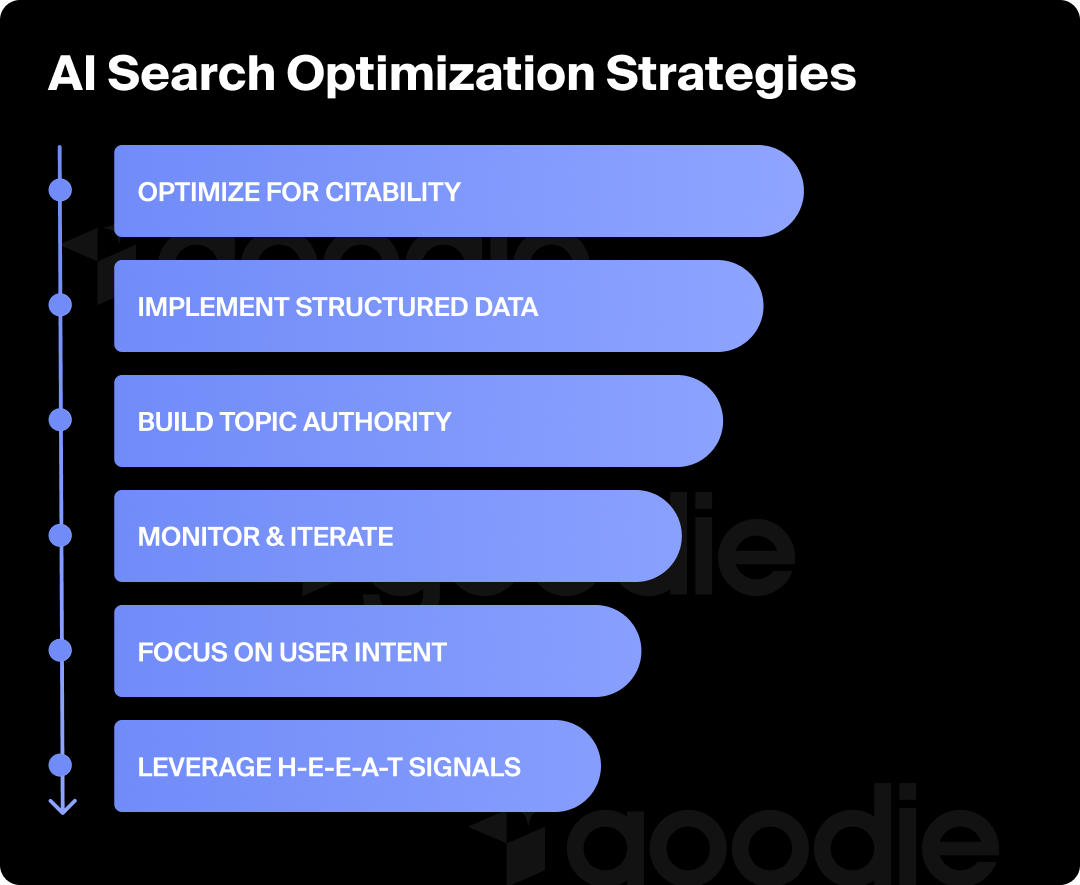
1. Optimize for citability: Write authoritative, fact-based content with clear sourcing. Include data, statistics, expert quotes, and original research. AI engines are more likely to cite content that demonstrates expertise and provides verifiable information. Always cite your own sources to build credibility.
2. Implement structured data: Use schema markup to help AI engines understand your content. Focus on Article, FAQPage, HowTo, Product, and Organization schema types depending on your content. Structured data acts as a translation layer between your content and AI models.
3. Build topic authority: Create content clusters around your core topics and link them together internally. When AI engines see that you've comprehensively covered a subject from multiple angles, they're more likely to view you as an authoritative source. Depth beats breadth.
4. Monitor and iterate: Use tools like Goodie to track your AI visibility and adjust your strategy based on what's working. If you notice certain content formats or topics are getting cited more frequently, double down on those. AEO is iterative; what works evolves as AI models improve.
5. Focus on user intent: Answer questions comprehensively and anticipate follow-up questions. Think about the user's full journey, not just the initial query. Content that satisfies user intent completely is more likely to be selected by AI engines.
6. Leverage H-E-E-A-T signals: Demonstrate Helpfulness, Expertise, Experience, Authoritativeness, and Trustworthiness in every piece of content. Include author bios, credentials, and publish dates. Link to reputable sources. These signals matter to both traditional search engines and AI models. Google's H-E-E-A-T guidelines remain relevant in the AEO era.
This is the question on every marketer's mind; as much as we’d love to give it to you straight, the answer is nuanced.
No, AI is not replacing SEO. It's evolving it.
SEO laid the critical groundwork: technical optimization, content quality, authority building, user experience, and mobile-friendliness. All of these fundamentals still matter. In fact, they matter more than ever, because AI engines rely on many of the same signals that Google's algorithm uses to determine authority and relevance.
Here's the relationship, though:
SEO provides the foundation:
AEO builds on that foundation:
The key difference is the end goal. SEO's goal was "rank #1 on Google." AEO's goal is "be cited by AI engines across platforms." It's an expansion of the search strategy, not a replacement.
If your brand is already succeeding in SEO, this is good news. Brands that have invested in SEO are well-positioned to succeed in AEO because they've already built the authority, content quality, and technical foundation. Now it's about extending that investment to optimize for AI surfaces. The future of search marketing isn't just SEO or just AEO. It's both.
Understanding how AI search engines work differently than traditional search engines helps clarify why these KPIs matter and what you should optimize for.
Understanding these techniques helps you see why citation rate, topic authority, and structured data matter so much. It's not just about gaming an algorithm; it's about aligning with how AI engines actually process and select information.
Theory is great and all, but execution is what matters. Here's how to actually build a dashboard to track these AEO KPIs.
Recommended Tools:
Dashboard Structure Suggestions:
Organize your KPIs into logical categories:
Visibility Metrics:
Traffic Metrics:
Authority Metrics:
Technical Metrics:
Reporting Cadence:
Set up monthly reporting to track trends over time. Just like SEO, AEO is a long-term game, so don't expect overnight results. Look for directional improvements: Are citations increasing? Is AI visibility growing? Is source attribution traffic trending up?
Benchmark Setting:
Create benchmarks based on your industry and content maturity. If you're just starting with AEO, expect to see gradual improvements over 3-6 months. If you've already invested in high-quality SEO, you may see faster gains as you layer in AEO strategy.
AEO is a much newer field, so there are more unknowns to deal with. While we don’t have as much insight on AEO as we do SEO, we do know this: as you build your AEO measurement strategy, avoid these common pitfalls.
Zero-click visibility is valuable. Brand exposure in AI responses builds awareness and authority even without immediate traffic. Don't dismiss your AEO efforts just because you're not seeing click-through spikes.
If you don't create custom channel groupings for LLM traffic in GA4, you're missing critical data. LLM referrals often get bucketed as generic "Referral" traffic, making it impossible to measure source attribution accurately.
AEO KPIs don't translate 1:1 from SEO. A drop in traditional organic traffic doesn't necessarily mean your AEO strategy is failing; it might mean users are getting answers directly from AI interfaces. We’re in the era of double-clicking into datapoints, into looking at the full picture.
Not everything can be quantified. Monitor the quality of citations (are you cited alongside reputable brands?), the context of mentions (are you cited for your core expertise?), and user feedback. When it comes to AI search, qualitative insights matter just as much.
AEO is a competitive game. If your competitors are being cited more frequently, you need to understand why. Track their visibility alongside yours to identify gaps and opportunities.
Pro Tip: Use Goodie to avoid these pitfalls. The platform tracks both your performance and your competitors' across AI platforms, helping you benchmark your progress and spot trends before they become problems.
The AEO measurement landscape continues to evolve, and it’s doing so quickly. Here's what we expect to see on the horizon:
Here’s what we’re getting at: start tracking these metrics now to build historical data and establish baselines. Tools like Goodie are already building towards this by giving marketers early access to AI search analytics. The brands that adapt early will have a significant competitive advantage.
AI search strategy requires a fundamentally new lens on KPIs; one that goes beyond the traditional SEO metrics we've relied on for decades. Clicks, rankings, and impressions still have a place, but they no longer tell the full story.
The metrics that matter most in 2026 and beyond are citation rate, AI visibility score, source attribution traffic, topic authority, Featured Snippet and AI Overview appearances, zero-click engagement metrics, content comprehensiveness, and structured data implementation. These KPIs capture what really matters in the AI search era: being trusted, cited, and visible across the platforms where users are actually searching.
The good news? If you've invested in SEO, you're not starting from zero. SEO built the foundation, and AEO is just expanding it.
The future of search is already here… and it's time to measure it accordingly.
.svg)
.svg)

.svg)

.svg)