Goodie

Get a Demo

Interested in trying Goodie? fill out this form and we'll be in touch with you.
Thank you for submitting the form, we'll be in touch with you soon.
Oops! Something went wrong while submitting the form.

AI Agent SEO Playbook: From Blue Links to Task Completion

A complete guide to Agentic AI SEO: learn how to optimize your site for AI agents with structured data, safe actions, APIs, and machine-readable context.
Ollie Martin
November 26, 2025
Table of Contents
This is some text inside of a div block.
Share on:
Share on LinkedIn

Decode the science of AI Search dominance now.

Download the Study

Meet users where they are and win the AI shelf.

Download the Study

Decode the science of AI Search Visibility now.

Download the Study

AI Agent analytics has given rise to a seismic shift in search behavior, and it’s one that everyone in the SEO world should be aware of. Instead of living in a world where users are served a list of blue links to sift through, they’re now served the answer right away (with the help of AI). 

This means that users can also ask AI agents to do things for them now, such as buying, booking, or scheduling. As the adoption of these tools increases daily, so does the importance to optimize for it. This leads us to the core idea of this article: treat AI Agents as programmatic consumers. Optimize for machine readability, actionability, and safety.

First Of All: What Exactly Is Agentic AI?

Agentic AI refers to autonomous systems that don’t just answer questions, but rather ones that plan, choose tools, and execute steps to achieve a goal. If you give an agent an objective (“find an in-stock e-bike under $1,500 and schedule delivery”), it can break that into a list of executable actions: gather options, validate specs, compare sellers, place an order, and confirm a time.

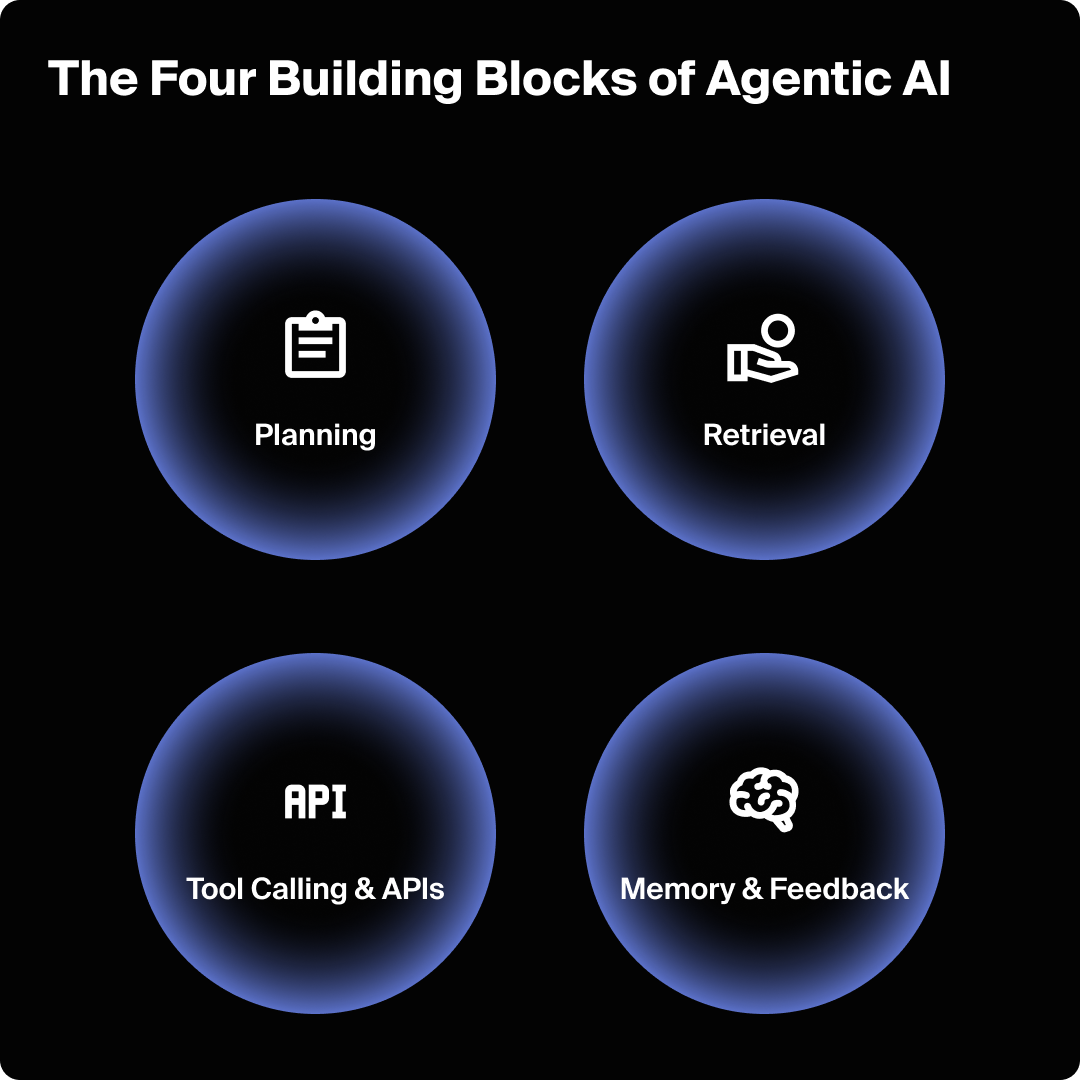
Under the hood, four building blocks make this work:

  • Planning to decompose the goal into ordered tasks;
  • Retrieval to pull relevant facts, policies, and prices;
  • Tool calling and APIs to act in the world: search catalogs, check availability, create carts, book slots;
  • Memory and feedback loops to learn from outcomes, handle errors, and adjust the plan.

Users will meet agents in multiple places: search surfaces that summarize and act, OS-level assistants embedded in phones and laptops, vertical marketplaces (travel, health, local services) where tasks map cleanly to bookings, and embedded product copilots that operate inside apps or websites. Optimizing for agents means making your brand legible, callable, and safe across all four corners.

Graphic showing the four building blocks of agentic AI.

Is ChatGPT an Agentic AI?

The short answer? Base chat ≠ fully agentic. However, with tool use, browsing, and computer use, ChatGPT can behave agentically. 

What does this mean for your website? It means that when AI assistants can call upon tools, you’ll be better suited to drive conversions. Think about it this way: your API and structured data has essentially become a landing page now. Except it isn’t for humans, it’s for AI agents.

SEO vs. AEO vs. Agentic AEO

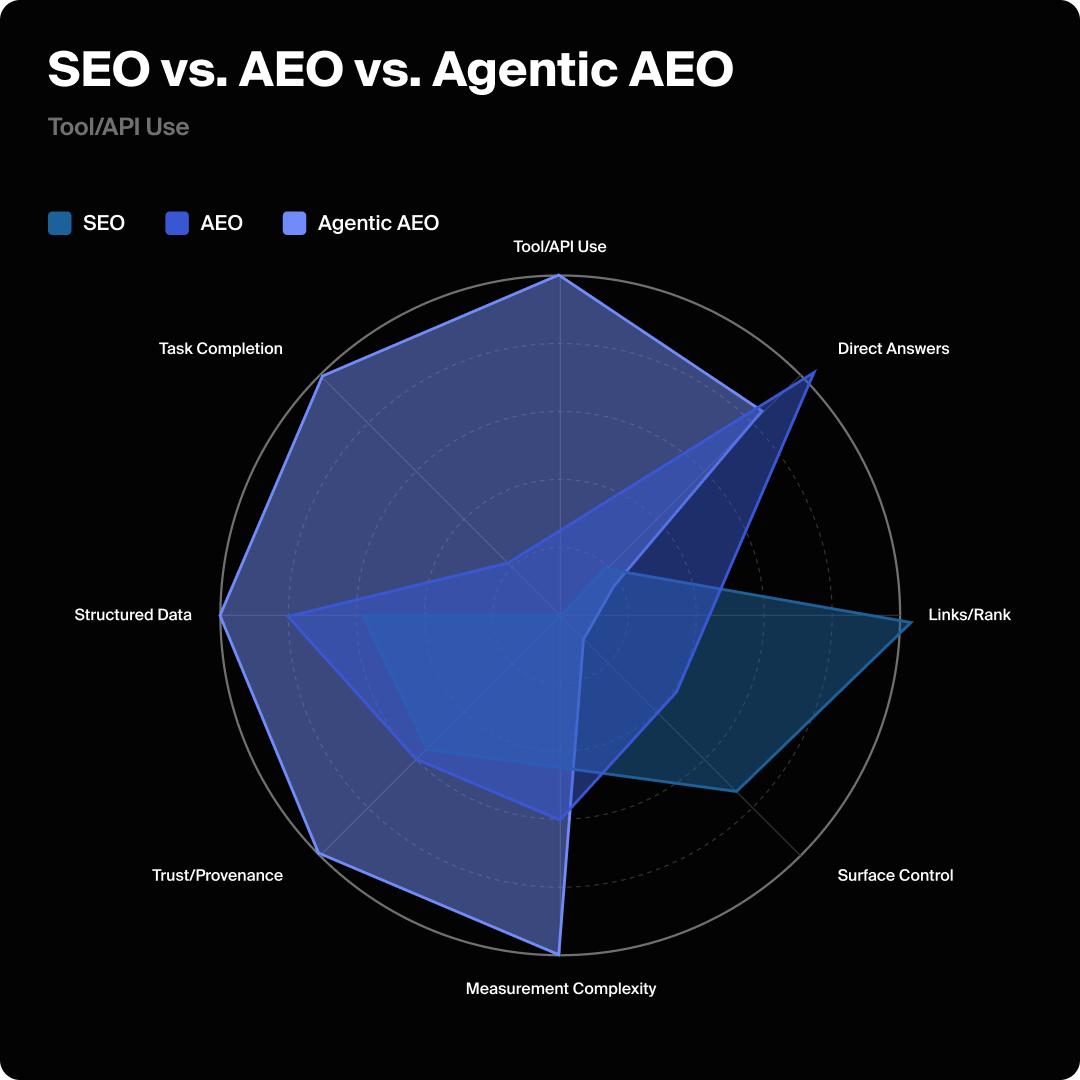
Classic SEO revolved around earning rankings, getting user clicks, and then earning onsite conversions. AEO is the practice of supplying precise, structured answers in order to gain visibility in a zero-click world. So what is agentic AEO?

Agentic AEO is the practice of supplying answers and executable paths (in the form of APIs and functions), plus trust signals for safe automation. Think about it this way: rank → answer → act.

The chart below also shows the overlap and importance for all of these different optimization practices:

Spider chart showing the differences between SEO, AEO, and agentic AEO.

So How Do Agents “Read” & Decide?

Agents focus on three main areas when making the decision of what to serve to a user:

  • Surface Content (readability): Utilize semantic headings, concise copy, and canonical product/service facts. Also, structured data can be utilized here.
  • Technical Data (structured interface): Make sure you’re using HTML, catalog feeds, well-documented APIs, function specs, and webhook callbacks.
  • Trust Levels (safety and provenance): Include author signing, author/org markup, policy pages, verified profiles, reviews, and compliance cues.

All three of these categories contribute to surfacing in Agentic AI responses. Remember though: consistency is key. You can cut down on friction and hallucination by ensuring consistency on docs, app help, and public profiles.

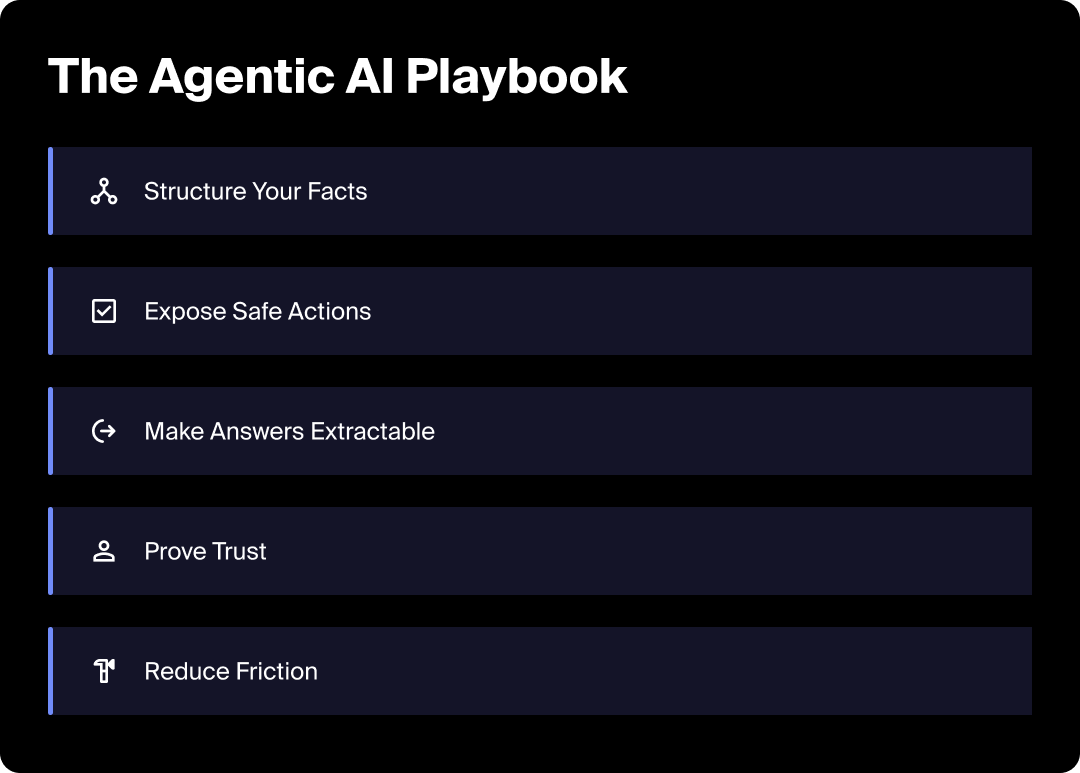
The Agentic AI Playbook

Now that we’ve looked into what agentic AI truly is and how your site is crawled, let’s get into the plan.

  1. Structure Your Facts
    1. Audit and standardize entity data (products, pricing, availability, policies).
    2. Implement schema.org types relevant to your vertical; include IDs, units, and constraints.
    3. Maintain freshness (lastUpdated fields) and unique IDs across systems.
  2. Expose Safe Actions
    1. Publish minimal, well-scoped APIs for the top agent tasks (search, check availability, calculate price/ETA, start checkout).
    2. Provide function/Tool specs (inputs, enums, validation rules, example payloads).
    3. Add idempotency keys, rate limits, and clear error semantics (agent-parsable).
  3. Make Answers Extractable
    1. Write “agent-ready” content: definition → constraints → steps → edge cases.
    2. Use lists, tables, and FAQs that map to parameters an agent would need.
    3. Keep policy and eligibility content explicit (age, geography, exclusions).
  4. Prove Trust
    1. Include author or org markup, reviewedBy, external citations, verified profiles.
    2. Utilize content signing or provenance and consistent brand identity across surfaces.
    3. Publish clear data-use and refund or return policies.
  5. Reduce Friction
    1. Offer pre-built flows and deeplinks (e.g., prefilled carts, booking intents).
    2. Provide lightweight sandbox/try-it for your API actions.
The five components of the agentic AI SEO playbook.

Agentic SEO Implementation: Quick Wins

You’re probably wondering: what can I do to get started right away? Lucky for you, there’s some quick wins you can utilize to get the ball rolling on Agentic AI optimization.

  • Use and implement something called a Top Task API. This identifies the top 3-5 actions agents most request and serves it to agents.
  • Work on adding and/or refreshing schema on core pages. This can be Product, Service, HowTo, or even FAQ schema. Keep in mind that structured data usage is one of the key ways to set your site up for success in our AI-driven search world. 

A few other things to consider could be:

  • Creating a developer or agent page (including a tool list, function specs, rate limits, and examples)
  • Publishing a facts file (focusing on machine-readable product and service facts)
  • Making sure that pricing, inventory, and policy text are aligned across all surfaces.

Measuring AI Agent Visibility & Impact

When measuring AI agent visibility and impact, start with coverage:

  • Measure what portion of priority pages carry valid schema, whether public copy, feeds, and docs agree on the same facts, and how fresh those entities are.
  • Next, assess actionability by counting callable functions per top task, verifying that parameters are typed with enums, and tracking both error rate and success rate; your north star here is time to a first successful sandbox call. 

For outcomes, monitor:

  • Task completion rate
  • Average steps to completion
  • Time-to-result (whether that’s a quote, appointment slot, or prefabricated cart); while tagging abandonment by failure reason in order to expose friction.

Demand capture then asks if the work moved the market:

  • Look for assisted conversions attributed to AI or agentic surfaces, lifts in branded queries and answer visibility, and your share of voice for priority intents.
  • Validate quality by checking ground-truth match on critical facts, policy and eligibility correctness (geo, age, stock), and periodic human spot-checks.
  • Instrument everything with an “Agent Analytics” log that records each function call end to end (inputs, validation, response, and outcome) and review weekly to fix high-frequency errors, close schema gaps, and ship one new callable step per top task.

What if You Had a Tool That Could Do It All?

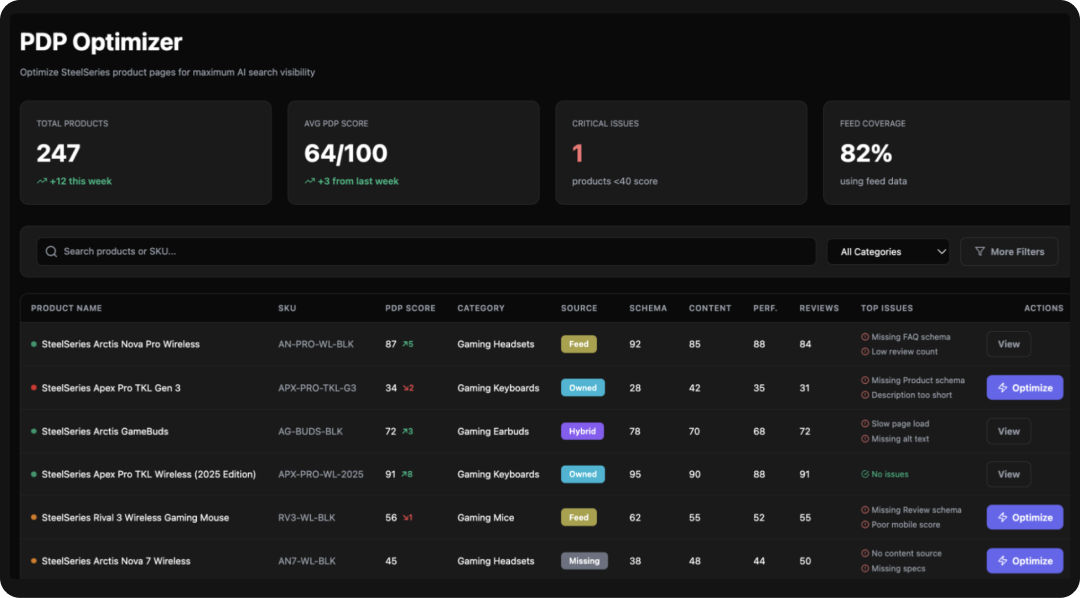
Take a look at Goodie’s Agentic Commerce Optimizer, which allows you to find gaps, optimize them, and understand the impact. This leading tool is truly one of a kind, and provides end-to-end observability, optimization, and attribution for agentic commerce. 

Screenshot of the Goodie AI dashboard.

Summing It Up

If the marketing saying of the 2010s was “Content is King,” then we’re ready to propose the saying for the 2020s: “Context is King.” As we move forward into the world of agentic AI, it will become imperative to set your site up for success. And where does this begin? It starts with providing context for everything on your site. 

It all starts with optimizing for machine readability, actionability, and safety. After putting emphasis on all of these items, develop a strategy and feedback loop that leads to growth. Don’t be afraid to tweak the context and optimizations behind your work; this will be a natural part of the process. Finally, always ensure that you’re measuring the effectiveness of your optimizations. 

Agentic AI SEO FAQs

What exactly is agentic AI?

Autonomous systems that plan and execute multi-step tasks by calling tools or APIs to achieve user goals with minimal supervision.

What does AEO stand for?

Answer Engine Optimization; it’s all about structuring information so that AI systems can deliver direct, trustworthy answers (often resulting in zero-click behavior).

Is ChatGPT an agentic AI?

Base chat isn’t fully agentic, but with tool or computer use and integrations, it operates agentically by planning steps and calling tools.

What’s the difference between SEO and AEO?

SEO optimizes for ranked links, AEO optimizes for direct answers. Agentic AEO extends AEO by enabling actions via APIs or functions allowing assistants to complete tasks.

Decode the science of AI Search dominance now.

Download the Study

Meet users where they are and win the AI shelf.

Download the Study

Decode the science of AI Search Visibility now.

Download the Study
Check out other articles
Enjoy the best AI Optimization newsletter on the internet - right in your inbox.
Thanks for subscribing! Your next favorite newsletter is on its way.
Oops! Something went wrong while submitting the form.
LinkedinInstagramYoutubeTikTok
© Goodie 2025
All Rights Reserved
Goodie logo
Goodie

AEO Periodic Table: Elements Impacting AI Search Visibility in 2025

Discover the 15 factors driving brand visibility in ChatGPT, Gemini, Claude, Grok, and Perplexity — based on 1 million+ prompt outputs.
Your visibility game just leveled up. We’ve sent the AEO Periodic Table: Elements Impacting AI Search Visibility in 2025 report to your inbox.


If you do not receive the email, please check your spam folder.
Oops! Something went wrong while submitting the form.
Goodie

AEO Periodic Table: Factors Impacting AI Search Visibility in 2025

Discover the 15 factors driving brand visibility in ChatGPT, Gemini, Claude, Grok, and Perplexity — based on 1 million+ prompt outputs.
Your visibility game just leveled up. We’ve sent the AEO Periodic Table: Elements Impacting AI Search Visibility in 2025 report to your inbox.


If you do not receive the email, please check your spam folder.
Oops! Something went wrong while submitting the form.
Goodie

The 14 Factor AI Shopping Visibility Study

Get the data behind how today’s leading AI models retrieve, score, and select products and what your brand must do to stay visible and purchasable.
Thanks for joining the next era of product discovery.
Check your inbox for the AI Shopping Visibility Study.

If you do not receive the email, please check your spam folder.
Oops! Something went wrong while submitting the form.