

Key Takeaways
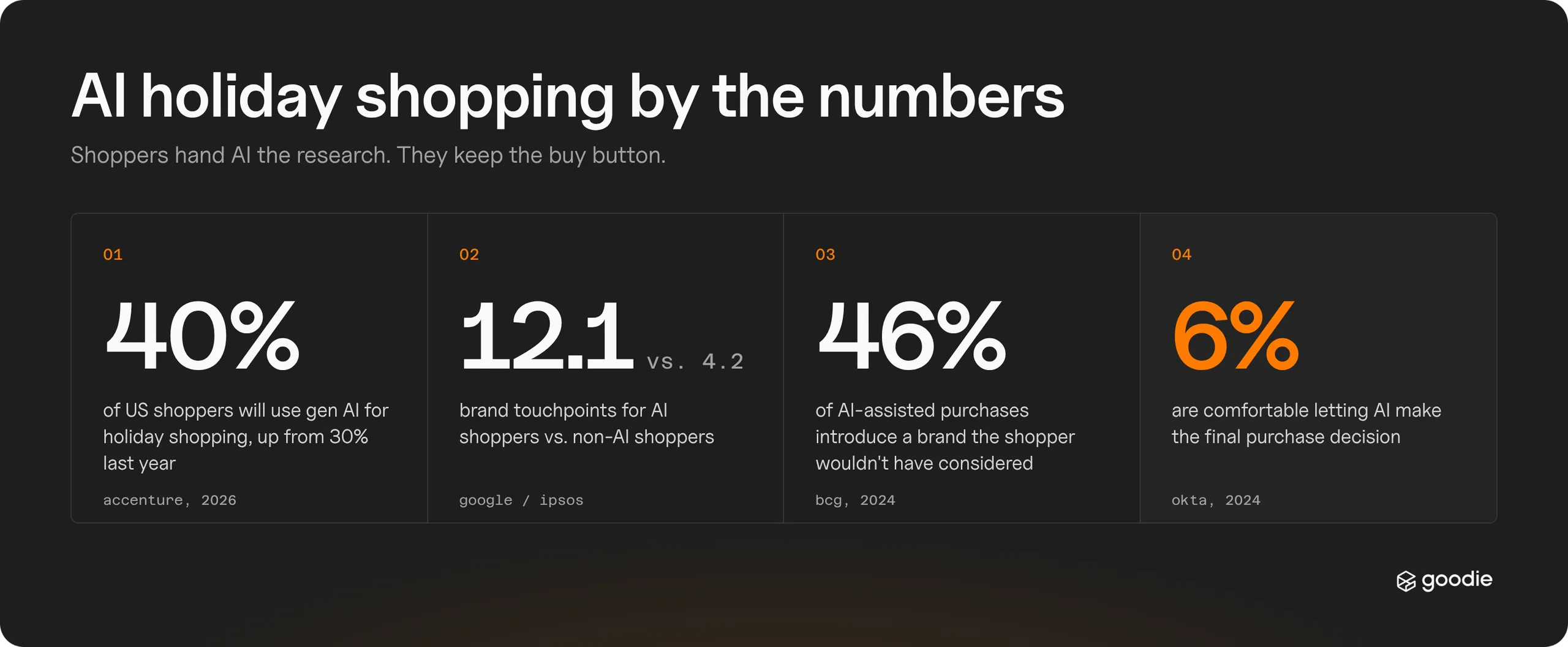
- AI is now a standard step in holiday research. 40% of US shoppers will use gen AI for holiday shopping this year, mostly to find deals, compare options, and pick a retailer.
- Shoppers let AI research but rarely let it buy. Only 6% of consumers are comfortable letting AI make the final purchase decision, so making the AI shortlist matters more than automating checkout.
- AI traffic is the highest-converting traffic retailers get. It converted 90% better and drove 83% more revenue per visit than other traffic in September, and Adobe expects it to grow 95% year over year on Black Friday.
- Each AI shopping platform needs its own approach. ChatGPT, AI Mode, Alexa for Shopping, Sparky, Muse and Instinct each source and rank products differently.
- Product data is the biggest lever before BFCM. Complete feeds, real-time pricing, structured shipping and return details, gift content that matches how people prompt, and third-party reviews decide which products agents recommend.
- Measure visibility as well as traffic. Track share of shelf and product position in AI shopping answers alongside AI referral revenue in GA4.
56% of US consumers plan to shop with generative AI this Black Friday. Only 6% of consumers are comfortable letting an AI agent make the final call on a purchase.
This holiday season, shoppers are handing AI the research (gift ideas, comparisons, deal hunting) and keeping the buy button for themselves. The brands that win are the ones that make the AI-generated shortlist, well before anyone reaches checkout.
And the shortlist is worth fighting for. In September, AI-referred visits to US retail sites converted 90% better than other traffic, the highest rate Adobe has recorded.
Below is the consumer and market data behind AI holiday shopping, the platforms that matter this season, where things are headed, and an AEO playbook for the weeks before (and during) BFCM.
How Are Shoppers Using AI for Holiday Shopping This Year?
Today, AI is a standard research step for holiday gifts. Accenture’s 2026 holiday survey of 4,048 US shoppers found that 40% plan to use gen AI for holiday shopping this year, up from 30% last year. Their top planned uses:
- Finding deals (39%)
- Comparing options (31%)
- Identifying the best retailer to buy from (30%)
AI is also widening the set of brands shoppers consider. Online shoppers who used AI noticed or interacted with 12.1 touchpoints on average, compared to 4.2 for non-AI users. BCG found that in 46% of purchases where AI plays a role, it introduces a brand the shopper wouldn’t otherwise have considered.
Shoppers also cross-check across assistants. 99% of people who use ChatGPT for product research also consult Google Search before buying, so brands need to show up on AI shelves across a range of platforms.
The Trust Gap Is Real and Specific
Shoppers trust AI to research, but they’re far less comfortable letting it buy on their behalf.
- Only 4% of consumers would let AI buy something over $100, and only 7% would let it buy something under $25.
- 22% to 30% would be more willing if they could give final approval, and 14% to 16% if the purchase could be reversed.
- A majority of respondents in a William Blair survey wouldn’t let AI purchase without reviewing it first.
Heavy AI users are the exception. US shoppers overall would let an agent spend $102 without approval, and weekly gen AI users would go up to $149. Comfort rises with lower stakes, reversibility, and a human approval step.
The implication for this one is matter-of-fact: discovery and comparison visibility matter more this season than having an automated checkout process.
How Much Holiday Revenue Is AI Driving?
AI is still a small slice of retail traffic, but it’s now the most valuable traffic retailers get. Adobe’s September 2026 data, based on more than 1 trillion visits to US retail sites, shows how quickly that flipped:
- AI traffic to US retail sites grew 71% year over year.
- It converted 90% better than non-AI traffic, the highest rate Adobe has recorded. In August 2025, it converted 9% worse.
- It generated 83% higher revenue per visit, with 53% higher add-to-cart rates and 73% more time on site.
Adobe expects AI traffic to grow 159% year over year on Thanksgiving, 95% on Black Friday and 88% on Cyber Monday, and expects AI’s revenue-per-visit advantage to double this season.
The conversion jump comes from what happens before the click. 60% of Google AI users say AI helps them make final decisions, find the best deal, and check out faster. By the time they land on a product page, most of the persuasion already happened inside an AI answer.
How Has AI Changed the Path From Gift Idea to Checkout?
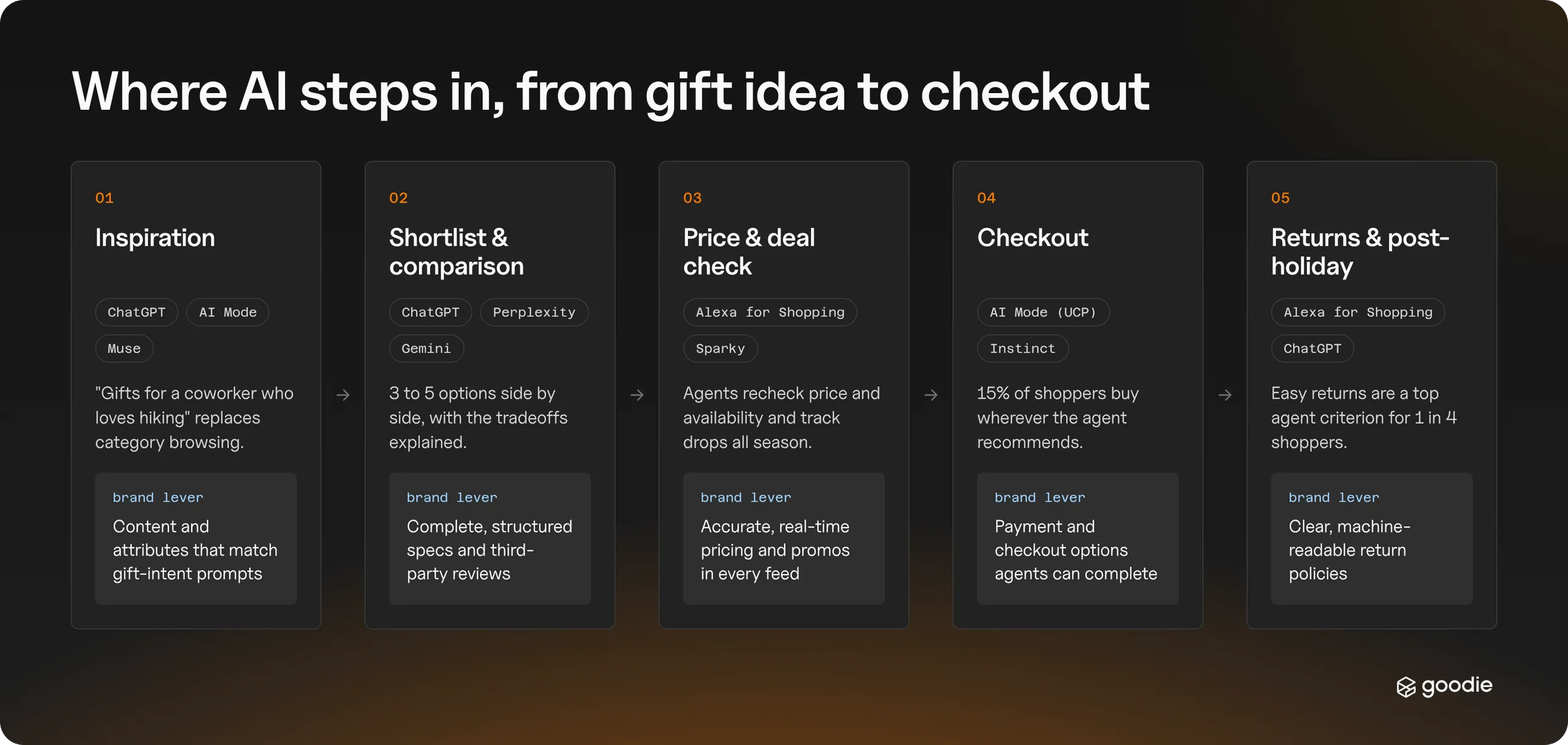
AI compresses inspiration, comparison, and deal-checking into a single conversation. A brand that misses the shortlist at the start has a slim chance of getting back in, given how the customer journey has changed.
Here’s how each stage has shifted and where brands still have control:
- Inspiration. “Gifts for a coworker who loves hiking” replaces a dozen category searches. AI personal shoppers build the starting list from product data, reviews, and content that matches the prompt. (Our breakdown of how AI personal shoppers pick products covers the mechanics.) Brand lever: content and product attributes that match gift-intent prompts.
- Shortlist and comparison. AI places 3–5 options side by side and explains the trade-offs. This is where most brands win or lose, and it’s why AI comparison shopping visibility deserves its own strategy. Brand lever: complete, structured specs and third-party reviews.
- Price and deal check. Agents recheck price and availability constantly, and 3 in 5 shoppers would let an agent split their basket across retailers. Brand lever: accurate, real-time pricing and promotions across every feed.
- Checkout. 15% of shoppers will buy wherever the agent recommends based on price and availability. Brand lever: payment and checkout options agents can complete.
- Returns and post-holiday. For 1 in 4 shoppers, easy returns are a top criterion when an agent chooses where to send them. Brand lever: clear, machine-readable return policies.
Which AI Shopping Platforms Matter Most This Season?
The AI shopping field has split into three groups: general assistants (ChatGPT, Claude), search-native AI (AI Mode, AI Overviews, Gemini, Perplexity), and retailer or platform agents (Alexa for Shopping, Sparky, Muse, Instinct). Each one sources and ranks products differently, so a single optimization tactic won’t cover all of them.
| Platform | What it does for holiday shoppers | What brands control |
| ChatGPT | Shopping research, side-by-side comparisons, image-based search and conversational filtering. | Product catalog and promotions via the Agentic Commerce Protocol |
| Google AI Mode & AI Overviews | AI shopping answers pulled from the Shopping Graph, with direct checkout via the Universal Commerce Protocol | Merchant Center feed, conversational attributes, loyalty data |
| Gemini | Product discovery, plus UCP-powered checkout for participating brands like Tapestry | Same Merchant Center and UCP setup as Google Search |
| Alexa for Shopping | Price tracking, up to a year of price history, comparisons and “Buy for Me” | Amazon listings, A+ content, reviews, pricing |
| Sparky | Walmart’s in-app assistant, which turns photos of handwritten lists into carts | Walmart Marketplace listings and content |
| Muse | Meta’s agent browses sites for deals and checks out with Link by Stripe after the user approves. Amazon blocks it | An agent-readable site, Stripe Link support |
| Instinct | Personal agent with a Shopify integration (launched Sept. 28) for availability search, Shop Pay checkout and delivery updates | Shopify catalog data, Shop Pay |
| Perplexity, Copilot, Meta AI, Claude, Grok | Research and comparison surfaces that cite the open web | Organic content, reviews, third-party coverage |
What Will AI Holiday Shopping Look Like Through BFCM and Beyond?
Expect a longer deal season, checkout consolidating around commerce protocols and more control shifting to retailer-owned agents. Here’s what we expect to play out this season and into 2027:
- The Black Friday spike flattens. Agents that track prices all season (Alexa for Shopping shows up to a year of price history) let shoppers set alerts and buy when the price drops. Single-day doorbusters now compete with agents watching prices all of November.
- Checkout moves to protocols, away from chat windows. OpenAI pulled back on Instant Checkout, while Google’s UCP already supports direct checkout for hundreds of thousands of brands and retailers.
- Retailer agents and walled gardens grow. 3 in 5 US shoppers prefer retailer- or brand-specific AI tools over public platforms, and Amazon already blocks Meta’s Muse. Expect more retailers to decide which agents get in, which fragments the surfaces brands need to track.
- Pricing gets scrutinized. The FTC has ordered Walmart, Target, and others to disclose how personal data shapes pricing. Inconsistent prices across feeds read as a trust problem to shoppers and agents alike.
- AI shapes January, too. Returns, exchanges, and gift card redemptions will run through the same assistants, so return policies and post-holiday content need the same attention as gift guides.
How Should Brands Prepare for AI Shopping Before Black Friday?
AI shopping agents recommend products they can read, verify, and trust. Preparation comes down to agent access, product data quality, content that matches how people prompt, and third-party proof.
Research on the factors driving product visibility in AI shopping found that structured product data completeness, freshness of price and availability, intent match, review volume, and offer competitiveness carry the most weight. The steps below map to those factors.
Make Sure AI Agents Can Read Your Site
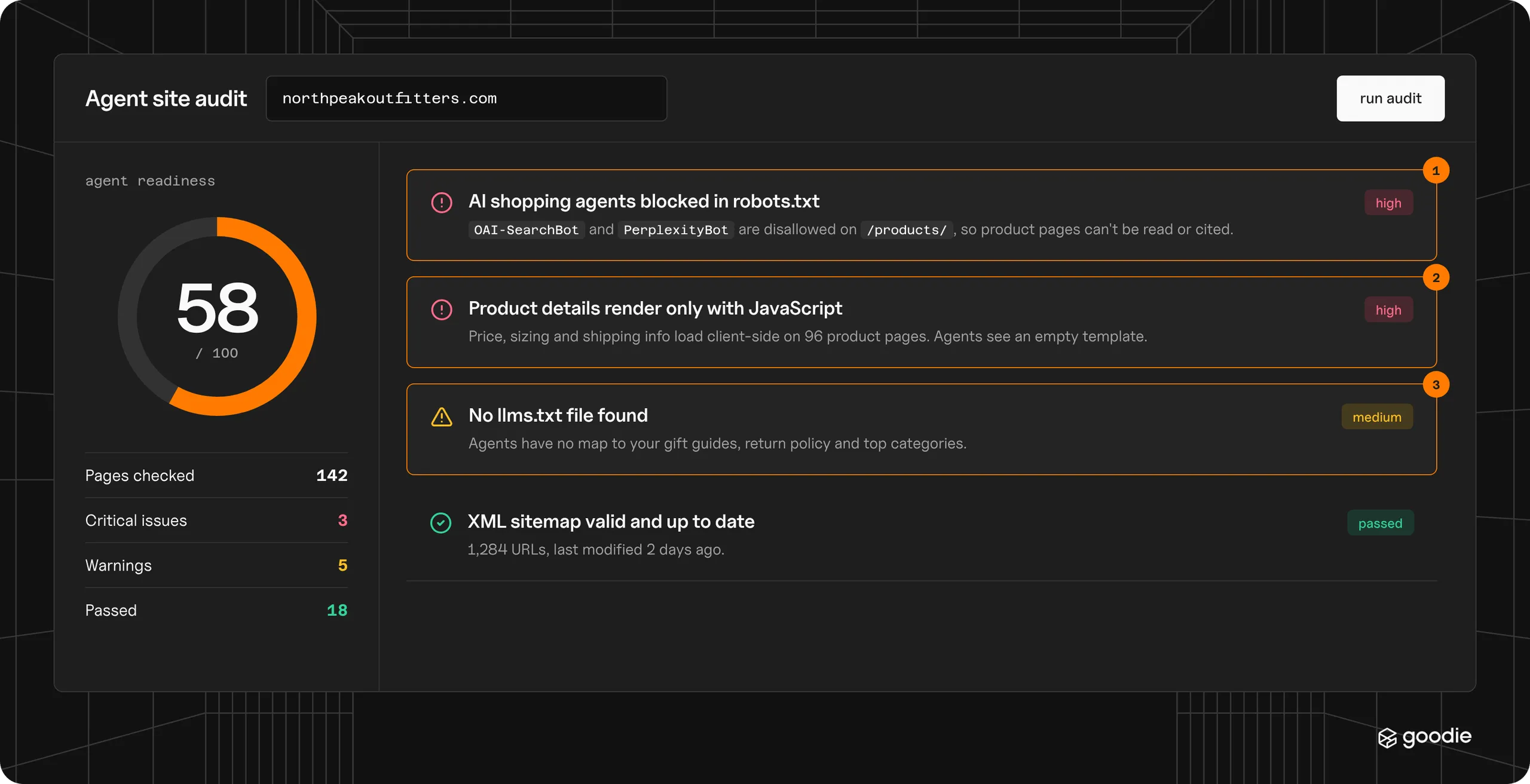
If an agent can’t parse your pages, your products don’t make the shortlist. Adobe’s Citation Readability Score found the average US retail homepage scores only 63%, meaning more than a third of homepage content is invisible to AI systems. General merchandise homepages scored 40%.
Start with the basics:
- Confirm robots.txt allows the AI crawlers and shopping agents you want visiting your site.
- Make sure product, category, and policy pages render key content in HTML, without hiding it behind scripts or interactive elements.
- Publish an llms.txt file that points agents to your most important pages.
Our free Agent Site Audit tool shows where AI agents run into problems on your site, and the free LLMs.txt Generator builds the file for you. For the bigger picture on designing for agent visitors, see our guide to AI agent experience (AX).
Get Your Product Feeds Holiday-Ready
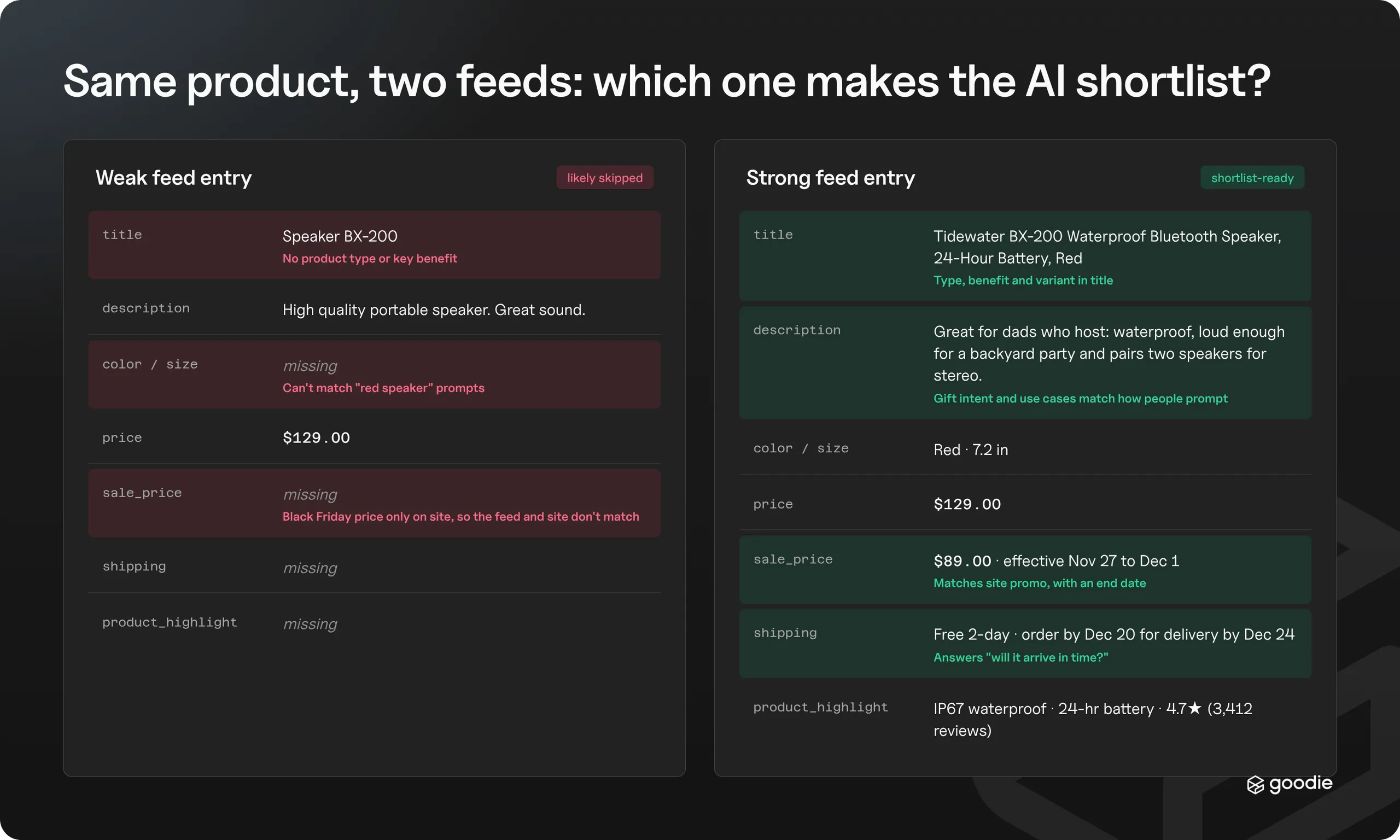
Product feeds are the most direct line into AI shopping results. Structured data completeness and price and availability freshness are the two biggest factors in our visibility research, together accounting for nearly 30% of visibility impact.
Before BFCM:
- Fill every attribute. Merchants who adopt core Merchant Center feed best practices see an average 5% increase in conversions the following month.
- Add conversational attributes. Google lets merchants submit extra context to product listings. In a lululemon test, those attributes appeared in relevant AI Mode recommendations 50% of the time.
- Sync promotions everywhere. A Black Friday price that shows up on your site but not in your feed (or vice versa) costs you the comparison.
- Submit to ChatGPT. Retailers like Target, Sephora, and Best Buy already feed catalogs and promotions into ChatGPT through the Agentic Commerce Protocol.
- Add loyalty data. Merchant Center surfaces member pricing and perks like free shipping across Google.
Structure the Details Agents Compare
When an agent puts your product next to a competitor’s, it compares price, availability, shipping speed, and return terms. Make those machine-readable with schema markup on every product page:
- Product and Offer schema with current price, availability, and priceValidUntil for sales with an end date
- Shipping details with delivery times, so agents can answer “will this arrive before December 24?”
- MerchantReturnPolicy with your return window and method (a top agent criterion for 1 in 4 shoppers)
- AggregateRating to surface review volume and score
Build Gift Content Around How People Prompt
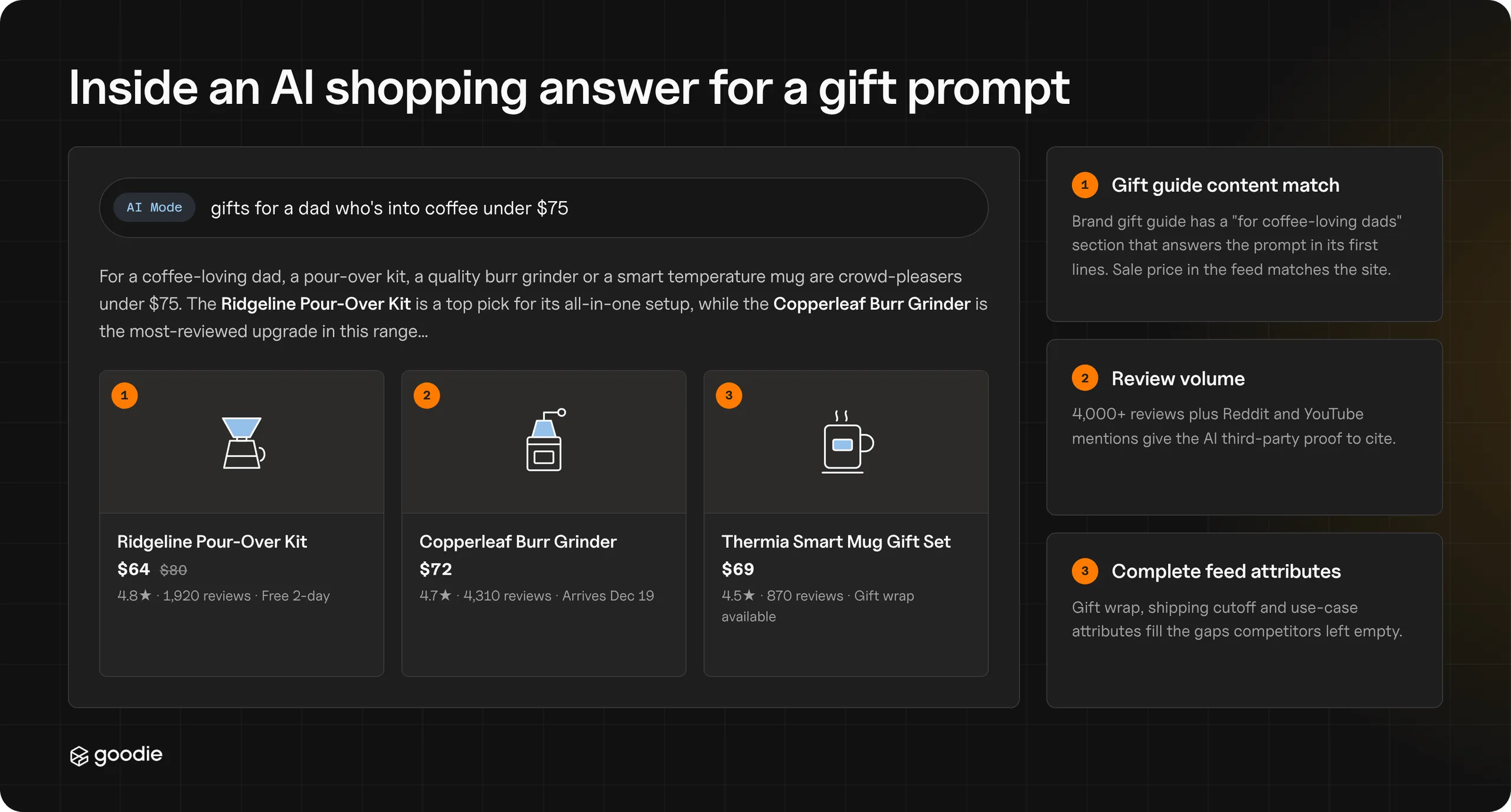
Holiday prompts are specific: a recipient, a budget, and an occasion. “Gifts for a 10-year-old who likes science under $40” is a typical query, and 27% of shoppers would ask an agent to shop for someone who is hard to buy for. Intent match and attribute coverage carry 12% of visibility weight, and benefit-focused, use-case-rich descriptions outperform plain feature lists.
To match those prompts:
- Build gift guides around recipients, budgets, and occasions, and answer the question in the first lines of each section.
- Write product descriptions that name use cases and recipients (“for the friend who’s always cold” beats a list of fabric specs).
- Add FAQ blocks to top gift products that answer the questions shoppers ask AI (sizing, shipping cutoffs, gift wrap, compatibility).
Earn the Third-Party Proof AI Cites
AI assistants check what other people say about a product before recommending it. Review volume and sentiment carry 11% of visibility weight, and the median product recommended by Amazon’s previous assistant, Rufus, had 2,991 reviews.
Focus on the sources AI already trusts:
- Reviews. Push for post-purchase reviews on your site and on retailer listings before the holiday rush peaks.
- Reddit. Reddit is the second-most cited domain across LLMs in Goodie’s research, which is why Reddit and Quora threads keep outranking brand pages in AI answers. Join relevant gift and category threads honestly and helpfully.
- YouTube creators. 70% of US viewers say creator content on YouTube helps them research purchases, and video gets cited by AI more often than many brands expect. Gift roundups and unboxing videos from creators double as AI citation sources.
Decide How Much Agentic Checkout You Need
Agentic checkout is growing, but shoppers still want the final say. Enable the routes your shoppers already use (Google’s Universal Commerce Protocol for AI Mode and Gemini, Shop Pay for Instinct, Link by Stripe for Muse and Buy for Me in Alexa for Shopping), and build every flow around a clear confirmation step and an easy reversal path. Those are the two conditions that make shoppers most willing to let AI buy.
What Can Brands Still Fix if BFCM Is Already Underway?
The highest-impact fixes are data and content updates that AI systems pick up quickly, and they keep paying off through Cyber Monday and the December gifting rush.
This week:
- Fix feed errors and disapproved products in Merchant Center.
- Audit price parity between your site, feeds, and marketplaces, especially for BFCM promotions.
- Add shipping cutoff dates to product pages and schema.
Before Thanksgiving:
- Refresh your top five gift guides so each section answers the prompt in its first lines.
- Add FAQ blocks to your top 20 holiday products.
- Run the same 10 to 15 holiday prompts across ChatGPT, AI Mode, and Alexa for Shopping, and note where competitors appear and you don’t.
Through December:
- Recheck those prompts daily through Cyber Monday and weekly after.
- Publish last-minute content (in-store pickup, gift cards, digital gifts) as shipping windows close.
- Update return and exchange pages for the January returns cycle.
How Do You Measure Whether AI Is Driving Holiday Sales?
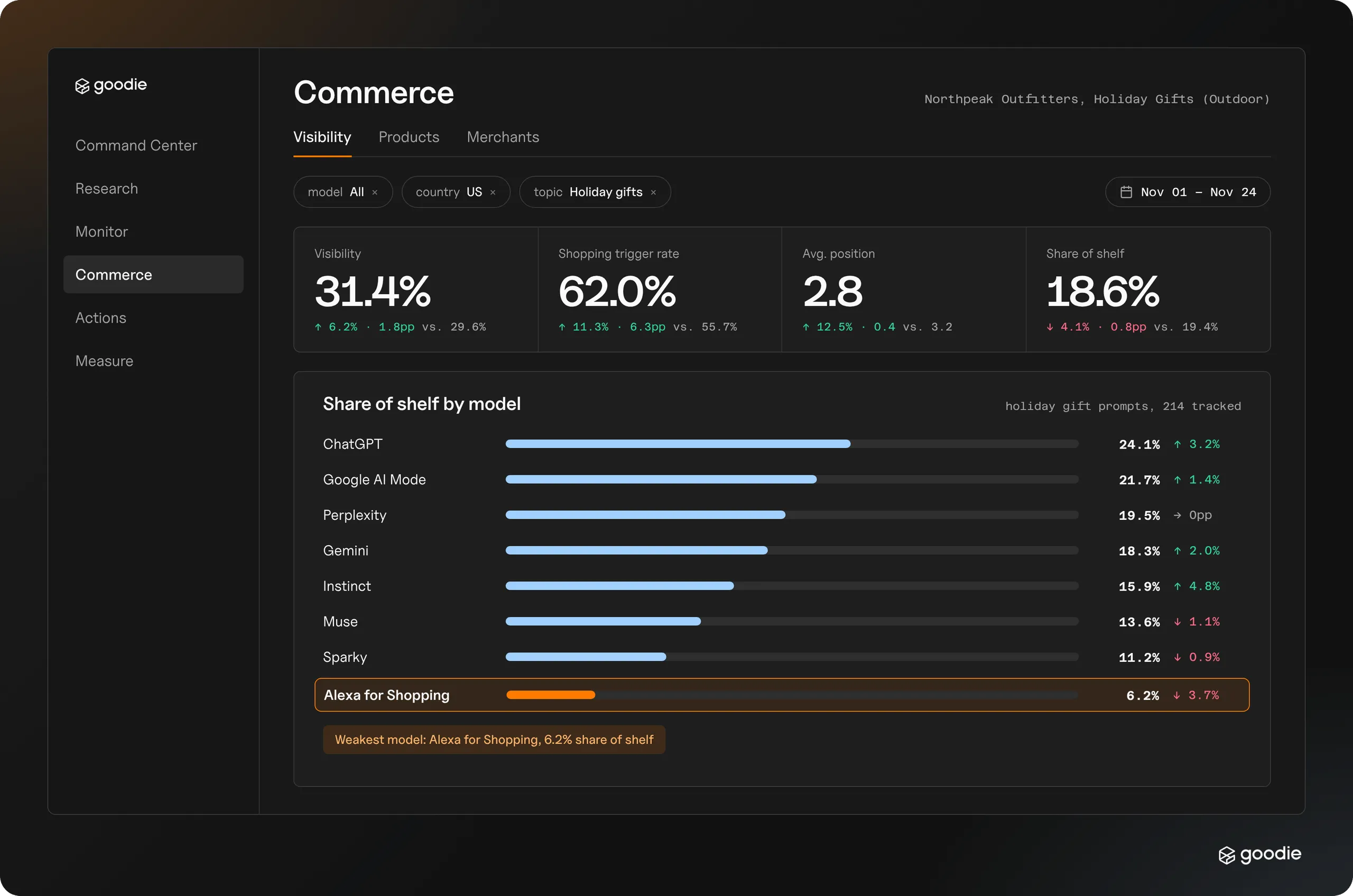
Track two things: how often AI recommends your products, and what that visibility produces in traffic and revenue.
Visibility in AI shopping answers. Ranking reports don’t show this. You need to run shopping prompts across AI models and record which products appear, where, and how often. Goodie’s Agentic Commerce Suite tracks share of shelf, shopping trigger rate, and product position across ChatGPT, AI Mode, Alexa for Shopping, Sparky, Muse, Instinct, and the rest of the 14 AI models Goodie monitors. Google’s Merchant Center offers AI performance insights for share of voice in AI Mode and AI Overviews, which is useful for Google’s surfaces. Our Agentic Commerce Suite guide walks through setting up holiday product tracking.
Win the AI Shelf Before Cyber Monday
See how often AI answer engines recommend your brand, then track every holiday product across 14 AI models.
2026 AI Holiday Shopping Guide: FAQs
No. In 46% of AI-assisted purchases, AI introduces a brand the shopper wouldn’t otherwise have considered. Familiarity still matters, since nearly three-quarters of shoppers want agents to buy from brands they know, but complete product data, strong reviews, and prompt-matched content give smaller brands a real path onto the shortlist.
They pull a large pool of candidates, then narrow it to a handful based on product data completeness, price and availability freshness, how well the product matches the prompt, reviews, and offer competitiveness. Our research found the top factors account for most of a product’s visibility, and weights differ by platform.
ChatGPT pulls shopping results from merchant catalogs submitted through the Agentic Commerce Protocol, plus information from across the web. Submit a complete catalog with current pricing and promotions, keep it updated, and make sure your product pages, reviews, and third-party coverage support the details in your feed.
Yes, and deal-finding is the top reason shoppers use AI this season (39% of shoppers). Alexa for Shopping tracks prices and shows up to a year of price history, and Meta’s Muse searches multiple sites for the best price. Agents can only surface your deal if your feeds and pages show the sale price accurately.
Agentic checkout lets an AI agent complete a purchase for a shopper through protocols like Google’s Universal Commerce Protocol or wallets like Shop Pay and Link by Stripe. Most brands should enable it on the platforms their shoppers use, with a clear approval step, since shoppers are far more comfortable when they confirm the final purchase.
Most AI shopping results are organic, drawn from product feeds, site content, reviews, and third-party sources. Paid placements exist on some surfaces, such as Shopping ads that appear alongside AI Mode results, but strong feed data and content are what earn organic inclusion across ChatGPT, AI Mode, Alexa for Shopping, and other assistants.