Yahoo may not be the first name that comes to mind when you think about AI Search, and that’s exactly why Yahoo Scout is worth paying attention to.
Rather than competing with chatbots or trying to rebuild search from scratch, Scout takes an entirely different approach. Yahoo is using AI to organize and explain information across Yahoo’s own content system and trusted publisher partners, delivering answers without disconnecting them from their sources.
The result feels less like a chatbot and more like a modern portal: an AI-powered layer designed to route users through information that Yahoo already knows and trusts. In a moment when AI search is shifting from crawling everything to interpreting what’s credible, that structural choice matters.
What Is Yahoo Scout?
Yahoo Scout is the latest AI answer engine to enter the scene; it synthesizes answers using Yahoo’s own content ecosystem, trusted publishing partners, and structured internal data.
Rather than functioning like a chat-first AI assistant like ChatGPT or a traditional search engine like Google, Scout is designed to interpret, connect, and explain information across Yahoo’s portfolio, delivering direct answers while preserving visibility into where those answers originate.
At its core, Scout exists as a means to route knowledge, not just generate text.
Yahoo has described Scout as a way to combine:
- Its owned content (news, finance, sports, weather, shopping, and more)
- Longstanding publisher relationships
- User context and historical search understanding
- into a single AI system built specifically for answering questions, not crawling the open web from scratch.
This is why Scout feels less like a conversational chatbot and more like a modern, AI-native portal that organizes information Yahoo already knows and trusts.
What Yahoo Scout Is
- An AI answer engine, not a chat tool
- Grounded in Yahoo-owned and licensed content
- Designed for high-confidence, high-accuracy responses
- Built to explain topics across everyday and complex intents (finance, sports, weather, shopping, lifestyle)
What Yahoo Scout Isn’t
- A Google replacement
- A generic LLM wrapper
- A pure open-web scraping engine
As Yahoo CEO Jim Lanzone has emphasized, Scout’s advantage is its depth. Yahoo already operates as a massive content network. Scout simply adds an AI reasoning layer on top of that foundation.
In other words: Yahoo didn’t wake up one day and decide to “do AI search.” They build an answer engine out of the infrastructure they’ve already been refining for decades.
How Yahoo Scout Differs From Other Search-Native AI Tools
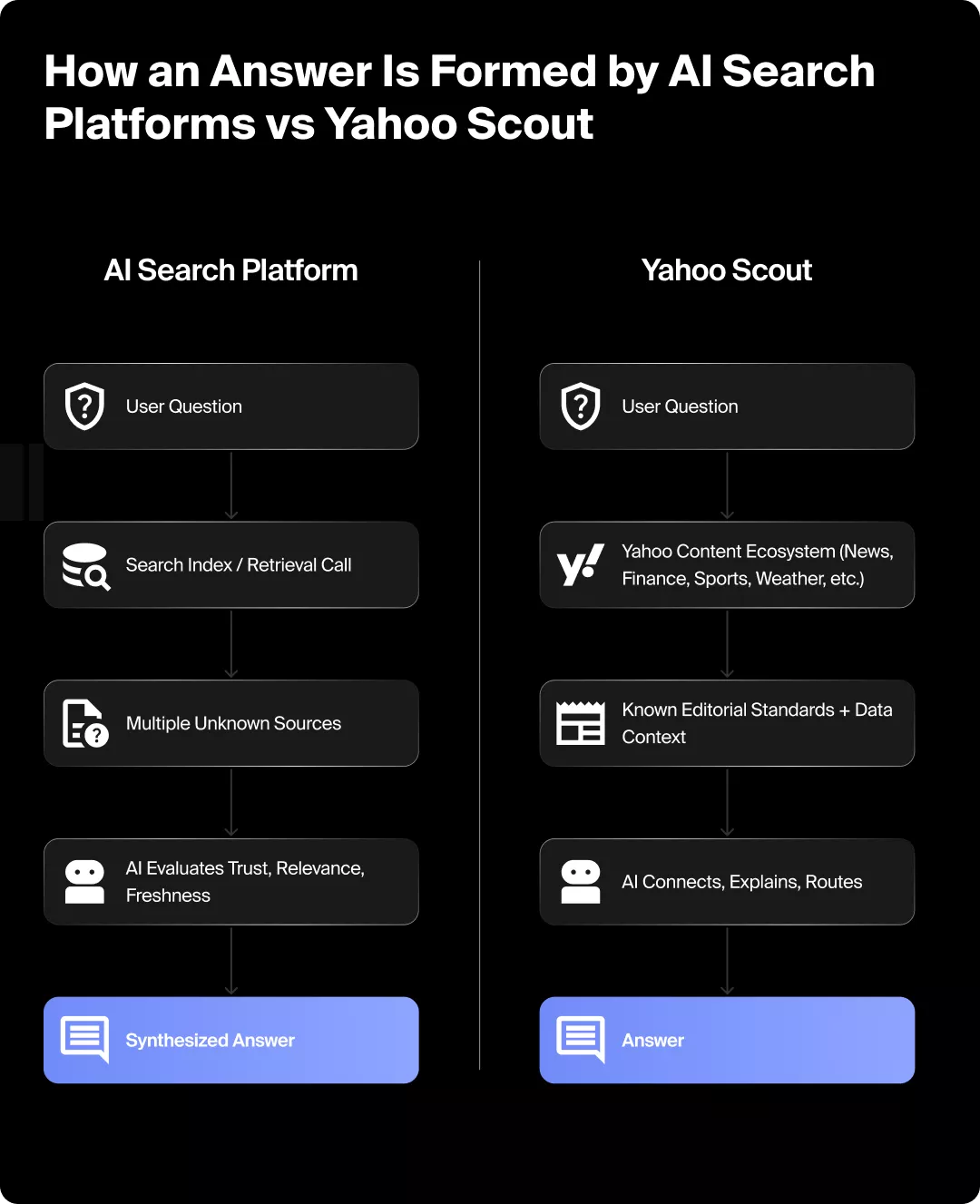
Some AI search experiences, like Google’s AI search features, are search-native. They sit directly on top of a traditional search index, retrieving web results first and then using AI to summarize or repackage what ranks.
Others, like ChatGPT, Claude, and similar tools, are LLM-native. They’re reasoning-first systems trained on a mix of licensed data, public web snapshots, and proprietary datasets. When they reference live or external information, it’s often through optional retrieval layers or tool calls, not a native content ecosystem they control.
Yahoo Scout takes a different path altogether.
Rather than starting with either a search index or a general-purpose language model trained on the open web, Scout begins with a defined, trusted content ecosystem: Yahoo’s own verticals, data products, and long-standing publisher relationships. It then applies AI as a reasoning layer on top of that foundation.
This creates a few meaningful differences:
- Ecosystem-first, not index-first: Scout prioritizes Yahoo-owned and licensed content before expanding outward, reducing reliance on broad, indiscriminate web crawling.
- Clearer source lineage: Answers are grounded in known Yahoo properties and partners, making it easier to understand where information comes from and why it’s trusted.
- Interpretation over generation: The AI layer is used to connect, explain, and contextualize information, not to replace the underlying content with a fully synthetic response.
- Different incentives by design: Search-native tools optimize for ranking and coverage. LLM-native tools optimize for fluency and reasoning. Scout optimizes for confidence, consistency, and editorial coherence across the content network Yahoo already operates.
In short, while many AI tools are trying to rebuild search or generalize intelligence, Yahoo Scout is focused on something more specific: using AI to activate and organize an existing content universe. That structural choice shapes how Scout answers questions and why it feels fundamentally different from both traditional search engines and chatbot-style AI tools.
Yahoo’s Structural Advantage: A Built-In Content Ecosystem
So we know that most AI search tools have to assemble trust from the outside in. They rely on crawling, ranking, or selectively retrieving information from across the web, then use AI to stitch those fragments together into an answer.
Yahoo Scout starts from the opposite position.
For decades, Yahoo has operated as a network of high-intent content destinations, each built around repeat user needs, editorial depth, and structured data. Properties like Yahoo News, Yahoo Finance, Yahoo Sports, Yahoo Weather, Yahoo Shopping, and Yahoo Mail do more than just drive traffic. They’re continuously updated information systems with clear ownership, provenance, and audience expectations.
Those are some pretty big things in the AI search world.
When an answer engine doesn’t just find content, but owns and maintains it, the AI layers can focus on interpretation rather than validation. Scout doesn’t need to decide whether a source is trustworthy in real time; it already knows the source, the context, and the standards behind it.
This is where Yahoo’s scale acts as a major advantage.
Each Yahoo vertical represents a different category of user intent:
- News and current events
- Financial research and market data
- Sports coverage and live updates
- Weather forecasting and alerts
- Product discovery and shopping decisions
- Daily utility and personal context through Mail
Taken together, they form a closed-loop content ecosystem, one that spans informational, transactional, and habitual queries. Scout’s role is to connect those dots and surface the most relevant explanation, not to reconstruct understanding from scratch.
Even seemingly lightweight properties like horoscopes or lifestyle content play a role. They signal how Yahoo understands recurring curiosity, personalization, and engagement: inputs that matter when AI systems are trying to respond to real human questions, not just keywords.
This is why Yahoo Scout feels different from most AI search experiences. It isn’t an interface layered on top of the web. It’s an activation layer for a content universe that already exists.
And in an era where AI models are increasingly constrained by data access, licensing, and trust, that kind of built-in ecosystem may turn out to be one of the most durable advantages in AI search.
Why Scout Looks More Like a Portal Than a Chatbot
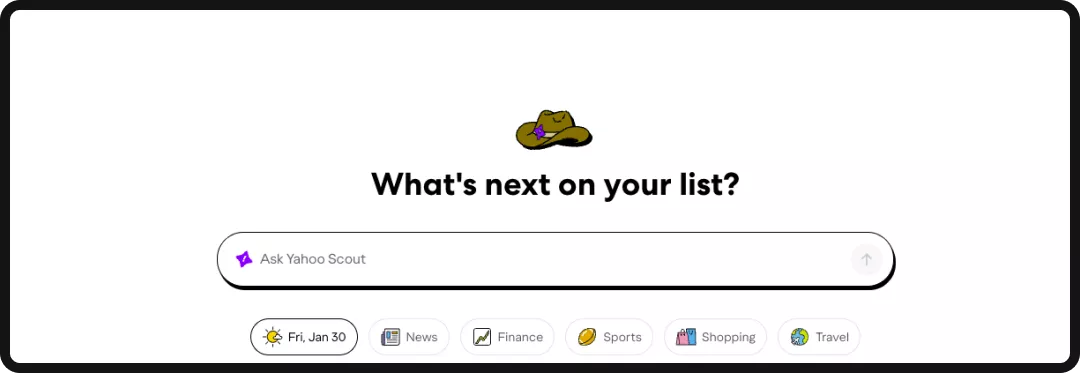
The first thing you notice when you open Yahoo Scout isn’t a chatbot personality or a stream of conversational prompts. It’s a question framed around intent:
“What’s next on your list?”
Rather than positioning Scout as a conversational companion (ChatGPT’s message reads “what are you working on?”), Yahoo presents it as a starting point, a place to orient yourself before deciding where to go next. Below the input, Scout immediately anchors users in familiar categories like News, Finance, Sports, Shopping, and Travel, reinforcing the idea that this is about organizing browsing instead of replacing it.
This reflects Yahoo’s roots. Yahoo didn’t begin as a crawler-first search engine. It began as a directory, a portal built to help users navigate the web through trusted categories, editorial judgment, and repeat destinations. Scout modernizes that same logic using AI.
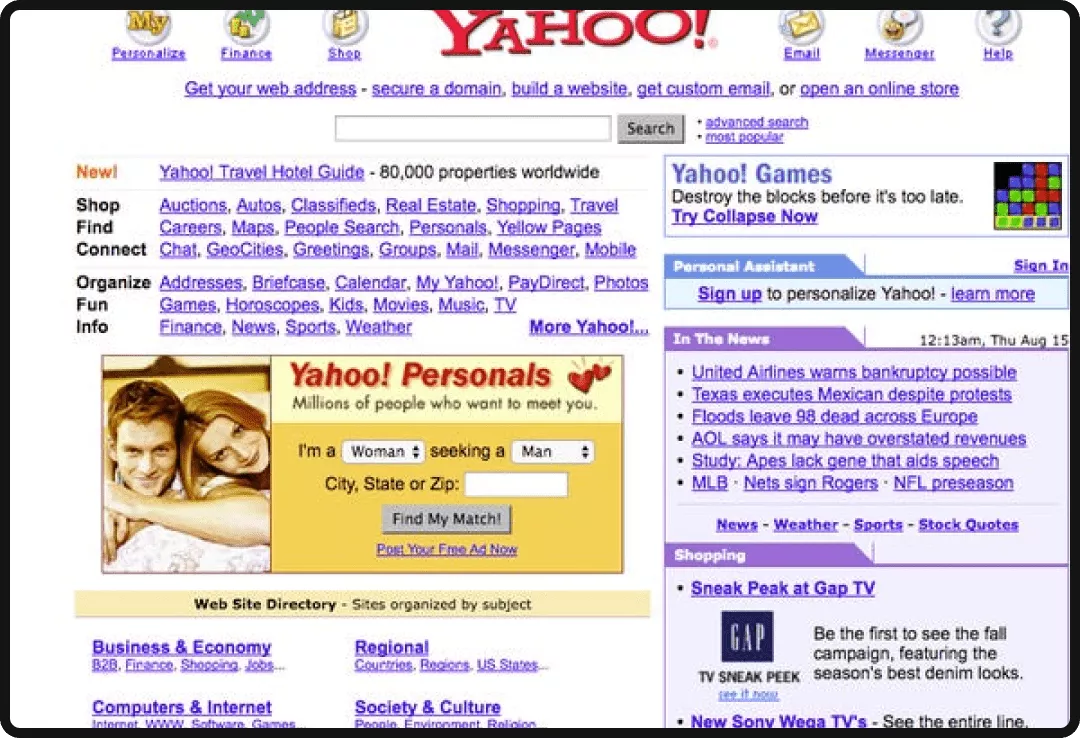
Instead of lists of links, Scout offers explanations. Instead of rigid categories, it responds to intent. Instead of asking users to start over with every query, it assumes continuity.
That’s a fundamentally different goal than most chatbot-style AI tools. Chat-first AI experiences are optimized to replace exploration. They aim to deliver a single, self-contained answer that closes the loop as quickly as possible. Scout does the opposite and acts as an intelligent routing layer to help users understand a topic, then guide them toward deeper coverage within Yahoo’s ecosystem.
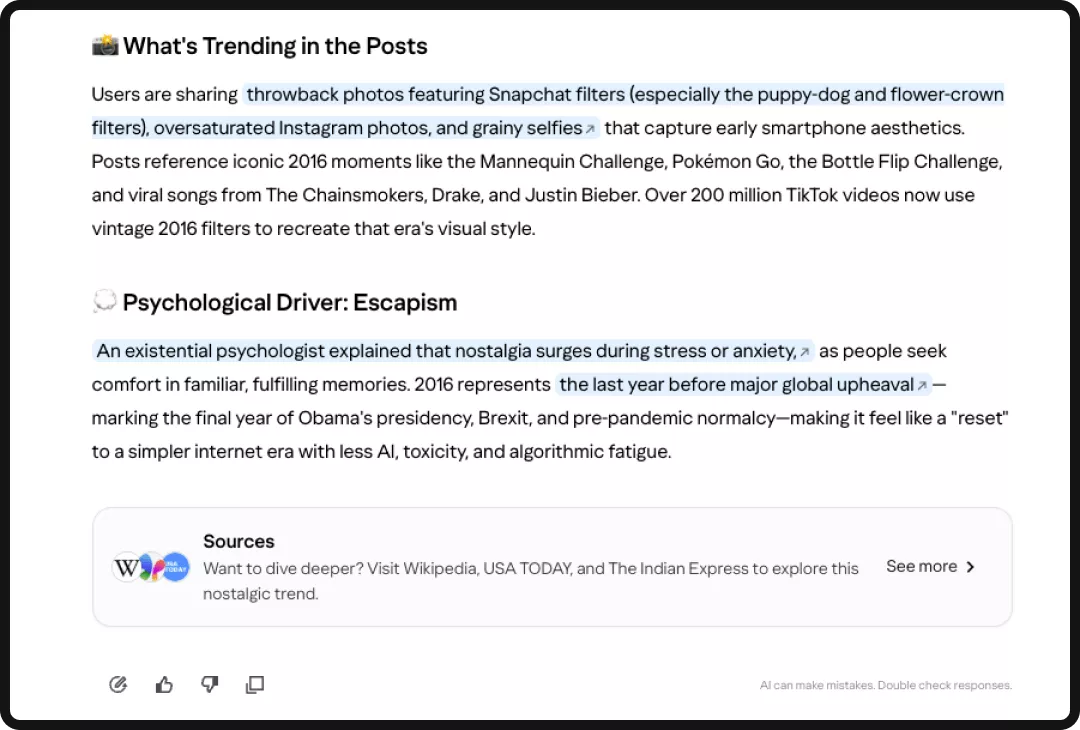
You can see this in the interface itself. The lack of heavy conversational scaffolding, the emphasis on verticals, and the absence of performative AI “personality” all signal that Scout is meant to feel less like a digital assistant and more like a home base for information.
In that sense, Scout isn’t trying to win the chatbot race. It’s reviving the portal, not as a static homepage, but as an AI system that connects questions to trusted destinations. And in an AI search landscape increasingly dominated by opaque answers and disappearing sources, that choice feels less nostalgic than strategic.
Why Yahoo Might Win This Phase of AI Search
With so many first-to-market platforms dominating the AI search race, it’s easy to assume that Yahoo’s running a race it can’t win. But in this phase of the AI search market, I don’t think it’s just about who builds the best AI search tool anymore. I’d place my bets on who can deploy AI on top of something that’s already really durable. And that’s where Yahoo quietly becomes dangerous again.
AI Search Is Moving From Access to Interpretation
Early AI search innovation focused on access: crawl more pages, retrieve faster, summarize better. But as data access tightens, licensing expands, and publishers push back, the bottleneck is shifting.
Many AI search tools have to evaluate whether the information they retrieve is accurate at the same time they’re trying to summarize it, which increases the risk of error or hallucination.
Yahoo operated under a different constraint. Because it primarily draws from Yahoo-owned and licensed content that already meets known editorial and data standards, the AI leyer doesn’t need to validate sources in real time. It can focus on connecting and explaining information that’s already been vetted.
Yahoo’s “Late” Entry Is Actually a Timing Advantage
Being early in AI search came with tradeoffs: messy sourcing, hallucinations, and unclear incentives for publishers. Yahoo avoided that first wave and in doing so, avoided locking itself into brittle assumptions about infinite data access.
Scout launches into a market that now values:
- Trust over novelty
- Consistency over coverage
- Relationships over reach
Those are all areas where Yahoo already has institutional muscle. Yahoo’s strength is its ability to combine user data, content, and long-standing partnerships into a coherent system. Scout is simply the interface where that system becomes visible.
Distribution Still Matters (& Yahoo Has It)
One of the most underestimated advantages in AI search is existing user behavior.
Yahoo isn’t asking people to adopt a brand-new habit. It’s embedding Scout into places users already check daily, news, finance, sports, weather, and mail. That makes Scout less of a destination you have to remember and more of a layer that quietly becomes useful.
This Is a Different Kind of AI Bet
Scout isn’t trying to be the flashiest, smartest model in the room. It’s trying to be the most grounded.
Pairing AI reasoning with owned content, licensed data, and clear incentives means Yahoo is betting that the next winners in the AI Search rave aren’t the ones who answer everything, but the ones that answer enough things extremely well and can explain why those answers should be trusted.
If the first era of AI search was about proving what models could do, this next era is about proving what systems can sustain. On that front, Yahoo is certainly prepared.
What Yahoo Scout’s Entrance Means for Brands
Yahoo Scout isn’t just another AI search surface to “optimize for.” It’s a signal that where your content lives and who validates it may matter more than how cleverly it’s written.
For brands, that changes the playbook in a few important ways.
1. Prioritize Presence Inside Trusted Content Ecosystems
Scout favors information that already lives inside known, editorially governed environments. That means brands should think beyond publishing on their own sites and ask:
- Are we cited, quoted, or referenced in trusted media outlets?
- Do we show up in finance, news, shopping, or industry verticals that platforms like Yahoo already rely on?
- Are third-party mentions consistent, accurate, and up to date?
Action: Invest in earned media, partnerships, and placements that embed your brand into authoritative content networks, not just SEO/AEO blog posts.
2. Optimize for Being Used, Not Just Indexed
In an ecosystem-first answer engine, content doesn’t win because it ranks #1. It wins because it’s useful enough to be reused.
Scout is more likely to surface:
- Clear definitions
- Explanatory content
- Structured comparisons
- Data-backed insights
Action: Audit your content for “answer readiness.” Ask: If an AI needed to explain this topic using our content, could it do so cleanly and confidently? If not, simplify, clarify, and structure.
3. Treat Brand Authority as a Distribution Channel
Scout reflects a broader trend: AI answer engines increasingly act as distribution layers for trusted brands, not neutral discovery tools.
If your brand is already seen as:
- Reliable
- Consistent
- Expert in a narrow domain
…it’s more likely to be pulled into AI answers.
Action: Narrow your topical focus. Depth in fewer areas beats shallow coverage across many.
4. Invest in Entity Consistency Across the Web
Because Scout relies on known sources and structured understanding, inconsistencies hurt more than ever.
Conflicting brand descriptions, outdated stats, or mismatched messaging across publishers introduce friction, even if your on-site SEO is perfect.
Action: Align how your brand is described across—
- Press coverage
- Product listings
- Review platforms
- Partner sites
Consistency increases AI confidence.
5. Stop Thinking “AI Search = One Platform”
Yahoo Scout makes one thing clear: AI search won’t consolidate into a single interface.
Some engines will be search-native. Some will be LLM-native. Others, like Scout, will be ecosystem-native.
Action: Build visibility strategies that travel across environments:
- Search
- AI answers
- Media ecosystems
… not tactics tied to a single tool.
The Bigger Takeaway
Yahoo Scout rewards brands that:
- Show up in trusted places
- Explain things clearly
- Maintain consistency across the web
It’s less about gaming AI prompts and more about earning inclusion in the sources AI already trusts.
Conclusion: AI Search Isn’t About Who’s First, It’s About Who’s Built for It
Yahoo Scout is easy to dismiss if you think AI search is still about who ships first or sounds the smartest. But that phase is already fading.
What Scout shows is that the next era of AI search will favor systems grounded in trusted content, clear incentives, and durable distribution. Yahoo activated a system that’s been operating for years instead of bolting AI onto a blank slate.
For brands, the signal is clear: AI search visibility is moving away from prompt tactics and toward being present in the sources AI already trusts. Authority, consistency, and ecosystem placement matter more than ever.
Scout isn’t trying to win the chatbot race. It’s betting that being built for sustainability beats being built for spectacle. And in this phase of AI search, that bet may age well.
Some icons and visual assets used in this post, as well as in previously published and future blog posts, are licensed under the MIT License, Apache License 2.0, and Creative Commons Attribution 4.0.
https://opensource.org/licenses/MIT