If you’re a B2B SaaS marketer, you’ve probably noticed that those hard-earned SEO rankings of yours may not be driving the traffic they used to. Welcome to the club! I’m pleased to announce that it’s not just you. But who’s the culprit? Drumroll please… it’s AI answers; they’re intercepting your clicks before users even reach your site.
Between Google AI Overviews, ChatGPT, Perplexity, and other LLMs providing direct answers to user queries, the traditional “search → click → convert” funnel has been pronounced DOA.
What does that mean? If you’re still optimizing exclusively for SEO without considering Answer Engine Optimization (AEO), you may as well not even exist in the spaces where your target audience is actually searching.
Here’s the thing, though: AEO for B2B SaaS isn’t just “SEO 2.0” or some trend you can ignore until it blows over. It’s a fundamental shift in how technical buyers research solutions, and the B2B SaaS companies that adapt now will dominate visibility in AI answers for years to come.
Without further ado, let’s talk about how to actually do this.
What’s the Difference Between AEO & SEO?
Before we get into the B2B SaaS-specific strategies (patience, we’re almost there), let’s dig more into the most common question: what’s the difference between AEO and SEO?
SEO is all about ranking high on traditional search engines, like Google and Bing. The ultimate goal is to drive clicks to your website by targeting keywords, building backlinks, and optimizing your site’s technical health. Success in SEO means your website appears in position 1-3 on the SERP, ideally driving a steady stream of organic traffic.
AEO, however, focuses on getting your content featured in AI summaries and direct answers served by answer engines and LLMs. The goal isn’t necessarily to get clicks; it’s to be cited, referenced, or synthesized into the answer that users see. Success in AEO keeps your brand visible, even in zero-click search experiences.
Pop quiz time: what’s the biggest mindset shift with SEO vs. AEO? With SEO, you’re optimizing for rankings. With AEO, you’re optimizing for being the authoritative source that AI models trust enough to cite.
That being said, here’s the kicker: SEO is still the foundation for AEO. So if your B2B SaaS site isn’t performing well in traditional search, you’re already at a massive disadvantage in answer engines. You can’t skip the fundamentals.
Why AEO Matters for B2B SaaS
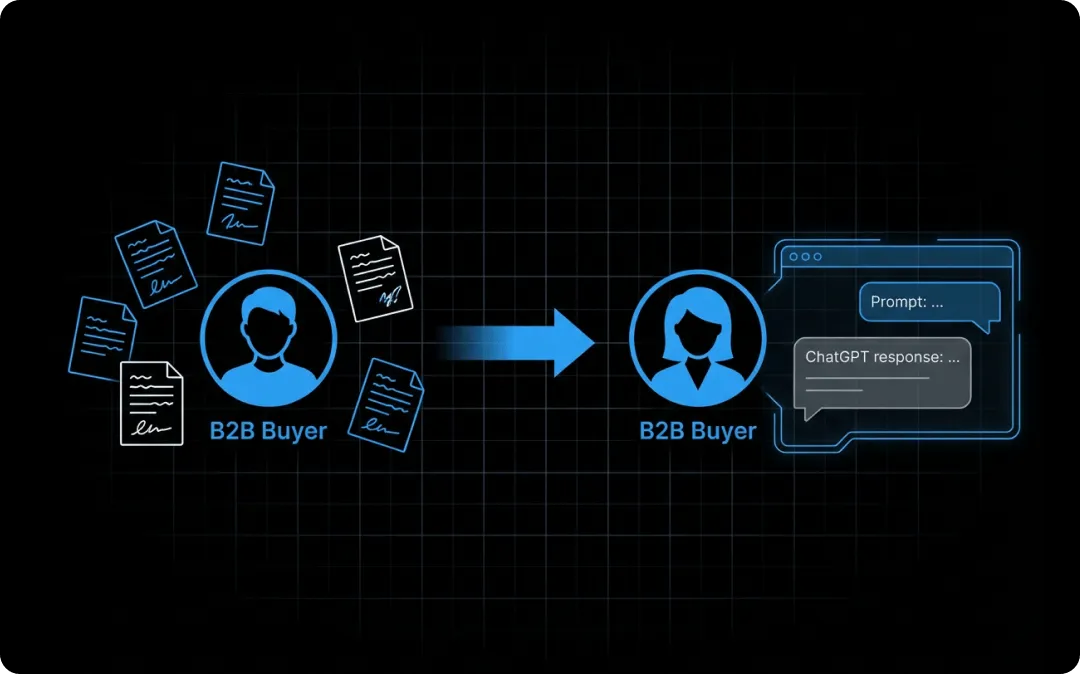
Because B2B SaaS is a larger and longer-term decision (not to mention one that’s on behalf of an entire organization), B2B SaaS buyers don’t impulse purchase like B2C consumers tend to do. Rather, they conduct extensive research, compare solutions, consult with stakeholders, and make decisions over weeks or months. From a user behavior perspective, this makes them prime candidates for using AI engines during their research phase.
Think about it: your ideal customer isn’t typing “best project management software” into Google anymore. They’re asking ChatGPT, “What’s the best project management tool for remote teams with 50+ employees that integrates with Slack and has time-tracking features?”
For the user, it’s an easy-answer paradise; for you (or your SEO team), it’s a major narrowing of the playing field. Because if your brand isn’t showing up in that AI summary, you’ve lost the opportunity to be considered.
Here’s why AEO is particularly critical for B2B SaaS:
- Longer sales cycles mean more research touchpoints. B2B buyers interact with 10+ pieces of content before making a decision. If answer engines are providing those answers without citing you, you’re missing crucial touchpoints.
- Technical buyers trust AI for unbiased comparisons. Rather than clicking through biased vendor pages, buyers are turning to AI for what they perceive as neutral, data-driven recommendations.
- Zero-click search is the new normal. With 58.5% of searches ending without a click, visibility in AI Overviews and LLM responses is how you get in front of buyers (even if they never visit your site).
Core AEO Strategy for B2B SaaS
Alright, enough with the “why” (I’m sure you’re ready to get into the real meat of this article); so let’s do it. Building an effective B2B SaaS AEO strategy requires a mix of content optimization, technical SEO hygiene, and a fundamental shift in how you think about search visibility.
1. Create AEO-Ready Content That Answers Real Questions
Answer engines prioritize content that directly and comprehensively answers user questions. This means your blog posts, help docs, and landing pages need to be structured around the specific questions your target audience is asking.
For B2B SaaS, this looks like:
- Integration Guides: “How to integrate [Product] with Salesforce” or “Does [Product] work with Microsoft Teams?”
- Comparison Content: “What’s the difference between [Product] and [Competitor]?” (I know it sounds a little icky, but yes, you should be writing this content; AI will find it.)
- Procedural Guidance: “How to set up SSO in [Product]” or “How to migrate data from [Competitor] to [Product]”
- Cost & Pricing Transparency: “Is [Product] Worth It?” or “How Much Does [Product] Really Cost?”
💡 Pro Tip: Use the “People Also Ask” boxes on Google SERPs as a starting point for question-based content. These are ✨literal✨ gold mines for understanding what your audience is actually asking.
2. Implement Structured Data Markup
If you’re not using schema markup yet, start yesterday. Structured data is how AI crawlers “know” exactly what your content is about, making it easier for LLMs to parse, understand, and cite your content.
For B2B SaaS, prioritize these schema types:
- FAQPage Schema: For any content with Q&A format.
- HowTo Schema: For step-by-step guides and tutorials.
- Product Schema: For product pages (include pricing, features, and reviews).
- Organization Schema: For your About page and company information.
- SoftwareApplication Schema: Specifically designed for software products.
💡 Pro Tip: Use the Schema.org Validator to ensure your markup is implemented correctly. Even small errors can prevent AI crawlers from properly reading your structured data.
3. Keep Working on Technical SEO (Yes, It Still Matters)
Remember when I said SEO is the foundation for AEO? This is where that matters most (*wipes my SEO copywriter tears away*). The main thing to remember here is this: AI crawlers time out way faster than Google’s crawlers, so if your site is slow or has technical issues, answer engines might not even be indexing your content.
Focus on:
- Core Web Vitals: Fast load times, minimal layout shifts, and quick interactivity.
- Mobile Optimization: AI crawlers index mobile versions first.
- Clean Site Architecture: Logical URL structures and internal linking.
- XML Sitemaps: Make it easy for AI crawlers to discover your content.
💡 Pro Tip: If your B2B SaaS site is built on WordPress, Webflow, or another CMS, most technical optimization can be handled with plugins or built-in settings. If you find yourself running into persistent issues, it’s time to loop in a developer (also, no offense, but what the heck have you been doing up to this point?).
4. Build Trust Signals That AI Recognizes
Answer engines prioritize authoritative sources when generating answers. This means you need to actively build trust signals that demonstrate your expertise and credibility.
Here’s how:
- Get cited by high-authority sites. Backlinks still matter, but now they matter for AEO too. Focus on getting featured in industry publications, guest posting on reputable blogs, and earning links from .edu or .gov sites.
- Note: While backlinks focused on traditional hyperlinks, AI citations can be linked or unlinked. Your brand name just has to be on that page!
- Publish original research and data. AI models love citing statistics and studies. If you can publish proprietary data (like our AEO Periodic Table), you’re much more likely to be cited.
- Maintain author bios and E-E-A-T signals. Google (and by extension, AI models) care about who wrote the content (hi, it’s me). Make sure every piece of content has a clear author with credentials and expertise.
The above may sound a little vague, but worry not; we’ve got some insider info coming up in the next section that can teach you exactly how to build those sweet, sweet trust signals 😉
5. Get Cited Where LLMs Are Looking (Hint: It’s Not Just Your Website)
Ready for an uncomfortable truth? LLMs aren’t primarily citing vendor websites when answering B2B SaaS queries. In layman’s terms, your brand will likely never be directly cited in an LLM (sorry). Rather, they’re pulling from a much wider ecosystem of third-party sources.
Here’s what we mean.
Between February and June 2025, Goodie analyzed 5.7 million citations from ChatGPT, Gemini, Claude, and Perplexity to identify which domains LLMs trust most for B2B SaaS-related queries. The results? A small set of domains captures a disproportionate share of citations, and they fall into three categories:
- Affiliate & Listicle Sites: PCMag, Capterra, TechRadar, G2, and CNET dominate across models. Think of those “best tools for X” roundups that LLMs rely on heavily.
- Social & UGC Platforms: Reddit is the top-cited domain for ChatGPT and Perplexity, while LinkedIn shows up frequently in Perplexity results. Wikipedia also appears across multiple models.
- News & Publishers: Forbes, TechCrunch, and other trusted publishers provide credibility signals that LLMs value.
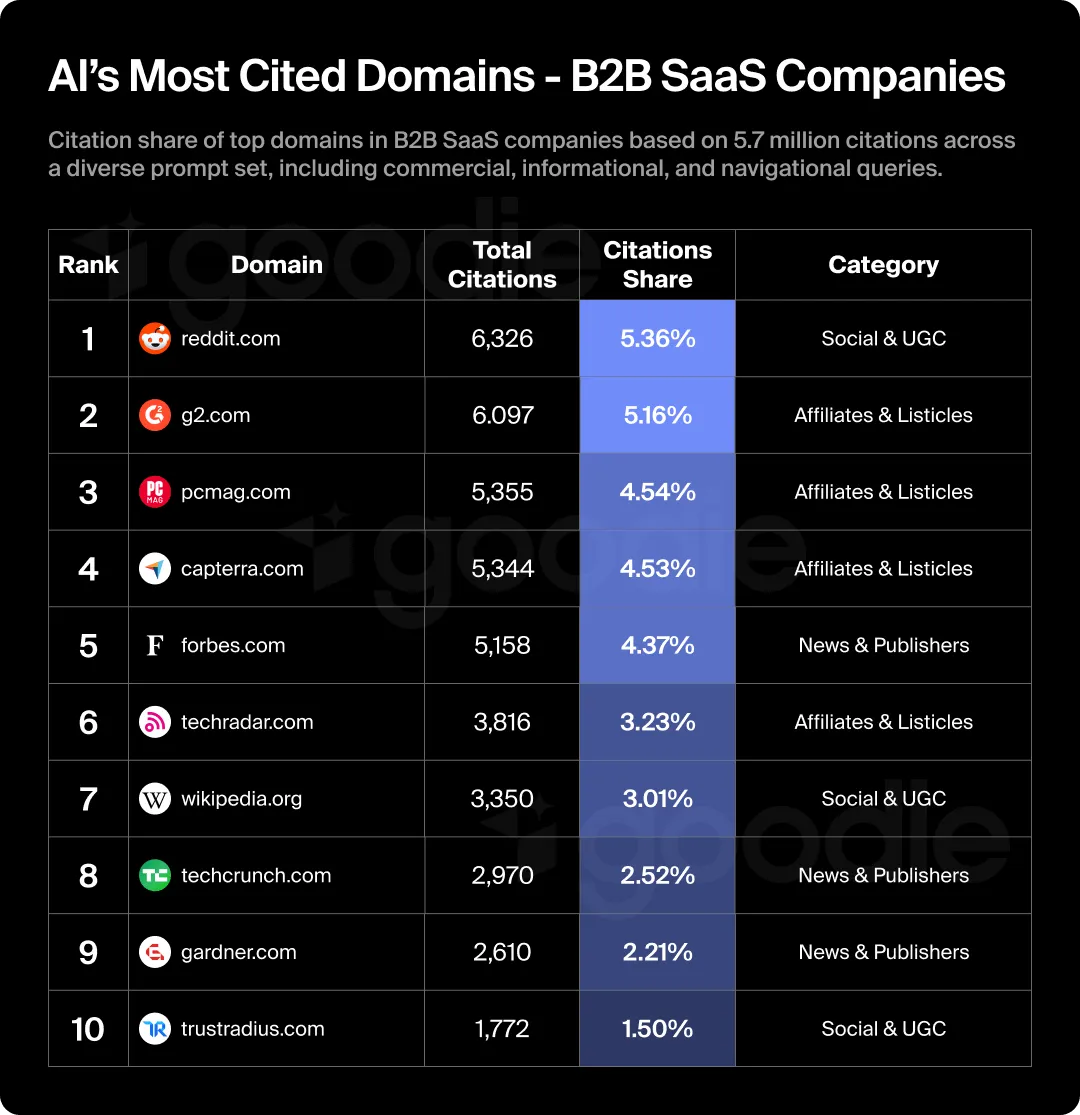
The key insight? If you want to be cited by LLMs, you need a presence beyond your own website. Here’s how to build that:
- Get featured in software review roundups. Reach out to Capterra, G2, PCMag, and similar publications to get your product included in relevant listicles. Different models have different preferences (Gemini leans heavily on affiliate content, while ChatGPT favors UGC), so don’t forget to diversify your approach.
- Participate in community discussions. Join Reddit threads in r/SaaS, r/marketing, or other relevant communities where your target audience asks questions. Don’t spam (Reddit gets weird about that); instead, add genuine value to conversations.
- Pursue press coverage. Getting mentioned in TechCrunch, Forbes, or industry-specific publications builds the kind of authority signals that LLMs recognize.
- Invest in video content. YouTube appears in the top 10 cited domains for both Perplexity and Gemini. Consider creating product demos or partnering with creators who review B2B SaaS tools.
Oh, and one more thing: Focus on informational and commercial queries, not branded ones. 88.1% of searches that use AI are informational, meaning users are asking “what’s the best project management tool for remote teams?” rather than searching for your product by name. Position yourself as the solution to their problem, not as a brand they should already know.
6. Monitor Your AEO Performance
Unlike traditional SEO where you can track rankings in Semrush or Ahrefs (sounds so easy now, doesn’t it?), AEO requires specialized tools to monitor your visibility in AI Overviews and answer engines.
You’ll want to:
- Track AI Overview appearances. Use tools like Goodie (yes, this is a shameless plug) to monitor when your content appears in Google AI Overviews or gets cited by LLMs.
- Analyze citation patterns. Which pieces of content are getting cited most? What questions are they answering? Use this data to inform your content strategy.
- Monitor zero-click metrics. GA4 hasn’t quite caught up yet; you should definitely set up custom channel groupings in GA4 to track referral traffic from answer engines like ChatGPT and Perplexity.
Real-time visibility tracking is critical because AI summaries change frequently, even more frequently than SERPs. A piece of content that’s cited today might be replaced tomorrow if a competitor publishes something more comprehensive.
Common AEO Mistakes to Avoid
Before we wrap this up, let’s talk about the mistakes that B2B SaaS companies often make when they’re just getting started with AEO:
- Assuming SEO Is Enough: If I may be blunt, it’s not. If you’re only optimizing for traditional search, you’re missing out on AI-driven traffic entirely.
- Writing Vague, Fluffy Content: Answer engines reward specificity. “10 tips for better project management” won’t get cited. “How to set up automated task assignments in Asana”? Now that’s more like it.
- Ignoring Technical Optimization: Slow sites and broken internal links kill your chances of being indexed by AI crawlers.
- Not Tracking AEO Metrics: You can’t optimize what you don’t measure. Set up tracking now so you can iterate on what’s working.
- Skipping Structured Data: Schema markup isn’t optional anymore. Implement it.
Final Thoughts: The New B2B SaaS Search Playbook
If you’re a B2B SaaS marketer still clinging to the old SEO playbook, it’s time to let go. Answer engines aren’t replacing traditional search, but they definitely are becoming the dominant way technical buyers discover and evaluate solutions. You have a tech-y product, you have to meet your tech-y audience where they are.
The companies that win in this new landscape are the ones that recognize AEO isn’t an “extra” or a “nice-to-have”… it’s foundational. Build your content strategy around answering real questions, optimize your site for AI crawlers, and track your visibility in AI-generated answers.
Because here’s the reality: your competitors are already doing this. And if you’re not, you’re losing visibility to them every single day.