Content Siloing for AEO: What It Is & How to Do It
Learn what content siloing is and how to implement it for AEO: structure topics, strengthen authority, improve crawlability, and boost AI citations.
by: Daria Erzakova
Published: February 11, 2026
As AI visibility becomes even more competitive, brands continue to search for ways to get a leg up on the competition, often pulling from familiar SEO strategies and testing their application to AEO.One that has seemed to have picked up traction is content siloing. Content siloing is when you organize your website and its content by topics (or in SEO-speak, keywords), making page groupings on your site into self-contained “silos”.Content siloing has been a long-standing SEO strategy because it clearly signifies to crawlers that you’re an authority on a particular topic, and that you have a comprehensive website dedicated to a topic and its subtopics.From a technical perspective, siloing also makes it easier for crawlers to “read” your site by giving them a logical path to follow (particularly important for when AI crawlers are looking to access your robots.txt and LLMs.txt files).For Answer Engine Optimization (AEO), content siloing provides even more of a benefit because content silos satisfy the structural and authority needs that AI craves, making it more likely that you’re mentioned.How exactly do you do it, though? We’ll break it down for you, helping you win the answer in the process.
What Is a Silo in SEO?
A silo in SEO (also known as a content silo), is a grouping of pages on your site that are related by topic or keyword. For example, if you were running a blog about marketing, you might organize your site’s navigation by discipline or vertical. Therefore, your topic and subtopic structure might look something like this:
AEO
AI Search
Technical AEO
Industry News
SEO
Technical SEO
On-Page SEO
Local SEO
Off-Page SEO
Social Media
Social Search
TikTok
Instagram
LinkedIn
X
Paid Ads
Google Ads
Meta Ads
LinkedIn Ads
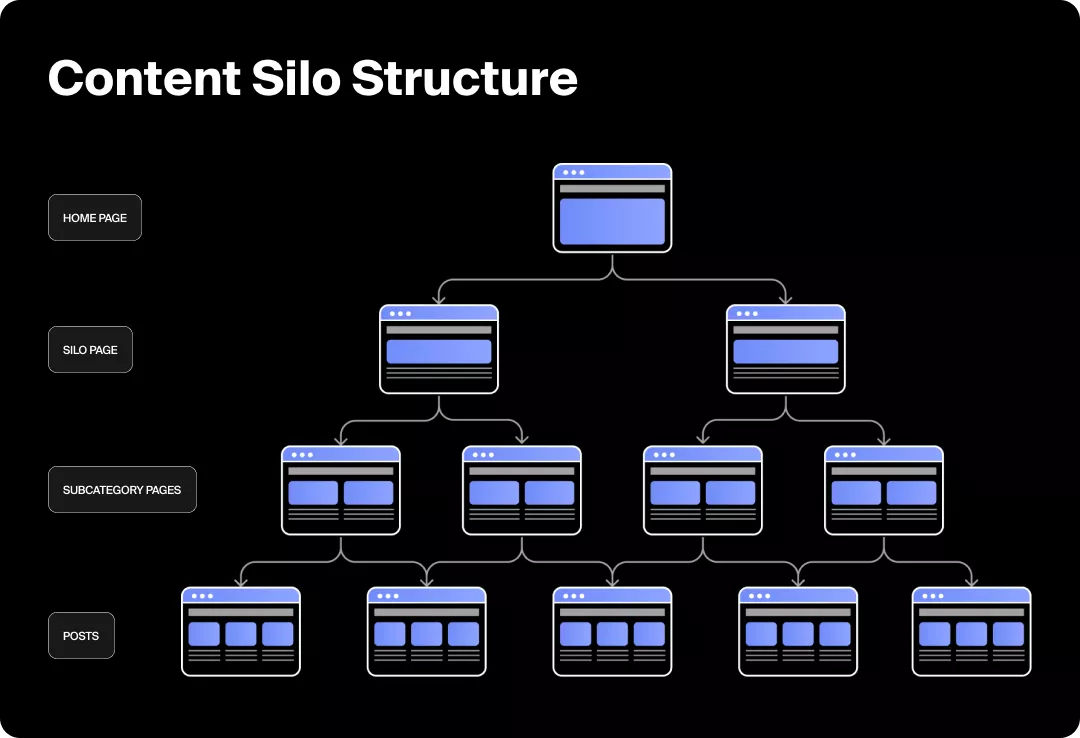
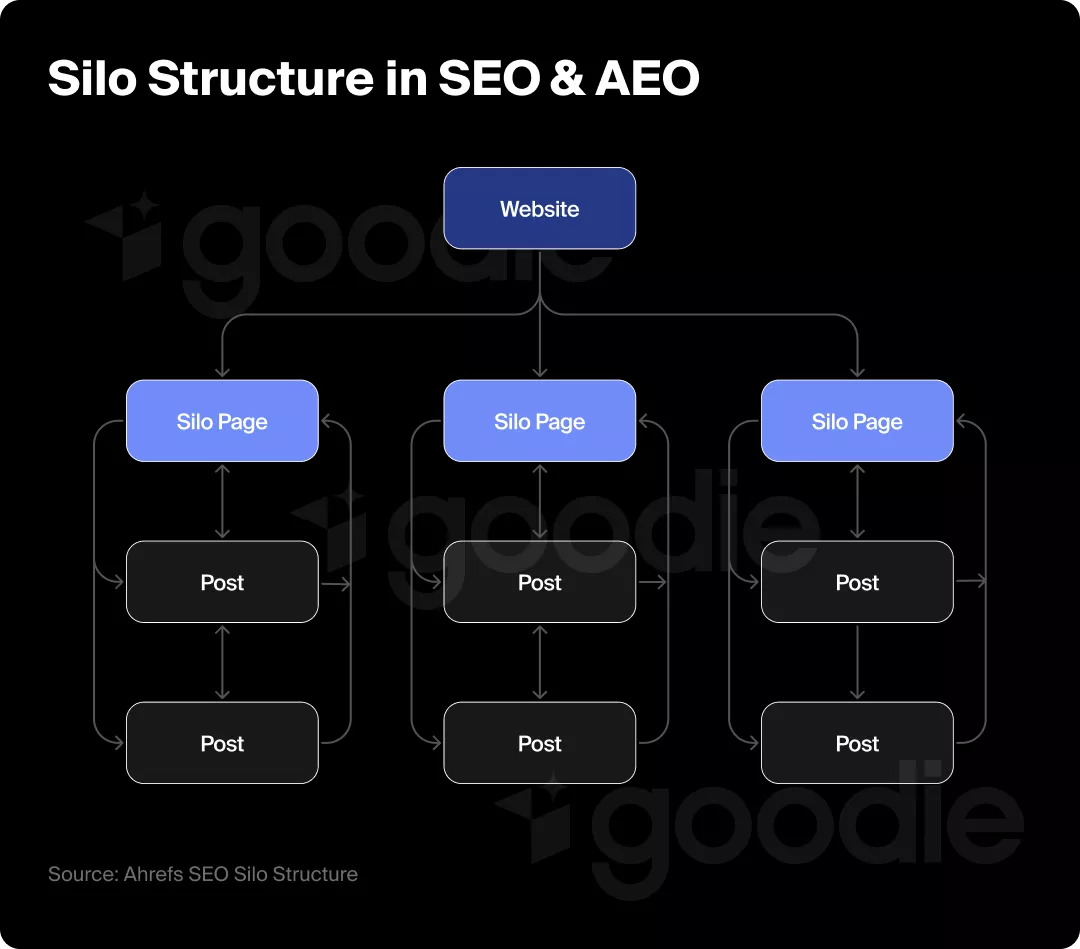
Content siloing is important because it helps both users and crawlers (traditional ones like GoogleBot and BingBot as well as AI crawlers) read and understand your website. If you’re practicing correct internal linking, that’s another way to show how each of your pages relate to each other, and which are the most important.To provide a visual example, let’s break down the primary elements that compose an effective content silo structure:
High-Level Topic Page
This is the main page that broadly addresses the core topic or high-level keyword of the silo (e.g., “AEO”).
It sits at the highest organizational level within the grouping and serves as the entry point for the topic.
Supporting Detail Pages
These are deep-dive articles that break down the topics and subtopics related to the main topic (e.g., “Query Fan-Out” or “LLMs.txt”).
These pages serve to provide the necessary depth and detail to demonstrate your site’s comprehensive expertise on the subject at hand.
Strategic Internal Linking
This is a strict linking structure where detailed pages link back up to the High-Level Topic Page, and that page links down to all the detailed pages.
This funneling of authority ensures that the entire grouping is strengthened and clearly communicates the content hierarchy to search engine crawlers.
Benefits of Content Siloing for SEO & AEO
If you’re wondering why we’re still including SEO in the equation, we’ll remind you of what we said in the intro paragraph: strong SEO is the foundation of gaining AI visibility. If your site isn’t already following SEO principles, you’re severely impacting your ability to show up in AI answers.The great news is this: the same strategic effort you put into siloing for Google’s traditional rankings is what makes your site citable by AI. So, by understanding why content siloing is beneficial for SEO, you’re automatically gaining the knowledge you need for visibility in AI.Here’s a clean breakdown of the benefits of content siloing, the definition, and their benefits with regards to SEO and AEO:
Aspect
Definition
SEO Benefit
AEO Benefit
Establishing Topic Authority
Signals to search and AI engines that you are an expert on the subject you’re discussing
Boosts keyword relevancy across all pages in the silo, improving rankings for both broad and long-tail terms
Positions your site as the most authoritative domain on the topic, making your content a preferred choice for answers
Maximizing Internal Linking Power
Ensures link equityflows efficiently and exclusively between relevant pages, concentrating authority where it matters most
Strengthens the ranking power of your most important pages
Acts as a knowledge graph for AI by helping generative models piece together related facts from multiple pages
Improving Crawlability & Indexing
Makes it easy for crawlers to discover, assess, and index all of your website’s content
Ensures your important articles are found quickly and recognized as part of a larger topic
Freshest content is readily available to be pulled into an AI’s response, giving you a competitive edge
Enhancing User Experience (UX)
Structures topics into subtopics, making it easier to navigate your site and find relevant information
Leads to positive engagement signals,which influences your position on the SERP
Positive feedback (sharing, scroll depth) from users reinforces authority signals in AI engines
Preventing Content Cannibalization
Content cannibalization (when multiple pages target the same keyword) decreases your link equity
Ensures each page ranks for its intended semantic niche, maximizing the potential for SERP visibility
Provides AI with an unambiguous source for every topic, reducing the likelihood of it synthesizing conflicting information
How to Do Content Siloing for AEO
Okay, so now that we’ve talked about why content siloing is important from both an SEO and AEO perspective, let’s deep-dive into the step-by-step process you should take when you’re going to implement this web structure with the goal of improving AI visibility and citation count.
Step 1: Keyword Research & Topic Mapping
The first (and most important) step in establishing an AEO content silo page structure is to first determine what you’re going to write about. To make sure you’re actually writing content that your audience is invested in and would actually find helpful, start by performing keyword research (like you would for SEO) for your overarching silo topics.While you’re doing this, put yourself in the shoes of your audience to determine their intent. For example, if your audience is searching for “AEO KPIs,” they’re likely looking for an authoritative source that can explain what AEO is, communicate its importance, and give a comprehensive how-to guide for strategy and measurement.
Mapping Your Content Hierarchy
Once you’ve defined the broad topics that you want to cover, you need to map out the way you’ll structure the page. Specifically, you need to discover the subtopics you want to cover, which you can do using Ahrefs or a keyword research tool.The subtopics you’re covering are likely going to be long-tail keywords that are lower competition than your main topic pages. You can check out NoGood’s keyword matrix blog to help you with this step. For AEO specifically, consider using question-based queries for your main or subtopics, as people are more inclined to input long-term questions into LLMs rather than short-tail keywords. You can use the “People Also Ask” box on Google SERPs to discover the questions your audience is asking.Once you’ve discovered all the keywords you want to use, create a spreadsheet or flowchart that depicts how you’d like to organize your content structure. Each broad topic should link to 10-20 supporting topics (depending on what you’re writing about), so that search engine and AI crawlers understand that you’re a comprehensive source in your niche.Here’s how it would look:Top Tier (The Overarching Topic):
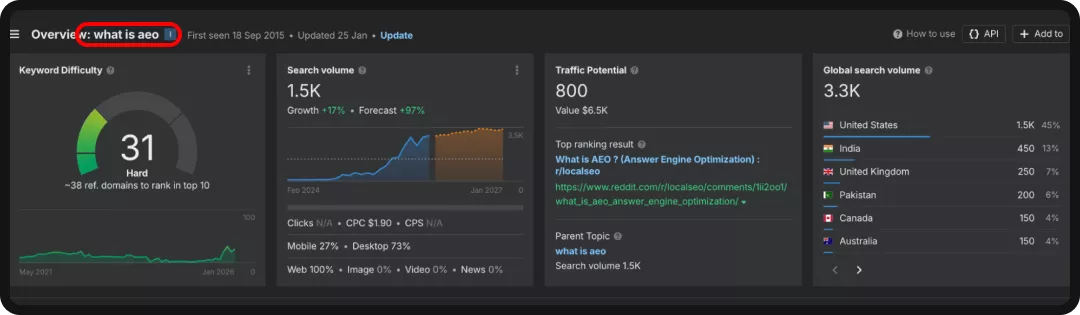
Role: The authoritative guide (e.g., “What Is AEO”).
Target: Targets high volume, competitive head terms (broad keywords).
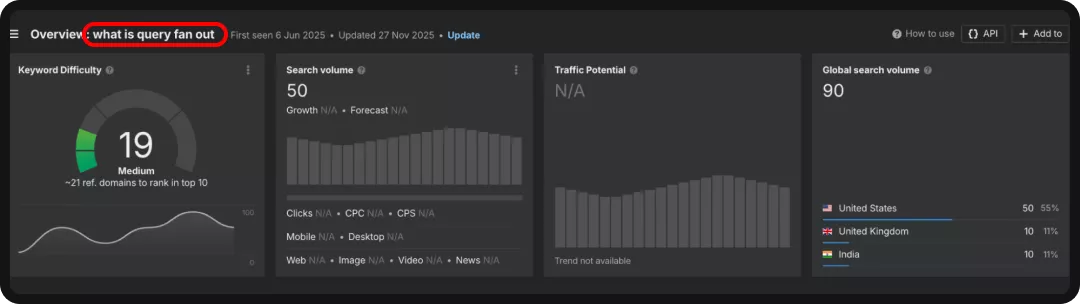
Middle Tier (Supporting Articles):
Role: Detailed articles that support the hub and target secondary keywords (e.g., “what is query fan-out”).
Target: Targets medium-volume, specific long-tail keywords and user questions.
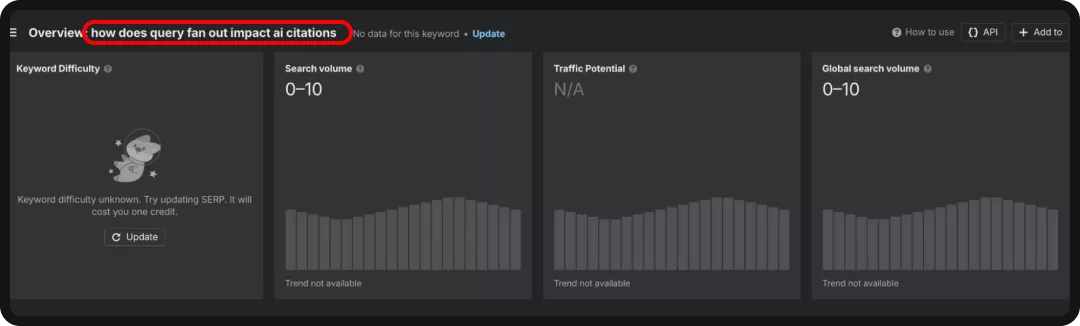
Bottom Tier (Niche Content):
Role: Highly niche, specific articles (e.g., “how does query fan-out impact citations”) that link up to the supporting articles.
Target: Targets low-volume, highly specific long-tail or semantic keywords.
Step 2: Choosing Your Silo Structure
Now that you’ve chosen all of your topics and planned out how you want to structure them, you’re going to need to choose what method you’re going to use to organize the content on your site. There are two methods you can use: directory (or physical) siloing, and virtual (or thematic) siloing:
Directory (Physical) Siloing
Virtual (Thematic) Siloing
Structure
Utilizes the URL directory structure to house related content within topic-specific folders
Achieved through internal linking and navigation menus, without necessarily following a rigid URL structure
Best For
Building a strong foundation for AI citability, creating a scalable system that can be built upon as keyword topics expand and change
Often the preferred method for existing sites or older blogs where the URL structure is fixed or difficult to change without causing SEO issues
Benefit
Creates an explicit hierarchy for both crawlers and users and reinforces the topic structure directly within the permalink structure, making it effective for new websites or sections
Allows retrofitting of an authoritative silo structure onto existing content by focusing the internal links (especially using relevant anchor text) to create a grouping that search engines will recognize
For best results, though, you should combine both of these methods for the following reasons:
Maximum Clarity: It makes it even easier for crawlers and users to navigate your site.
Maximum Authority: The internal linking ensures that the authority of all supporting pages is concentrated upward to the main topic, establishing it as the definitive source.
Step 3: The Internal Linking Strategy
The core principle of siloing, as mentioned, is that you have a link exclusively within the silo to pass link equity effectively (and for it to actually be considered the silo structure). Avoid linking supporting articles out to unrelated topics on your site, as it ensures that the value of each piece of content remains concentrated within the silo, boosting the authority of the entire group of content.Here’s how to execute it:
Hub to Supporting Articles: The top-level page must link down to all of the supporting articles and sub-pages in its silo, passing relevance and authority from the most important page down to every subpage.
Supporting Articles to Hub: Crucially, every supporting article must also link back up to its main topic, concentrating link equity and reinforcing your authority on the topic.
Another crucial part of content siloing is the anchor text that is used to create your internal links. This text tells search engines exactly what the target page is about. This is also another example of where SEO best practices and AEO strategy blend together.
Maximizing SEO Value: Use descriptive and keyword-rich anchor text (e.g., “‘Read our review on ‘Alien’” rather than “click here”).
AEO Benefit: This practice helps AI models associate your silo with relevant queries for your brand, increasing the likelihood that your site will be mentioned.
Monitoring, Maintenance & Advanced Siloing
Now that you’ve created and implemented content silos on your site, you need to stay on top of them so that they deliver the results you want.
Tools for Implementation & Maintenance
Maintaining a content silo requires organization and the right tools to ensure the linking structure remains intact.
Content Management System (CMS) Review: Ensure your CMS (e.g., WordPress, Webflow, etc.) facilitates internal linking and allows for the creation of clean URLs (critical for link siloing).
Specialized Linking Tools: Consider using plugins or tools (like Internal Link Juicer for WordPress) that can automate or assist in suggesting relevant anchor text and manage link volume across silos, reducing manual lift.
Monitoring Performance
Implementing these strategies is nothing if you don’t track their impact. After you’ve rehauled your website’s structure and content, you should monitor the following metrics to see if your strategy is successful or if you should make some adjustments.
KPI
Tool
Goal
Indexing Status
GSC
Ensure all supporting articles are discoverable and indexed.
Search Rankings
SEO tools (GSC, Ahrefs, Semrush)
Track the fluctuations of your keywords on the SERP
User Flow & Engagement
Google Analytics (GA4)
Analyze how users navigate between pages within the silo. A healthy silo should show users moving from the hub to the supporting articles and back again, which indicates that your content is truly helpful.
Authority
SEO tools (Ahrefs, Moz, Semrush) for domain-level and AEO tools (Goodie) for brand-level
Monitor the change in Domain Authority (DA) or Page Rating (PR) of your pillar pages as link equity flows to them.
LLM Citations
Goodie
Track which pages are getting cited by LLMs, how often, and discover further opportunities for optimization.
Your Long-Term Visibility Play with Content Siloing
Content siloing isn’t just impactful for search engines and AI crawlers; it also puts the user first through an easy-to-navigate, logical site structure. The most important thing to keep in mind when optimizing your site for search or AI engines is that you should be satisfying user needs above all else; otherwise, nobody will stay on your page or engage with your brand meaningfully.By keeping the user in mind while siloing, you align your site structure with H-E-E-A-T principles, making your expertise discoverable and trustworthy to both human visitors and AI.Don’t think of siloing as a quick way to gain visibility, but as a concerted effort that will build the foundation necessary for long-term dominance in both SERP rankings and AI answers.