Something peculiar happened last quarter to a mid-sized outdoor gear retailer in Portland:
- Traffic from Google held steady
- Instagram engagement increased
- Conversion rate collapsed by 40% in eight weeks
The culprit wasn’t a pricing problem or a website redesign gone wrong. It was something most of their team didn’t yet have a word for: ChatGPT’s shopping agent had started routing customers elsewhere, and the company’s products had become invisible to the machine now mediating thousands of purchase decisions.
For two decades, we’ve understood commerce through the lens of search. You optimize for keywords. You compete for ad placements. You design experiences that capture human attention and convert human intent. The fundamental transaction has been retailer-to-consumer, with Google or Instagram acting as the sophisticated middleman. That model is dying faster than anyone in boardrooms wants to admit.
The new middleman is ChatGPT’s agent (and others like it); decision-making entities that shop on behalf of humans, sometimes without the human even knowing a shopping trip occurred.
These agents don’t browse. They parse, compare, and transact based on data structures that most marketing teams have never had to think about. And they’re rewriting the rules of visibility in real time.

When Feeds Become Storefronts
Here’s what happens when someone asks ChatGPT to recommend a backpack for a weekend hiking trip:
- The agent doesn’t visit your website, read your carefully crafted product descriptions or marvel at your lifestyle photography
- It queries structured data feeds, evaluates completeness and consistency, cross-references reviews and specifications, and ranks products based on criteria that have nothing to do with your SEO strategy
So what of your brand story? The agent never even loads the page where you tell it. Your social proof? It only counts if it’s packaged in machine-readable format. Your beautiful product page? Functionally irrelevant to the transaction.
The Portland retailer’s problem wasn’t that their products got worse or that demand for them decreased. Their website was a masterclass in conversion rate optimization for human visitors who arrived ready to browse. But those human visitors were increasingly sending ChatGPT to shop for them, and the agent was bouncing off incomplete product data.
Traditional branding and SEO techniques can’t solve this problem, because the problem operates in a different layer of commerce entirely. When ChatGPT’s agent evaluates your product, it needs:
- Semantic schemas
- Structured attributes
- Pricing consistency
- Return policy clarity,
- Specification completeness that updates in near-real-time
Miss any of these elements, and your product simply doesn’t exist in the agent’s consideration set. There’s no page two of results to fall back on. There’s no “good enough” ranking that still captures some traffic. You’re either in the pool of options or you’re functionally delisted.
This explains why some retailers are seeing 192% growth in add-to-cart actions and 278% boost in sales after overhauling their data schemas. The correlation is direct: better agent comprehension leads to better product selection. The products didn’t change. The prices didn’t change. What changed was legibility to machines.
The Fifteen-Minute Economy
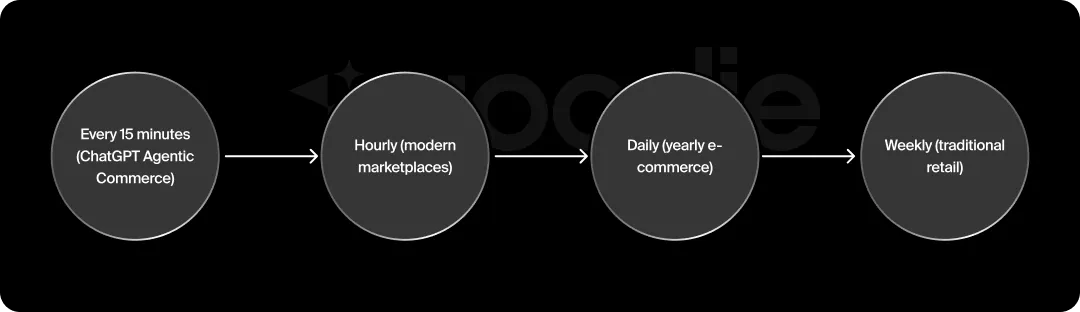
Talk to anyone managing product feeds at scale and you’ll hear the same stress point: agents expect updates at least every fifteen minutes.
This tempo breaks most retail operations. Legacy systems were built for daily batch updates (maybe hourly if you were sophisticated). Marketing teams planned campaigns in weeks, optimized in days. The infrastructure wasn’t designed for this pace of change.
But agents don’t care about your infrastructure constraints. They care about accuracy at the moment of query.
- An out-of-stock item that still shows available in your feed? That’s a ranking penalty
- A price that doesn’t match your checkout API? Penalty
- Slow API response times that make the agent wait? Lower ranking
The technical requirements mirror sitemaps but with brutal specificity. Every product needs comprehensive identifiers, enriched descriptions, pricing, shipping, and inventory details in formats like JSON, CSV, or XML. Optional fields like reviews, ratings, and product variants aren’t optional if you want competitive ranking. Products get ignored if feed data contradicts backend APIs.
Payment integration reliability has become an essential ranking factor. Agents penalize merchants for repeat checkout failures or payment errors. This forces collaboration between teams that operate in silos: SEO specialists now need to work with engineering on uptime and error handling. Marketing can’t optimize in isolation anymore.
Product Cards & the New Ranking Wars
The mechanics of agent selection reveal a different competitive landscape. Success comes down to what insiders call “Product Cards,” the comprehensive metadata bundles that agents evaluate when ranking options. Winning these rankings means:
- Deeper review counts
- Robust FAQs
- Granular attributes
- Crystal-clear stock
- Delivery status
Recent analysis of agent purchasing decisions shows these factors tipping outcomes in ways that feel arbitrary to marketers trained on Google’s algorithm. A product with lower reviews but more complete attribute data might win the recommendation. A higher priced option with better variant handling and faster API response could beat a cheaper competitor with spotty inventory updates.
The optimization playbook reads differently, too. When your product doesn’t surface at the top of ChatGPT’s agent recommendations, the answer isn’t better ad spend or improved keyword targeting. It’s iterating through feed enhancements: adding user-generated content, expanding attribute completeness, layering in contextual information that helps agents understand use cases and compatibility.
This is where data enrichment moves beyond basics into competitive advantage. Long-form content, expert reviews, PDF specifications, video transcripts; all of it helps language models build richer context for recommendations. The agents are trying to be helpful. They need raw material to work with.
Real-time APIs and protocols like Model Context Protocol ensure instant updates for price, stock, and catalog status. The infrastructure requirements are substantial: merchants need to participate across all major answer engines and commerce channels, maintaining structured and contextual data that works for both human shoppers and autonomous agents.
The Protocol Problem
OpenAI and Stripe are building the rails for this system through protocol development that standardizes how agents interact with commerce systems. Merchants need products that are “agentic commerce-ready,” which means matching evolving data standards and passing validation checks that didn’t exist two years ago.
The specifications get technical fast:
- Product ID formats
- Checkout endpoints
- Tokenized payment flows
Optimization is iterative and never complete.
Smart merchants are testing across multiple agent implementations rather than optimizing for a single platform. The differences in data interpretation matter. An agent that prioritizes delivery speed might parse your feed differently than one optimizing for price or sustainability credentials. Broad compatibility becomes the goal.
Automated feed management systems like Feedonomics have become essential infrastructure. They handle the enrichment layer: GTINs, specifications, images, attributes that eliminate errors and speed cross-channel syndication. Real-time performance monitoring, campaign optimization, and governance features like scheduled syncs, change logs, and rollback capabilities are now table stakes.
The operational requirements touch every part of the organization. Continuous feed monitoring and rapid syndication to new platforms have moved from “nice to have” to standard operating procedure.
From Daily Updates to Hourly Optimization
The pace keeps accelerating. Best practices now call for hourly feed optimization, reflecting how quickly agents make ranking and listing changes. Daily or weekly updates leave too much opportunity on the table.
This creates odd incentives. Merchants find themselves optimizing product listings for natural language search terms and user prompts, trying to align product data with how people actually ask ChatGPT for recommendations. The keyword research process starts to feel like prompt engineering.
The end goal has shifted from being discoverable to being highly recommended. Brands need:
- Agent-ready infrastructure with structured, reliable, and context-rich data
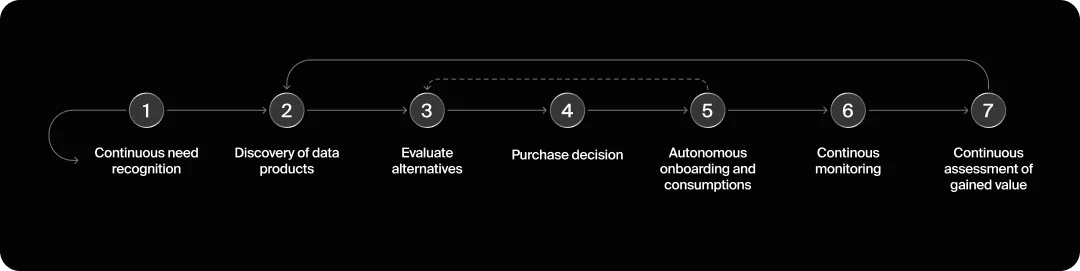
- Agents are autonomously managing entire shopping flows, from initial query through checkout
- Merchants need to ensure product feeds are interpreted accurately at every stage
What This Means for Everyone Else
The Portland retailer eventually figured it out. They brought in a specialized agency, overhauled their product data infrastructure, and implemented automated feed management that updates every twelve minutes. Their conversion rate recovered within six weeks. But the episode revealed something unsettling: they had built an entire business on assumptions about how products get discovered and purchased, and those assumptions were quietly becoming obsolete.
This is happening across retail at different speeds. Large merchants with sophisticated technical teams and substantial resources are adapting faster. Mid-market retailers are scrambling to understand what’s even required. Small businesses are still unaware their products are getting filtered out of agent recommendations.
The gap will widen. Agent-powered commerce rewards scale in new ways:
- Robust feed management
- Update in near-real-time
- Test across multiple platforms
- Maintain comprehensive product data
Some of this feels like the early days of SEO, when retailers suddenly needed to care about meta descriptions and backlinks. But the pace is faster and the penalties for getting it wrong are more severe. With SEO, you could rank on page two and still capture some traffic. With ChatGPT’s agent recommendations, you’re either in the consideration set or you’re nowhere.
The Uncomfortable Questions
This transformation raises questions nobody seems ready to answer. What happens to brand equity when purchase decisions flow through intermediaries that don’t see brand? How do you build customer loyalty when customers increasingly interact with ChatGPT rather than retailers? What’s the role of a .com website when transactions happen inside a chat interface?
The pivot from visual and story-driven experiences to machine-optimized product feeds represents more than a technical challenge. It’s a philosophical shift in what retail means. The craft of merchandising, of creating desire through presentation and narrative, becomes less relevant when the presentation layer gets abstracted away.
Some retailers are pushing back on this future. They’re betting that human shopping behavior won’t actually change that much, that people will still want to browse and discover rather than delegate decisions to agents. Maybe they’re right. But the data suggests otherwise. When given the option to offload routine purchasing decisions to automated systems, people tend to do exactly that.
The uncomfortable truth is that most products are interchangeable at a functional level. A backpack is a backpack. An HDMI cable is an HDMI cable. The differentiation happened through branding, through the story you told about what the product meant. ChatGPT’s agent doesn’t care about meaning. It cares about specifications, price, availability, and reviews. It’s ruthlessly functional.
This doesn’t mean brand dies completely. It means brand needs to work differently. You need to be a brand that agents recommend, which requires a different kind of excellence. Reliability, completeness, speed, consistency. These have always mattered, but they were often secondary to the emotional resonance you could create with good marketing.
Standing in the Right Spot
The ground is still shifting. New protocols emerge. Agent capabilities expand. The technical requirements evolve. Nobody has complete clarity on where this ends up.
What’s increasingly clear is that commerce is splitting into two parallel tracks:
- The human-facing experience that still matters for certain categories and purchase types, and the agent-facing infrastructure that’s becoming essential for everything else
- Retailers need both, but the agent track is growing faster and requires expertise that most teams don’t have yet
The merchants who adapt fastest share certain characteristics. They treat product data as a core asset rather than an afterthought. They’ve automated feed management and monitoring. They test constantly across platforms. They’ve broken down silos between marketing, technical, and operations teams. They understand this isn’t a one-time project but an ongoing operational capability.
The Portland retailer’s experience offers a useful lesson: you can do everything right by yesterday’s standards and still find yourself suddenly obsolete. The question isn’t whether to adapt to ChatGPT’s agentic commerce. The question is whether you’ll adapt fast enough to avoid the forty-percent conversion collapse while you figure it out.
How to Submit Your Feed
So what does this look like in practice? The mechanics of submitting a feed to ChatGPT’s agentic commerce system follow established patterns but with heightened expectations for data quality and freshness.
- Your feed needs to live at a stable, accessible URL. Think of it like a sitemap but for products. The format should be JSON, XML, or CSV with comprehensive fields for each product: unique identifiers (GTINs when available), detailed descriptions that answer the questions an agent might receive, pricing that includes any conditional logic (bulk discounts, membership pricing), shipping costs and timelines, inventory status, and return policies
- The description field deserves special attention. This isn’t the place for marketing copy or aspirational language. Agents need specifications, dimensions, materials, compatibility information, use cases. Write like you’re answering a knowledgeable friend’s question about whether this product will solve their specific problem
- Images matter, but not in the way you think. Agents don’t evaluate aesthetic quality. They need clear, multiple angles, with alt text that describes what’s actually visible. If your product has variants (colors, sizes, configurations), each needs its own complete data set.
- Reviews and ratings should be aggregated and structured. Individual review text helps agents understand common use cases and potential issues. Star ratings without context are less useful than review summaries that capture themes.
- Your API needs to be fast and reliable. When an agent queries your system, response time matters. Slow APIs get penalized in ranking. Downtime is catastrophic. Error handling needs to be graceful and informative.
- Payment integration requires working with established protocols. OpenAI and Stripe are building standardized checkout flows. Your system needs to accept tokenized payments, handle errors transparently, and confirm transactions instantly.
How to Optimize What You’ve Submitted
Submission is the beginning, not the end. Optimization is continuous and data-informed.
- Monitor where your products appear in agent recommendations. This requires testing with various prompts and use cases. Ask ChatGPT to recommend products in your category under different constraints (budget levels, feature requirements, use cases). See where you rank. More importantly, see where you don’t appear at all.
- When you’re missing from recommendations you should win, audit your feed for completeness. Are you missing optional fields that competitors include? Is your inventory data stale? Are your descriptions specific enough to match the prompt?
- Attribute completeness is the most common gap. If you sell camping gear, your tent needs more than just “4-person capacity.” It needs packed weight, setup time, waterproof rating, season rating, pole material, and floor dimensions. The agent is comparing your product against others with complete specifications. Incomplete data reads as lower quality or less suitable.
- Update frequency matters more than you think. If your inventory changes and your feed doesn’t reflect that for hours, agents learn your data is unreliable. Frequent updates signal operational competence. Aim for real-time if possible, or at minimum every fifteen minutes for products with volatile inventory.
- Pricing consistency across your feed and your checkout API is non-negotiable. Agents penalize merchants where the price in the feed doesn’t match the price at checkout. If you have dynamic pricing (time-based, quantity-based, membership-based), that logic needs to be reflected in your feed or handled transparently at checkout.
- Test your checkout flow obsessively. Failed transactions, unclear error messages, or complicated approval processes all hurt your ranking. Agents remember merchants who create friction. The goal is zero-click purchasing: the agent handles everything without requiring the user to troubleshoot.
- Add contextual content that helps agents understand when your product is the right choice. If you sell ergonomic keyboards, include information about wrist positioning, typing styles that benefit most, desk setup considerations. This context helps agents make better recommendations, which improves your conversion rate, which improves your ranking.
The Metrics That Matter
Traditional eCommerce metrics don’t map cleanly to agentic commerce. Traffic is meaningless if agents never load your page. Bounce rate doesn’t exist in the same way. You need new measurement frameworks:
- Recommendation frequency is the core metric. How often does ChatGPT’s agent suggest your product when it’s relevant? This requires systematic prompt testing across your category
- Conversion rate from recommendation to purchase tells you if your feed data matched the actual product experience
- Low conversion despite high recommendation frequency suggests a data quality problem
- Checkout completion rate reveals technical reliability
- If users reach checkout but don’t complete, your payment integration or error handling needs work
- Feed freshness can be measured by comparing your feed timestamp to your actual inventory system
- Lag time here impacts ranking
- API response time is tracked by the agents themselves
- You should measure it too, aiming for sub-second responses under load
- Attribute completeness can be scored by comparing your feed to competitors. What percentage of possible fields are you populating? Where are the gaps?
What Comes Next
The Portland retailer now treats their product feed like they once treated their website. It gets daily attention, continuous optimization, and dedicated resources. Their feed manager reports to the CMO. Their API uptime is a C-suite metric. They test every prompt they can imagine and track their ranking obsessively.
This is the new normal. The shift to agentic commerce isn’t coming. It’s here. ChatGPT is already mediating purchase decisions at scale. Other agents are launching. The protocols are stabilizing. The merchants who adapt now will have a significant advantage. The ones who wait will face the same conversion collapse that hit the Portland retailer, except by then the recovery path will be more crowded and competitive.
Standing in the right spot means understanding you’re not really selling to customers anymore. You’re selling to ChatGPT’s agent, which shops on behalf of customers. And that agent is extraordinarily literal about what it needs to make your products recommendable. Give it complete, accurate, fast data and you survive. Ignore these requirements and you disappear, slowly then suddenly, into that invisible shelf where products go when they can’t be parsed.