Meta AI may not be the first tool people think of, but it had the second-highest monthly active users (MAU) in 2025; over 1 billion. That’s largely because Meta AI integrated its AI assistant directly into Facebook, WhatsApp, Instagram, and Messenger, where people already spend tons of time. Users can also chat with Meta AI through its standalone website or app.
Meta AI is everywhere. It’s baked into Facebook, WhatsApp, Instagram, and Messenger, and even powers the smart features in Ray-Ban Meta glasses for early adopters. Unlike standalone chatbots that require you to open a separate app, Meta AI shows up where people already spend their time. In many cases, it doesn’t even need to be manually triggered; search for something on Instagram, and you’ll often see a generative Meta AI answer sitting at the top of the page. Because it’s so deeply integrated across multiple platforms and user behaviors, brands have a unique opportunity to reach audiences across different verticals simply by showing up where Meta AI operates.
Since most of Meta AI’s activity stems from its integration into Instagram, Facebook, and WhatsApp, brands that appear in its generative answers have a significant advantage. So if you want to optimize your visibility in Meta AI search, listen up; we’re about to break it down.
What Does Visibility in Meta AI Search Really Mean?
Because Meta AI can surface content across Instagram, Facebook, WhatsApp, and even Ray-Ban Meta glasses, we need to be clear about what counts as “visibility” within this ecosystem.
Organic Content & Discoverability
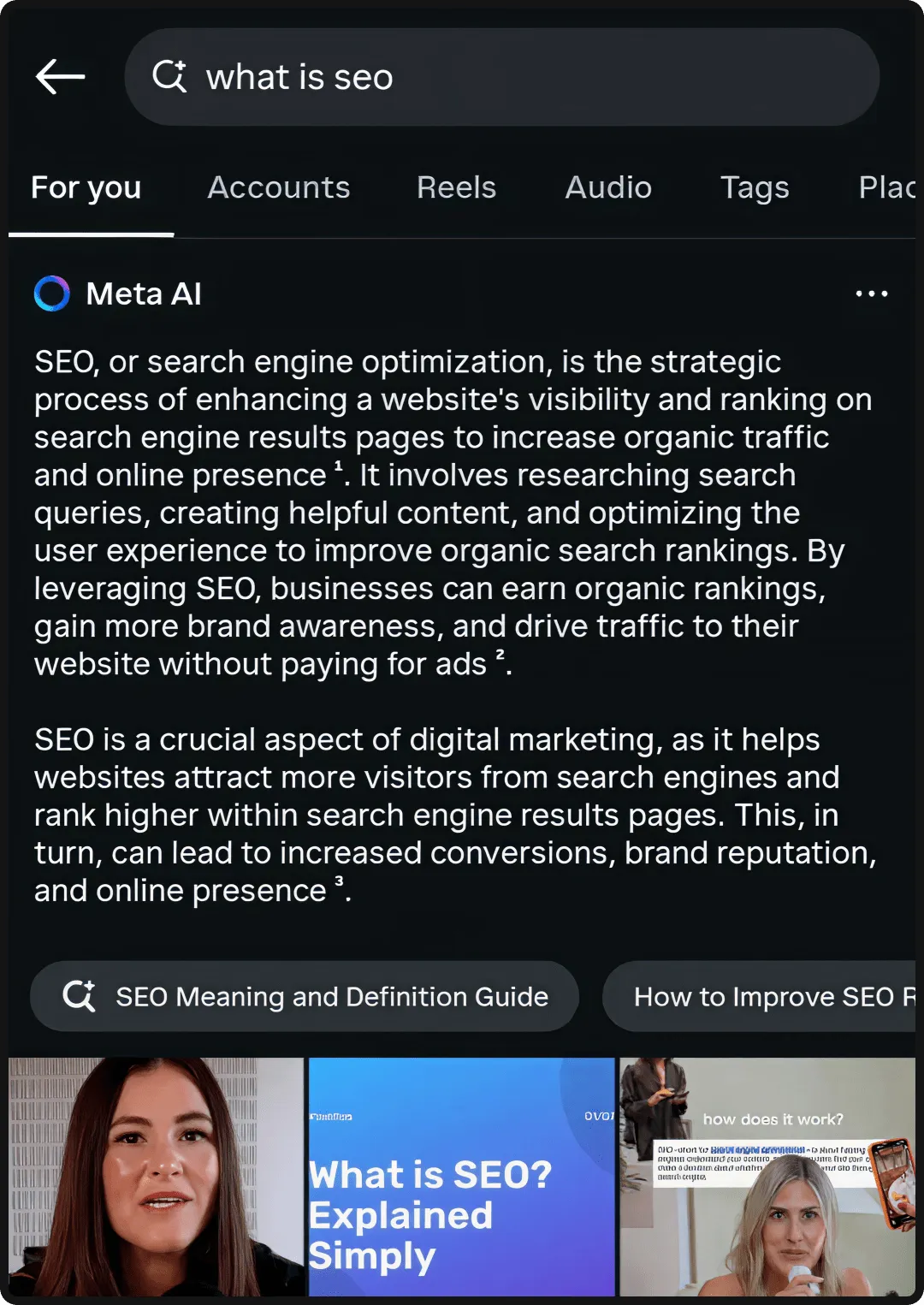
When someone searches inside Instagram or Facebook, Meta AI often inserts a generative summary right at the top of the results, before any traditional search listings. The catch? Meta doesn’t reveal where these answers come from, and unlike other LLMs, you can’t ask for sources or get a citation list. It’s a closed box.
Optimization Focus: Prioritize high-quality, authoritative content with clean structure, strong HTML, clear metadata, and direct, answer-first writing. (Keep reading, we’ll break down exactly how to do this.)
Meta Glasses
Although Meta Glasses represent a smaller portion of the ecosystem, they offer the most contextual form of visibility. Users can ask questions about whatever they’re looking at in the real world. For example, if someone is in a shoe store and finds a pair they love but can’t justify the price, they might ask Meta Glasses to find a similar style within their budget.
Optimization Focus: Because Meta Glasses pulls from both web data and Meta’s internal knowledge graph, your optimization needs to cover the full spectrum: accurate location data, clean product catalog info, and up-to-date local listings. High-quality visual assets also matter more than ever: detailed product images, consistent imagery across social profiles, and strong alt text all help AI identify and match what the user sees through the glasses.
Meta AI Chatbot
Meta AI is at its strongest when used as an integrated feature inside Facebook, Instagram, or WhatsApp, but it also exists as a standalone chatbot via its website or app. In chatbot mode, Meta AI behaves much like ChatGPT and Gemini, which means the fundamentals for optimizing visibility are similar to standard LLM optimization.
Optimization Focus:
- Structure for Citation: Use schema markup (FAQ, How-To, Organization) and write in an answer-first format. The goal is to give AI clean, structured text blocks it can easily lift, interpret, and cite.
- Establish Trust and Authority: LLMs favor sources with depth and credibility. Build topical expertise over time and maintain strong H-E-E-A-T signals (Helpfulness, Experience, Expertise, Authoritativeness, Trustworthiness).
- Match Natural Language: Write clear, concise content that mirrors the way users actually phrase their questions. If someone searches, “How do I set up the Meta Pixel?”, your content should respond directly and avoid unnecessary jargon.
Optimizing Content for Meta AI Search
Like most modern LLMs, Meta AI uses Retrieval Augmented Generation (RAG). In practice, this means Meta converts a user’s query into a numerical representation (a vector embedding) and then runs a semantic search across a pre-indexed database to find the most relevant chunks of information.
Put simply: RAG helps Meta AI decide which sources to pull from and how to rank them, based on factors like relevance, authority, freshness, and clarity. Because of this, your content strategy needs to be intentional, targeted, and built on top of the SEO fundamentals you already have in place.
Below, we break down the key strategies you should use to improve your visibility across Meta AI’s ecosystem.
Build Cross-Platform Authority
Because Meta AI tends to cite higher-authority sources, your goal is to position your brand as an entity the model trusts. Not everyone can instantly become a high-authority domain (otherwise, SEO would be easy), so phase one is earning citations from high-authority sources while you continue building your own.
- Earn Mentions: Your Meta AI optimization strategy should include proactive PR and digital outreach designed to get your brand mentioned by high-domain-authority publishers, industry reports, and other trusted sources. Start by running the prompts you want to rank for and seeing which sites Meta AI is already citing. Or, use a tool like Goodie to analyze citation patterns at scale. From there, build a targeted outreach list and launch campaigns aimed at earning those strategic mentions.
- Topical Depth: Earned media matters, but your owned content still has to hold its weight. Move beyond one-off articles and build pillar pages supported by topic clusters that showcase thorough, nuanced expertise. And make sure your content actually adds something new. If you’re rewriting the same guide everyone else has already published without adding new insights, no one (including the AI) has a reason to choose you.
Write Content for Natural Language & Answer-First Structure
Meta AI is trained on natural language, meaning it favors content that mirrors how people actually speak and search. Your content should be clear, conversational, and structured in a way that makes it easy for the AI to extract, interpret, and quote. Lead with the direct answer first, then provide context; this helps Meta AI surface your content in generative answers.
Strategically Map Content to the Funnel
Before you write anything, define the user’s intent. Meta AI is used across the full funnel; from broad, top-of-funnel discovery queries (“What is generative AI?”) to bottom-of-funnel commercial searches (“best growth marketing agency in NYC”).
- Informational Queries: Provide straightforward answers to simple “what,” “why,” and “how” questions, supported by comprehensive guides that demonstrate credibility and depth.
- Commercial Queries: Optimize comparison-driven content (like listicles, versus pages, and product overviews) using the same language your audience uses when evaluating solutions. Make it obvious why your brand belongs in the consideration set.
- Discovery: Use Ahrefs, keyword research, and “People Also Ask” insights to identify the exact questions users ask at each funnel stage. Your job is to provide answers that genuinely satisfy those questions: cleanly, clearly, and in user-first language.
Lead With the Answer
Every paragraph and major section should open with a clear, 1-2 sentence statement that directly answers the question in the header. Match the phrasing your audience actually uses. You can find this through Ahrefs, “People Also Ask,” and other query-intent tools.
- Focus on Clarity, Not Keywords: Meta AI’s NLP systems prioritize semantic clarity, not keyword density. Avoid jargon, fluff, and salesy phrasing. Use complete, straightforward sentences that make your meaning obvious on the first read.
- Keep it Snippable: Write in short, focused paragraphs (2-4 sentences), with each one containing a single self-contained idea. This makes your content easier for users to read and easier for Meta AI to lift into a generative answer.
Optimize for Machine Readability
Generative AI, including the crawlers Meta relies on, performs best when content is cleanly structured. Unlike Google’s more mature indexing systems, Meta’s retrieval pipelines are less forgiving of messy code, unclear hierarchy, or unstructured text. To ensure Meta AI can properly ingest, understand, and cite your content, you need to prioritize machine-readable formatting.
- Schema Markup: Add FAQ, HowTo, Organization, and even KnowsAbout schema to key pages. Schema serves as a structural roadmap, explicitly labeling the information on your site so Meta AI can quickly understand what your page covers and where to pull relevant answers.
- Use Descriptive Headings: Your H1s, H2s, and H3s should function as clear, question-style signposts, not vague or overly clever headings. This helps both users and Meta’s crawlers understand the intent and structure of your content.
- Lists & Tables: Summarize complex ideas using numbered lists, bullets, and HTML tables whenever appropriate. Modular content is easier for AI to parse, rank, and lift directly into generative answers, increasing your chances of appearing at the top.
Prioritizing Content Freshness
Meta AI tends to prioritize newer information, especially for topics that evolve quickly, like industry stats, product features, pricing, regulations, and anything with a fast update cycle.
- Update and Republish Annually: Review your top-performing pillar pages each year and refresh them with new data, updated screenshots, clarified explanations, and more current language. Updating the publication date helps signal freshness to Meta’s crawlers.
- Use Date in the Title (Strategically): For content where recency is a major ranking factor, e.g., “Best AI Tools for Content Marketing in 2026,” including the current year in the title signals to both users and AI systems that your information is up-to-date.
- Monitor Core Data Points: Identify the critical facts, stats, technical specs, and definitions your content relies on. Build a quarterly review process to check these for accuracy and update them as needed. Keeping your content consistently current helps maintain trustworthiness and visibility in Meta AI’s generative answers.
Tracking Visibility in Meta AI
It’s important to remember that optimizing for Meta AI is a long game. Visibility here is less about immediate, trackable metrics and more about sustained brand presence, which can influence awareness, consideration, and conversions over time.
Because Meta AI (and other LLMs) often satisfy a user’s question directly within the generative answer, you’re unlikely to see clear traffic spikes attributed to AI citations. Instead, think of AI mentions as upper-funnel touchpoints: they build familiarity, which can translate into direct traffic and eventual conversions later on.
Here are the key ways to measure your impact:
1. Manual Prompt Testing & Logging
A free (though very manual) way to track your Meta AI visibility is to emulate your audience’s searches and document the results over time.
- Create a Prompt List: Build a spreadsheet of high-intent prompts you want your brand to win (e.g., “What’s the best creative tool for video editing?”). Remember that many Meta AI searches originate inside Instagram or Facebook, so mimic the casual, conversational tone people use on those platforms. Google keyword research is a great starting point for inspiration.
- Test & Record: Run each prompt through the Meta AI chatbot.
- Log the Output: For every query, document the date, full response, and whether your brand or URL was mentioned. If not, record the URLs that were cited; these become targets for outreach or competitor analysis.
- Track Sentiment: Note how your brand is positioned when it’s mentioned. Are you framed as a leader, a budget-friendly option, or an industry staple? Monitoring sentiment helps you maintain brand consistency and understand how Meta AI perceives your value.
2. Monitoring Indirect Conversions
To tie long-term Meta AI visibility back to revenue, you need to monitor the metrics that AI influences, not just traditional click-based KPIs. The connection is murky, but here’s how to get meaningful signals.
- Engagement Metrics (Measuring Quality): Users who arrive after encountering your brand in an AI answer are essentially “pre-vetted,” so measuring session quality becomes crucial. Look for improvements across direct, branded search, and other channels:
- Engaged Sessions
- Higher Average Time on Site
- Increased Pages Per Session
- Attributed Conversion Metrics (Measuring Revenue Lift): While Meta AI is usually an awareness touchpoint, it can influence downstream conversions. Track how AI exposure impacts the full funnel by monitoring:
- Actions Initiated: Form submissions, demo requests, or product views that follow a period of heightened brand visibility.
- Actions Completed: Purchases or scheduled demos where Meta AI likely played a role as an early touch in the multi-channel journey.
- Live Chat Engagements: Users who learn about you through Meta AI often skip forms and jump straight to chat for late-stage evaluation.
- Direct Traffic Analysis: Watch your “Direct Traffic” channel in GA4 over time. Sustained lift here often signals increased brand awareness from non-clickable sources like podcasts, word-of-mouth… and AI mentions, where users don’t click, but type your brand in directly.
3. Leveraging Specialized AEO Tools
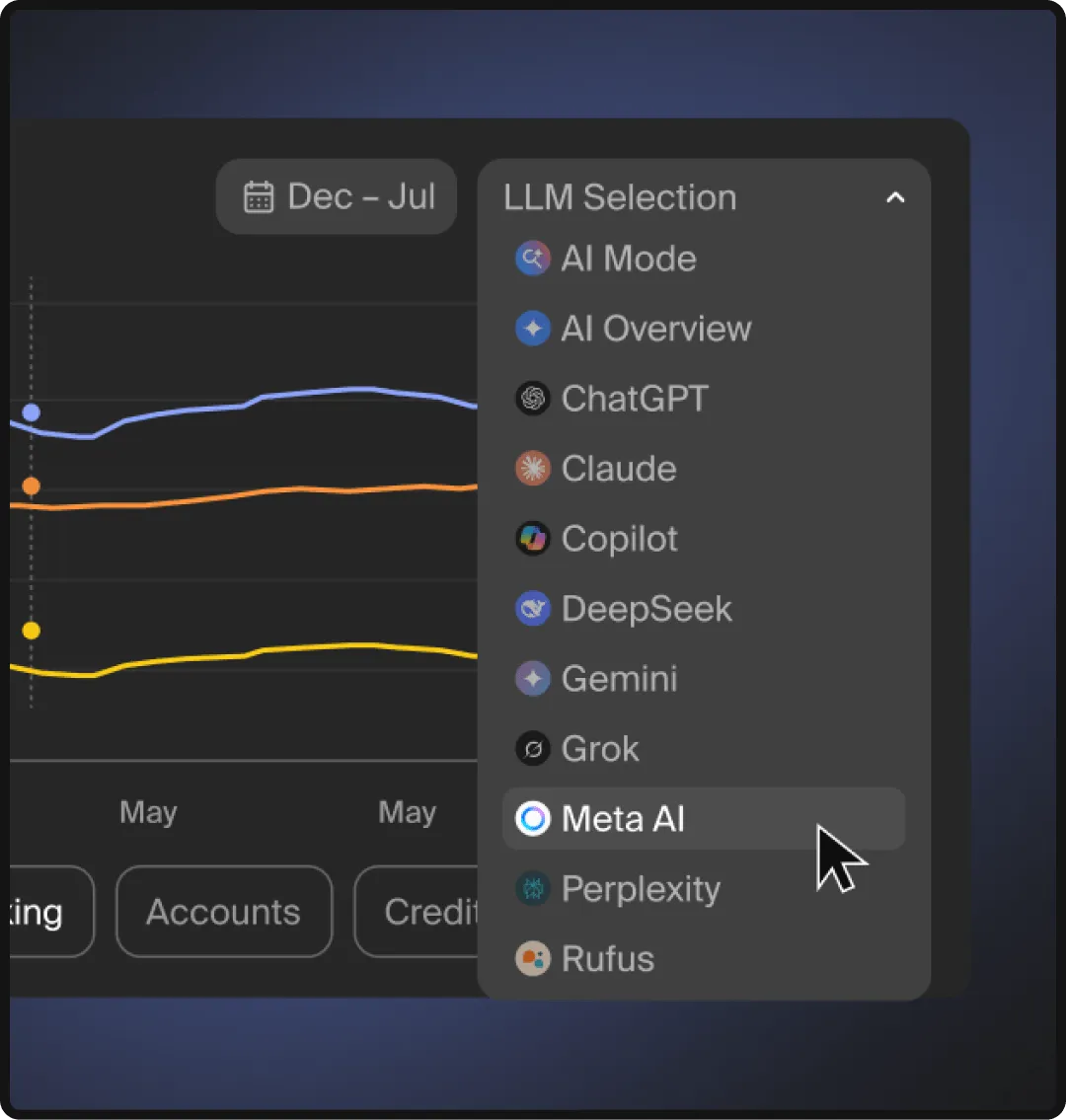
If you don’t want to track everything manually, specialized AEO tools can automate the heavy lifting; including platforms like Goodie. Goodie monitors your visibility, citations, and sentiment across Meta AI, helping you understand when and where your brand appears.
It also goes beyond simple tracking: Goodie can surface social query trends, identify competitor co-appearance patterns, and optimize your product data for Meta AI shopping and recommendation surfaces. In other words, it gives you a full picture of how your brand performs across Meta’s AI ecosystem, without the spreadsheets.
Gaining Visibility in the Meta AI Search Ecosystem
Meta AI matters not just because it has its own chatbot, but because it’s deeply embedded into the world’s most popular social platforms. With more than 1 billion monthly active users, overlooking Meta AI in your optimization strategy is a real risk to your brand.
Winning here requires a two-pronged approach: optimizing the content you already own, and actively earning mentions in the places Meta AI pulls from most. This is a visibility strategy, not a traffic strategy. You’re unlikely to see a sudden spike in sessions, and that’s okay. What you are building is far more durable: long-term brand visibility in an ecosystem where standing out is becoming harder by the day.
In a world full of noise, consistent visibility inside AI-generated answers is the new competitive advantage.
Thinking about optimizing for Meta AI? Reach out to our team, and we’ll show you how Goodie can help.