If you’re anything like us (a bunch of search nerds always on the hunt for information), you’ve probably noticed that AI search isn’t just growing. It’s fragmenting. ChatGPT hit more than 800 million weekly active users in October of 2025. Google’s AI Mode and AI Overview went from experimental to default. Perplexity launched Comet. Meta AI embedded itself into Instagram and Facebook feeds. And that’s just the latest happenings from the last quarter.
With so much happening in the space, we need to refocus on what actually matters in 2026. It’s no longer possible to say that 2026 is the year AI search “arrives,” because to no surprise (at least not in our industry), AI search is already here.
Instead, 2026 is the year AI search splinters into specialized platforms, each with distinct retrieval patterns, citation preferences, and user behaviors. Brands that treat “AI optimization” as a monolithic strategy will lose valuable traffic. Those that adapt to platform-specific behaviors will be successful in the adapted AI search.
Let’s break down what’s actually changing, what’s dying, and what you need to do about it.
The 4 Forces Reshaping AI Search in 2026
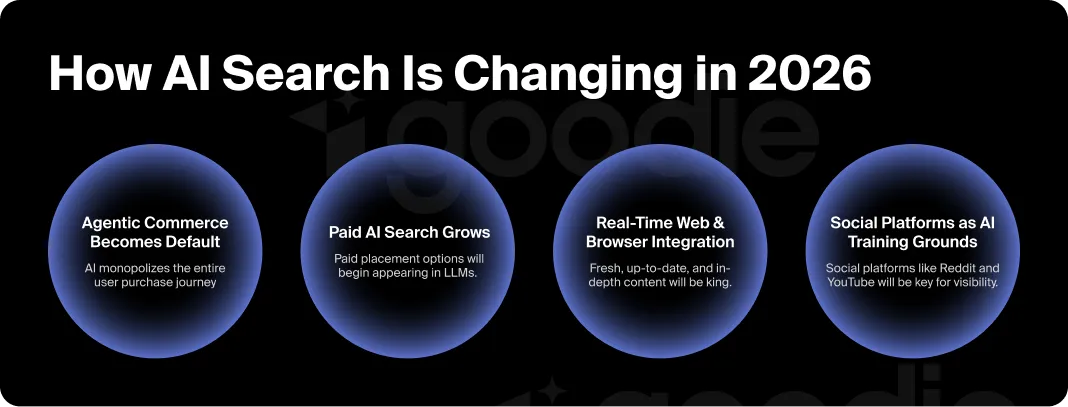
1. Agentic Commerce Becomes Default
AI used to recommend products in lists, then it transitioned to carousels; in 2026, AI will go so far as to complete the customers purchase for them. ChatGPT supports in-chat checkout, and Google’s AI Mode is becoming more visual and shoppable. Both Perplexity and Amazon also now have native shopping assistants.
For eCommerce brands, this means PDPs (Product Detail Pages) need to be structured for AI crawlability, not just human readability (if you’re interested in how, we have a tool for that). Feeds must include critical attributes, variants, and availability data that matches what’s on the page. If AI can’t parse your product information cleanly, you won’t just not be recommended; you won’t be seen (let alone purchased).
As an example of growth and impact in 2025, we saw the boom of Rufus becoming essential for D2C brands. Brands who are unaware of how they’re perceived and whether they are showing up are missing out on the 250+ million customers who use Rufus to find products.
With Amazon boasting a greater than 145% user increase in this year alone, and customers using Rufus being over 60% more likely to make a purchase, showing up in Rufus should be a brand priority. AI is commandeering the product decision process; now models will begin to own the conversion, too.
This growth on Rufus is expected to quickly translate over to other LLMs that integrate eCommerce directly in the platform. If Rufus has already primed customers to change their behavior, then we already have an idea of how quickly users will adopt new buying habits.
2. Paid AI Search Grows
OpenAI and Perplexity are both building advertising platforms. This isn’t speculation; it’s happening. Perplexity already has Comet ads in beta, showing users sponsored queries that guide them to certain products and take them down specific lines of questioning. OpenAI’s Operator will likely follow suit. Expect paid placement options across major AI search platforms early in 2026.
What Do Paid Ads in LLMs Mean for Brands?
Search marketing is getting yet another remodel; and this time, the free organic visibility space will decrease in LLMs. Just like how Google decreased the organic space on the SERP, the same is likely to happen in 2026 in AI chatbots and models.
Though OpenAI has been clear on their position that they didn’t initially want to do ads, with this change in view to a more profitable model, the question becomes not just “will they have ads” but “what will the ads look like”.
No matter what happens, brands should start budgeting and be prepared to bid for ad space in LLMs in 2026.
3. Real-Time Web & Browser Integration
Self-contained LLMs (models trained on static datasets) are dying. ChatGPT’s GPT-5 with search, Perplexity’s real-time retrieval and crawling of news sites, and Gemini’s live web access all point to the standard that was set in 2025: RAG, or Retrieval Augmented Generation.
This is good news for marketers. Fresh content now matters a lot, given that LLMs are looking for the best and most recent information to provide their users. RAG systems pull from recently published articles, updated product pages, and current data sources.
This also means that SEO timelines are compressing. Content that’s optimized today can be cited tomorrow (that doesn’t necessarily mean it will be, but it can be, and that’s still a lot faster than previous indexing processes).
What’s New With RAG in 2026
LLMs are integrating directly into browsers. Claude’s Chrome integration hints at the importance of utilizing LLMs directly in our daily activities. We’re moving away from the quickly forgotten “failure” of OpenAI’s browser (even though that was only a month ago as of the writing of this article).
Although the first go-around was a flop, it doesn’t mean that the future isn’t in LLM browsers. The pivot of companies integrating directly into existing browsers continues to show how new technologies are enhancing systems that we already have. That’s the future.
4. Social Platforms as AI Training Grounds
Reddit discussions, TikTok videos, Instagram posts, and YouTube tutorials aren’t just social content anymore. They’re training data and retrieval sources for LLMs.
Youtube has exploded in December, turning into not only one of the top social sources for LLMs but also one of the top overall sources for D2C prompts. After a brief fall from favor, Reddit is also climbing back into the conversation as a valuable platform to optimize for in 2026.
Real content is valuable to LLMs not just for finding brands, but also for learning from human sourced data to improve their platforms.
All of this to say, social is a primary AI visibility driver that is growing exponentially; it isn’t a side channel. Brands that ignore social presence or treat it as a branding exercise will miss out on one of the most citable content types AI models trust.
Platform-Specific Evolution: Why AI Optimization as a Catch-All Strategy Fails
Think of this as a reality check: saying you’re “optimizing for AI” in 2026 is like saying you’re “optimizing for social media” in 2015. You’ll be left asking why you aren’t successful with a catch-all strategy; aren’t all LLMs pulling information from the same source?
If your AI search strategy isn’t working, ask yourself this: which platform matters to my customers? What’s the use case? Who’s my audience? The answers matter more than optimizing for the category of LLMs.
Each AI platform is carving out distinct retrieval behaviors, citation preferences, and use cases. That means a strategy that works for ChatGPT won’t necessarily work for Perplexity. What ranks in Gemini won’t necessarily appear in Claude. Your brand perception may also be different depending on the LLM. What’s considered a negative sentiment by Perplexity (say, a negative review about your brand) might not even be cited by ChatGPT.
The platforms are specializing, and brands need to follow suit.
ChatGPT & OpenAI: Conversations, Creative Work & General Research
Backtracking on what we just said, it’s true that ChatGPT remains the most catch-all of the LLMs. It was first to market, has the largest user base, and is coming scary close to becoming its own verb like Google did years ago (à la “let me ask Chat”).
ChatGPT balances conversation with research-deep dives and creative projects. Users turn to it when they want detailed simple explanations, multi-step reasoning, or help producing something tangible.
What Does ChatGPT Look Like in 2026?
OpenAI’s goal is to position ChatGPT as a conversational interface with an operating layer. Essentially, it’s set to become an action layer that fits into workflows. ChatGPT Operator turned into ChatGPT Agent Mode with Operator no longer being its own entity. Search integration will get tighter. Expect more citations from authoritative research sources and websites.
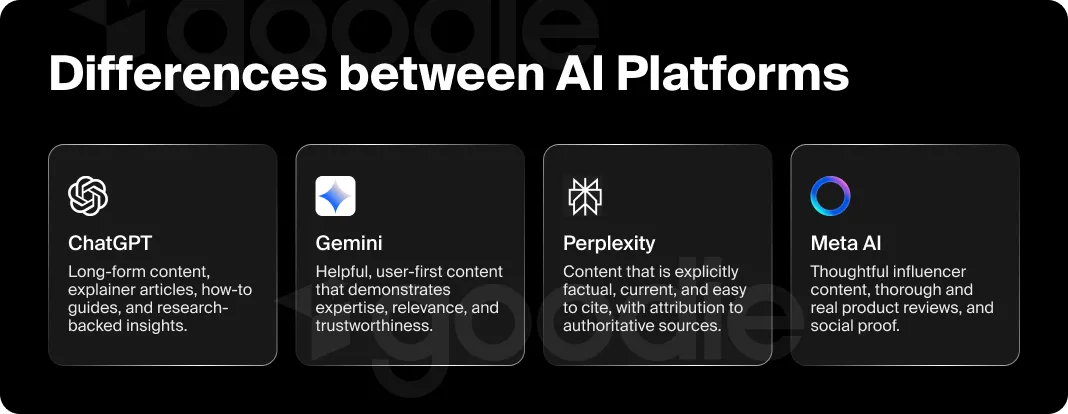
As for optimization strategies, long-form content, explainer articles, how-to guides, and research-backed insights will continue to be more valuable for ChatGPT. Structured headings and clear topic hierarchies matter. ChatGPT has (and will continue to) favor content that can be parsed into discrete, referenceable sections.
Google, Gemini & AI Overview: The Traditional Search Integration Play
Google isn’t abandoning traditional search; it’s just layering AI on top of it. AI Overview now appears on roughly 15-30% of informational queries (with some statistics going as high as 50% of all queries), and AI Mode is becoming the default experience for a growing user segment.
Then came December 14, 2025. Google rolled out a core algorithm update that shifted brand visibility overnight. Domains that previously ranked well in traditional search saw fluctuations in AI Overview inclusion. Some brands gained ground; others lost citation share completely.
Did Anything Change to Impact Visibility?
The short answer should be unsurprising. Yes, visibility will be impacted if you aren’t fully following Google’s general recommendations. Google is favoring sites with stronger H-E-E-A-T signals (Helpfulness, Experience, Expertise, Authoritativeness, Trustworthiness), cleaner schema markup, and content that directly answers user intent without filler.
It is filtering out “AI slop” and re-focusing on actual users. If your pages weren’t already optimized for featured snippets, structured data, and human readers, the December update punished you.
This change is a signal of the future we are preparing for. As the long-time search powerhouse, Google knows exactly what it’s looking for: any classic “black hat” activities that signal brands trying to game the system to be visible. If that’s sounding anything like what you’ve been up to, then you need to re-think your strategy, because with each core algorithm update you’re going to lose visibility that you may have previously gained.
Google’s evolution is in part AI Overview’s evolution; it’s no longer just text summaries. Instead, it’s also integrating images, video snippets, and product carousels. AI Mode takes this further with a fully conversational interface that blends search results with generative answers.
What Still Works for Google Optimization?
Brands should focus on producing consistently helpful, user-first content that clearly demonstrates expertise, relevance, and trustworthiness rather than trying to optimize for individual updates. Core updates reward sites that improve overall content quality and structure over time, so brands should monitor Search Console trends and make sustained improvements instead of reacting with short-term fixes.
Perplexity: Academic & Research Queries
Perplexity is now positioned as a hybrid AI search and research platform focused on delivering detailed, sourced answers across both academic and general queries, with an emphasis on citation quality and verifiable information. It is a full-funnel research tool that mimics a user’s product search journey by predicting follow up questions that can guide users to the most optimal products or services.
In 2025, Perplexity launched Comet: an AI-powered browser that integrates search, summarization, and task automation into a single interface, expanding its role from answer engine toward a full search and assistant ecosystem. This evolution means that brands should optimize not just for deep research visibility, but also for broad context and structured information that Comet’s AI can readily reference.
How Do I Optimize for Perplexity?
Perplexity rewards content that is explicitly factual, current, and easy to cite, with clear attribution to primary or authoritative sources. Brands perform best when information is structured in concise, declarative formats (think definitions, comparisons, tables, and direct answers) that Perplexity can surface verbatim.
Freshness, source credibility, and clarity matter more here than brand voice or creativity, as users come to Perplexity to verify information and make decisions, not to be persuaded.
Meta AI: Social Discovery & Product Recommendations
Meta AI isn’t competing with ChatGPT or Gemini for research queries. It’s competing for product discovery and social recommendations. Embedded in Instagram, Facebook, and WhatsApp, Meta AI pulls from social content, product tags, and user-generated discussions.
This shift comes from Meta AI not being a dominant player in the new traditional AI search. Instead, its major role is competing with advertising, personalized assistants, and infrastructure integration into already popular platforms like Facebook, Instagram and WhatsApp.
Meta continues to push AI deeply into its core products and services, moving from automating ad creation and targeting, to building AI compute infrastructure and new generative models (all slated for 2026). Having recently fallen behind their competitors, they’ve announced two new models (internally called Mango and Avocado) to be released in the first half of 2026.
What Should Brands Focus On for Meta AI?
This is where thoughtful influencer content, product reviews, and social proof matter. Meta AI citations lean heavily on Instagram posts, Facebook groups, and community discussions. Traditional websites still appear, but social-native content dominates.
Focus on product pages with Instagram Shopping integration, branded hashtags with consistent usage, and content that performs well organically on Meta platforms.
To quickly state the obvious, if your brand isn’t active on Instagram or Facebook, you’re invisible here. And surprise surprise, a lack of activity on Instagram and Facebook also impacts your visibility in other LLMs, not just Meta; so get posting.
“Specialist” LLMs: DeepSeek, Grok & Regional Players
DeepSeek had an initial gain globally, but faded quickly in the U.S. and Europe. The initial hype didn’t translate to sustained momentum and was undercut in adoption and development. Market fear was stifled by data privacy, and regulatory controls that were placed on the platform, all but halting the potential growth of DeepSeek.
Specialist LLMs like Grok (xAI’s model) pull heavily from X (formerly Twitter) for real-time news and trending topics. Their model relies on user content fueling the LLMs answers, but doesn’t translate very well out-of-platform.
Regional players like Baidu’s Ernie Bot in China and Yandex’s models in Russia are carving out geography-specific dominance.
Each of these platforms has distinct retrieval fingerprints. Grok, for example, cites X almost exclusively for trending topics and breaking news. DeepSeek favors technical documentation and Stack Overflow. The platforms are built not for specific use cases, but rather for specific user niches.
What Strategies Die & What Strategies Survive in 2026
Now that you understand the path we’re on for AI search in 2026, let’s get down to the specifics of what is and (likely) isn’t going to make it until 2027.
What Dies
- Keyword stuffing and low-value SEO tactics (AI models ignore these)
- Content farms and sites with thin, duplicative content (citation algorithms filter them out as noise)
- Domains without structured data or schema markup (AI can’t parse them efficiently)
- Brands that rely solely on traditional Google SEO without adapting to AI retrieval patterns (the signals are similar, but different)
- “Optimize for all AI platforms equally” strategies (specialization wins)
What Survives
- Authoritative domains with strong H-E-E-A-T signals
- Content structured for both human readers and machine parsing (remember the balance of crawlability and user accessibility)
- Brands that invest in platform-specific optimization strategies
- Sites with robust schema markup and clean technical infrastructure
- Companies that build for AI agent experiences, not just AI answers
In short, what are the domains that will lose citation share? Content farms, low-authority blogs, sites without technical optimization, and brands that treat AI search as an afterthought.
Who’s Going to See Success in 2026?
Editorial publications with fact-checking standards, UGC platforms with high engagement, eCommerce sites with clean product data, and niche authoritative sources in specialized verticals.
How Brands Need to Adapt Now
If you’re waiting for AI search to stabilize before you optimize, good luck; that’s unlikely to happen anytime soon. Sure, in 2026 we’ll see some leveling of trends, but the space is still changing quickly. You need to be able to adapt on your feet constantly. Here’s what definitely works right now.
Structured Data Requirements
Schema markup is a minimum requirement if you want to be cited:
- Product schema for eCommerce (with price, availability, reviews)
- FAQ schema for informational content
- HowTo schema for instructional pages
- Organization schema for brand entity recognition
- Article schema with author and publication metadata
AI crawlers (like ChatGPT’s GPTBot and Claude’s ClaudeBot) don’t execute JavaScript. They fetch HTML and parse structured data. If your content relies on client-side rendering without server-side fallbacks, AI won’t see it.
Content Formats That LLMs Actually Cite
Not all content is created equal in AI’s eyes. Based on our citation analysis, here’s what gets pulled most frequently:
- Lists with clear hierarchies (numbered or bulleted with context)
- Step-by-step guides with actionable instructions
- Data tables and comparison charts (if marked up correctly)
- FAQ sections that directly answer specific questions
- Product specifications and feature lists
- Research summaries with linked sources
What Content Isn’t Working?
Long narrative paragraphs without clear structure, content behind paywalls or login walls, pages with slow load times, and sites that block AI crawlers via robots.txt.
Building for Agent-First Experiences
AI agents (like ChatGPT’s Agent or Google’s AI Overview) don’t just read content anymore; they interact with it. This means that your site needs to be usable by non-human visitors.
Here are some key considerations:
- Navigation should be semantic and logical (clear heading hierarchies)
- Forms should be machine-readable (proper labels and field types)
- Product actions (add to cart, checkout) need clean API endpoints
- Page speed matters even more (AI systems have 1-5 second timeouts)
- Error handling needs to be graceful (broken links kill AI crawl efficiency)
Platform-Specific Optimization Strategies (Not One-Size-Fits-All)
We’ve said it before and we’ve said it again: stop “optimizing for AI” as a monolith. Build platform-specific strategies keeping in mind the following best practices:
- ChatGPT: Focus on long-form explainer content, research-backed insights, and structured how-to guides. Optimize for conversational queries.
- Google/Gemini: Prioritize featured snippet optimization, robust schema markup, and content that answers questions in the first paragraph. H-E-E-A-T signals matter here more than anywhere else.
- Perplexity: Get cited by authoritative sources rather than trying to rank directly. Build relationships with academic institutions, journalists, and researchers.
- Meta AI: Invest in social content that performs organically on Instagram and Facebook. Product integration with Instagram Shopping is critical for eCommerce brands.
Measurement That Matters (Beyond Impressions)
Traditional SEO metrics don’t map cleanly to AI search. Here’s what to track instead:
- Citation share: How often is your brand mentioned across LLM responses compared to competitors?
- Domain authority in AI contexts: Which of your pages get cited most frequently, and why?
- Sentiment analysis: Are AI models describing your brand positively, negatively, or neutrally?
- Traffic attribution: Which AI platforms are driving actual visitors to your site (and are they converting)?
- Agent analytics: How many AI crawlers are visiting your site, and are they successfully indexing your content?
Tools like Goodie can track these AEO KPIs at scale, giving you visibility into AI performance the same way Google Analytics tracks traditional search.
2026 Predictions From the Data
Based on current citation trends and platform evolution, here’s what we’re betting on for 2026.
Citation Concentration Trends
The high authority sites gain more control. Authority consolidation will accelerate as models refine their trust scoring. This will filter out “black hat” AI search tactics and truly consolidate sources based on the quality of the site and information.
New entrants will struggle unless they have distribution partnerships with established platforms. Reddit and Youtube deals signal this trend, platforms are licensing content directly rather than crawling openly. They are licensing to prioritize their content over other platforms. User data and voice is valuable.
New Source Types Emerging
We’ll see AI models start citing:
- Video and podcast content more frequently (as multimodal improves)
- Video content with clean metadata and captions
- Community forums beyond Reddit (Discord, Slack, specialized communities)
- Proprietary datasets and research from paywalled sources (through licensing deals)
- Real-time social content from TikTok, Instagram Reels, and YouTube Shorts
Industry-Specific Shifts
- B2B SaaS: Reddit’s dominance will gain again, but LinkedIn content will gain ground as AI models start valuing professional context more.
- Finance: NerdWallet and other affiliate comparison sites will face competition from real-time market data providers and fintech apps with structured APIs.
- Healthcare: Medical journals and .gov sites will remain dominant, but telemedicine platforms and patient forums will start appearing more frequently.
- eCommerce: Amazon product pages will become more citable (especially via Rufus), but direct-to-consumer brands with strong schema markup can compete.
Traffic Attribution Changes
We predict that users will split queries between ChatGPT (for deep research), Perplexity (for sourced answers), Google AI Mode (for quick facts), and Meta AI (for product discovery).
The zero-click trend continues: users will get answers without visiting websites and will rely on specialized platforms to solve their problem. For brands, this means citation visibility becomes more valuable than click-through rates.
Conversion rates from AI search will continue to outperform traditional organic search. Users who do click through from AI results have already been pre-qualified by the model’s recommendation.
What This Means for Brand Building
Brand building in AI search is different. Authority matters more than awareness and trust signals matter more than traffic. Citation frequency matters more than impressions. Brands that invest now in becoming citable, trusted, and authoritative will own their industry. Brands that wait will be invisible.
The playbook is simple (and we don’t mean easy):
- Build content that AI systems trust enough to cite
- Earn backlinks from domains AI already trusts
- Structure your data so AI can parse it efficiently
- Optimize platform by platform, not as a monolith
- Measure what matters: citations, sentiment, traffic quality
Where We’re Going Now
AI search in 2026 won’t look like AI search in 2025. The platforms are specializing, the algorithms are maturing, and the citation patterns are solidifying.
Brands that treat this shift as “just another SEO update” will lose. Treat this as if it’s a core algorithm update but instead of this being driven by Google it’s driven by user behavior. Brands that recognize this as a fundamental change in information retrieval will position themselves for long-term visibility.
By mid-2026, citation patterns will be entrenched. Authority domains will be locked in their positions. New entrants will face exponentially higher barriers to entry.
What Should You Prioritize in Q1 2026?
- Audit Your Current AI Visibility: Where are you cited today? Where are you invisible? Which platforms matter most for your audience?
- Implement Structured Data: Schema markup in tables and for and dropdowns. If you haven’t done it yet, start now.
- Build Platform-Specific Content Strategies: Stop optimizing for “AI” and start optimizing for ChatGPT, Perplexity, Gemini, and Meta AI individually.
- Track the Right Metrics: Citation share, sentiment analysis, and traffic quality matter more than impressions.
- Test & Iterate: Adapt when algorithms change. What works today might not work in six months.
AI Search in 2026 & Beyond: FAQs
Will traditional SEO die in 2026?
No, but it will evolve. Traditional Google search still processes billions of queries daily, and that won’t disappear overnight. However, the skills required for visibility are shifting. Keyword optimization alone won’t cut it. Structured data, content quality, and AI-specific optimization will become mandatory.
Which AI platform should I optimize for first?
It depends on your audience and industry. For B2B SaaS, focus on ChatGPT and Perplexity. For consumer products, prioritize Google’s AI Overview and Meta AI. For research-heavy industries, Perplexity wins. Audit where your target users actually search.
How do I measure AI search performance?
Track citation frequency (how often you’re mentioned), citation sentiment (how you’re described), traffic attribution (which AI platforms drive visitors), and conversion rates from AI referrals. Tools like Goodie can automate this.
Can small brands compete in AI search?
Yes, but it’s harder. Authority consolidation favors established domains, but niche expertise can win in specific verticals. Focus on becoming the authoritative source for a narrow topic rather than competing broadly.
What’s the biggest mistake brands make with AEO?
Treating all AI platforms the same. Each has distinct retrieval patterns and citation preferences. A one-size-fits-all approach fails. Build platform-specific strategies instead.
Will paid AI search replace organic visibility?
Not replace, but supplement. Just like Google, AI search will blend organic and paid results. Budget for both. Organic visibility builds long-term authority; paid placement drives short-term traffic.
How often should I update my AEO strategy?
Quarterly at minimum. AI platforms ship updates constantly. What worked in Q1 might not work in Q4. Monitor citation trends, adjust content strategies, and test new approaches continuously.